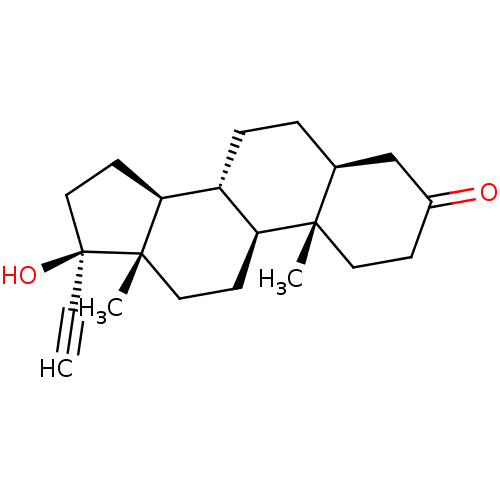
 BDBM50423536 CHEMBL260202 17-Ethinyl-Dihydrotestosterone
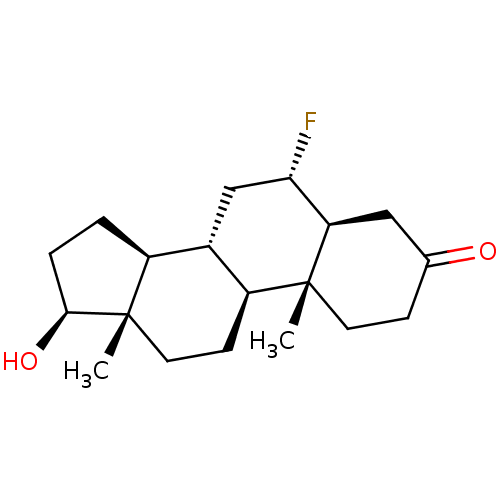 BDBM50423549 CHEMBL408707 6Alpha-Fluoro-Dihydrotestosterone
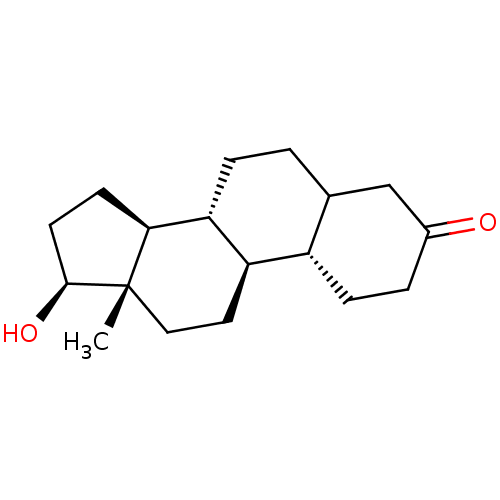 CHEMBL260641 19-Nor-Dihydrotestosterone BDBM50423543
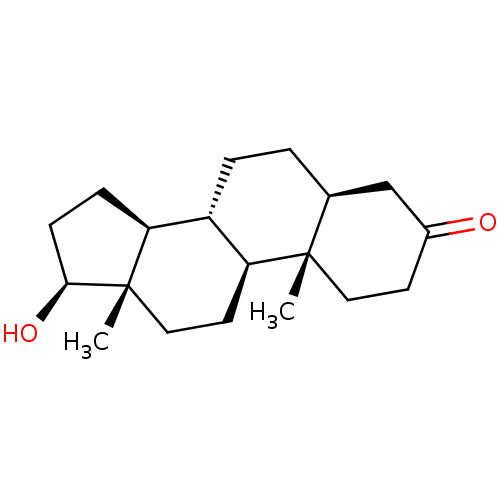 DHT Dihydrotestosterone [3H]DHT (5alpha,17beta)-17-hydroxyandrostan-3-one BDBM50366473 (1S,2S,7S,10R,11S,14S,15S)-14-hydroxy-2,15-dimethyltetracyclo[8.7.0.0^{2,7}.0^{11,15}]heptadecan-5-one BDBM18161 CHEMBL27769
- Schöttner, M; Spiteller, G; Gansser, D Lignans interfering with 5 alpha-dihydrotestosterone binding to human sex hormone-binding globulin. J Nat Prod 61: 119-21 (1998)
- Peřina, M; Kiss, MA; Mótyán, G; Szczyrbová, E; Eliáš, M; Študent, V; Kurfürstová, D; Kovalová, M; Mada, L; Bouchal, J; Frank, É; Jorda, R A-ring-fused pyrazoles of dihydrotestosterone targeting prostate cancer cells via the downregulation of the androgen receptor. Eur J Med Chem 249: (2023)
- Bellavance, E; Luu-The, V; Poirier, D Potent and selective steroidal inhibitors of 17beta-hydroxysteroid dehydrogenase type 7, an enzyme that catalyzes the reduction of the key hormones estrone and dihydrotestosterone. J Med Chem 52: 7488-502 (2009)
- ChEMBL_466706 (CHEMBL922711) Displacement of [3H]5alpha dihydrotestosterone from human sex hormone binding globulin
- ChEMBL_457372 (CHEMBL940963) Displacement of [3H]dihydrotestosterone from human androgen receptor expressed in Sf9 cells
- ChEMBL_1539997 (CHEMBL3737755) Inhibition of rat liver type 1 5alpha-reductase assessed as transformation of testosterone to dihydrotestosterone
- ChEMBL_1539998 (CHEMBL3737756) Inhibition of human prostate type 2 5alpha-reductase assessed as transformation of testosterone to dihydrotestosterone
- ChEMBL_36273 (CHEMBL648840) Binding affinity towards human androgen receptor (hAR), using dihydrotestosterone as radioligand for competitive binding assay
- ChEMBL_1441437 (CHEMBL3373392) Inhibition of rat liver 5alpha-reductase type 1 assessed as conversion of [3H]testosterone to dihydrotestosterone
- ChEMBL_1441438 (CHEMBL3373987) Inhibition of human prostate 5alpha-reductase type 2 assessed as conversion of [3H]testosterone to dihydrotestosterone
- ChEMBL_199192 (CHEMBL807120) In vitro inhibition of DHT (dihydrotestosterone) on proliferation of androgen-sensitive cancer Schionogi (SC-3) cells
- ChEMBL_699332 (CHEMBL1647250) Inhibition of human prostate 5alpha-reductase type 2 assessed as formation dihydrotestosterone from [4-14C] testosterone
- ChEMBL_971947 (CHEMBL2405557) Antagonist activity at human pSG5-AR assessed as inhibition of dihydrotestosterone-induced effect by reporter gene assay
- ChEMBL_1653051 (CHEMBL4002306) Inhibition of human prostate 5-alpha reductase 2 assessed as decrease in conversion of testosterone to dihydrotestosterone by chromatographic method
- ChEMBL_475674 (CHEMBL937560) Inhibition of wild type androgen receptor expressed in CV1 cells assessed as dihydrotestosterone-stimulated transactivation by CAT reporter gene assay
- ChEMBL_432234 (CHEMBL914606) Antagonist activity at androgen receptor expressed in HeLa cells assessed as inhibition of dihydrotestosterone-induced transcriptional activity by reporter gene assay
- ChEMBL_449393 (CHEMBL899661) Antagonist activity at human androgen receptor expressed in HeLa cells assessed as inhibition of dihydrotestosterone induced transcriptional activity by reporter gene assay
- ChEMBL_457596 (CHEMBL923797) Antagonist activity at androgen receptor expressed in MDA-MB-453 cells assessed as inhibition of dihydrotestosterone-induced response in reporter gene assay
- ChEMBL_36106 (CHEMBL648071) Antagonistic activity against human androgen receptor (hAR) in CV-1 cells was determined as a function of maximal inhibition of dihydrotestosterone using cotransfection assay
- ChEMBL_805650 (CHEMBL1960484) Antagonist activity at androgen receptor expressed in Cos7 cells assessed as inhibition of dihydrotestosterone-induced luciferase activity after 24 hrs by reporter gene assay
- ChEMBL_1449353 (CHEMBL3372081) Inhibition of Sprague-Dawley rat liver steroid 5-alpha-reductase assessed as inhibition of testosterone conversion to dihydrotestosterone incubated for 30 mins by HPLC method
- ChEMBL_474428 (CHEMBL934261) Antagonist activity at human AR ligand binding domain expressed in african green monkey COS7 cells in presence of 5-alpha-dihydrotestosterone by Gal4 hybrid assay
- ChEMBL_1735695 (CHEMBL4151231) Antagonist activity at human CMX-AR expressed in HEK293 cells assessed as reduction in dihydrotestosterone-induced transactivation activity after 24 hrs by luciferase reporter gene assay
- ChEMBL_752066 (CHEMBL1786230) Antagonist activity at wild type androgen receptor expressed in african green monkey CV1 cells assessed as inhibition of dihydrotestosterone-induced transcriptional activity by luciferase reporter gene assay
- ChEMBL_1658408 (CHEMBL4008020) Antagonist activity at GAL4-fused human AR LBD (667 to 919 residues) expressed in CHO-K1 cells assessed as inhibition of dihydrotestosterone-induced transactivation activity after 5 to 6 hrs by luciferase reporter gene assay
- BIOLOGICAL ACTIVITY Reagents and instruments: radiolabeled dihydrotestosterone (DHT-d3) and unlabelled dihydrotestosterone (DHT) purchased from Sigma-Aldrich (St. Louis, Mo.), scintillation solution purchased from Perkin Elmer Life Sciences (Boston, Mass.), hydroxyapatite (HAP) suspension purchased from Bio-Rad Laboratories (Hercules, Calif.), buffer (containing 10 mM Tris, 1.5 mM disodium EDTA, 0.25 M sucrose, 10 mM sodium molybdate and 1 mM PMSF, pH value adjusted to 7.4), and hydroxyapatite (HAP) solution (containing 50 mM Tris and 1 mM KH2PO4, pH value adjusted to 7.4).
- ChEMBL_1678006 (CHEMBL4028149) Antagonist activity at human GAL4-DBD fused AR ligand binding domain transfected in human Huh7 cells co-expressing GAL4-RE-Luc assessed as reduction in dihydrotestosterone-induced luciferase activity after 16 hrs by luciferase reporter gene assay
- Androgen Receptor Binding Assay The competitive radio-ligand binding analysis was performed on human AR extracts from transfected Sf9 cells in the presence or absence of differing concentrations of test compound and a fixed concentration of 3H-dihydrotestosterone (3H-DHT) as tracer. AR bound 3H-DHT levels are determined in the presence of compounds and compared to levels of receptor specific binding when no competitor is present. Compound binding affinity to the human AR is expressed as the concentration of compound at which 50% of the maximum specific binding is inhibited (IC50).
- In Vitro Inhibition Assay This work was performed at the MDS Pharma Services, Pharmacology Laboratories, Taiwan. The assay was an in vitro evaluation of the ability of an extract or a pure compound to inhibit the steroid 5alpha -reductase enzyme from metabolizing testosterone into dihydrotestosterone. This is an enzyme-immunoassay (EIA) for quantitative determination of testosterone in human serum or plasma. The significance of this type of inhibition is that it can lead to eradication of benign prostatic hyperplasia (BPH). Two distinct isozymes are found in mice, rats, monkeys and humans: type 1 and II. Each of these isozymes is differentially expressed in tissues and developmental stages. In human, type 1 steroid 5alpha -reductase is predominant in the sebaceous glands of most regions of skin, including scalp and liver and is responsible for approximately one third of circulating DHT. Inhibitors of steroid 5alpha -reductase may be of benefit in the treatment of androgenetic alopecia.
- Binding Activity of Compound to Androgen Receptor AR The binding activity of the compound to AR was determined using the LanthaScreen TR-FRET Androgen Receptor Coactivator Assay kit (brand: Thermo, Cat. No: A15878). The AR receptor agonist dihydrotestosterone (DHT) (brand: Sigma, Cat. No: D-073) was diluted 10-fold with DMSO in a 96-well V-bottom plate. The highest concentration was 100 μM, 8 concentrations in total. The test compound was diluted 10-fold with DMSO. The highest concentration was 3000 μM, 8 concentrations in total. The compound was further diluted 50-fold with the detection buffer Nuclear Receptor Buffer A (containing 5 mM DTT) provided in the kit, 10 μL of the diluted compound was transferred to a 96-well half-area microplate, 5 μL of AR-LBD protein (4× concentration) was added to the test compound, then a mixture of 5 μL of fluorescein-coactivator peptide and Tb-labeled anti-GST antibody (4× concentration) was added, and the experiment was performed in duplicate. The plate was incubated at room temperature for 2 h, the fluorescence values (Excitation 337, Emission 520/495 nm) were detected using the PHERAstar instrument, and the 520:495 ratio was calculated. With the log value of the final concentration of the compound as the X axis and the 520/495 ratio as the Y axis, data was input into the processing software Graphpad Prism 9, and the EC50 value was calculated by four-parameter fitting.
- Antagonist Activity for AR Antagonist activity for AR was evaluated according to the following method. COS-7 cells (ATCC) were transfected with pMMTV-luc vector (reporter plasmid having, as an androgen response element, murine mouse mammary virus long terminal repeat) and pEX-hAR vector (human androgen receptor expression vector: which expresses human AR gene under control of CMV promoter) by using Nucleofector (registered trademark) Kit R (Lonza) as a transfection reagent and Amaxa (Lonza). The COS-7 cells obtained after transfection were seeded in a clear bottom 96 well microplate (BD) at 1.5×10⁴/well with phenol red free RPMI1640 containing 10% charcoal-treated fetal bovine serum (hereinbelow, DCC-FBS) (hereinbelow, the medium is referred to as an evaluation medium), and then cultured overnight. The culture was added with the evaluation medium containing dihydrotestosterone (DHT) (final concentration of DHT: 1 nmol/L) or the evaluation medium containing the compound of Examples or the compound of Comparative Examples (final concentration of the compound of Examples or the compound of Comparative Examples: 5, 14, 41, 123, 370, 1111, 3333, or 10000 nmol/L), followed by culture for 24 hours. Then, the transcription activity value was measured. The transcription activity was measured by using Bright-Glo Luciferase Assay System (Promega). From the measured transcription activity, 50% transcription activity inhibition concentration (IC50 value) was calculated by logistic regression when the transcription activity value obtained by using 1 nmol/L DHT was 100% and the transcription activity value obtained by using the evaluation medium only was 0%.