 Hydroxy-Fasudil BDBM50027431 HYDROXYFASUDIL
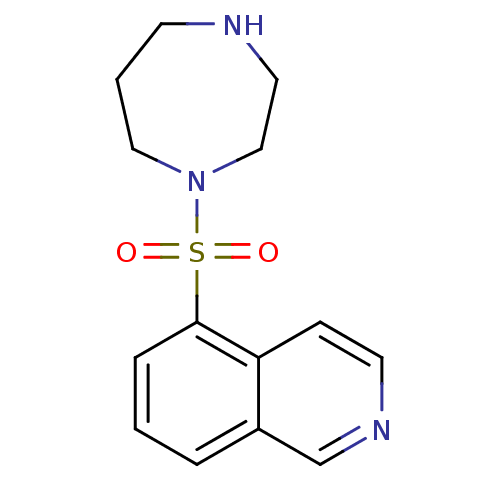 Fasudil (HA-1077) CHEMBL541388 US20240246972, Compound Fasudil 5-(1,4-diazepane-1-sulfonyl)isoquinoline BDBM14027 cid_163751 CHEMBL38380 US9687483, Fasudil AT877 5-(1,4-diazepan-1-ylsulfonyl)isoquinoline HA-1077
- Martín-Cámara, O; Arribas, M; Wells, G; Morales-Tenorio, M; Martín-Requero, Á; Porras, G; Martínez, A; Giorgi, G; López-Alvarado, P; Lastres-Becker, I; Menéndez, JC Multitarget Hybrid Fasudil Derivatives as a New Approach to the Potential Treatment of Amyotrophic Lateral Sclerosis. J Med Chem 65: 1867-1882 (2022)
- Qi, L; Lv, T; Cheng, Y; Yu, M; Han, H; Kong, H; Xie, W; Wang, H; Zhang, Y; Huang, Z Fasudil dichloroacetate (FDCA), an orally available agent with potent therapeutic efficiency on monocrotaline-induced pulmonary arterial hypertension rats. Bioorg Med Chem Lett 29: 1812-1818 (2019)
- Inhibition Assay Attention was focused on exploring, in turn, the SAR around the phenyl ring A, branching and substitution at the benzylic position, urea linkage of 1aa, without varying the [4-(4-pyridinyl)-2-thiazolyl] terminus (FIG. 4). The [4-(4-pyridinyl)-2-thiazolyl] group was believed to act as a hinge-binding moiety with the nitrogen of the pyridyl H-bonding to the back bone NH of the hinge Met156, as seen in the crystal complex of ROCK1 with Fasudil (PDB ID 2ESM) (Jacobs, et al., The structure of dimeric ROCK I reveals the mechanism for ligand selectivity, J Biol Chem, 2006, 281:260-8).All compounds were systematically screened against ROCK1 and ROCK2. IC50 values were systematically determined only for compounds that inhibit 40% of ROCK1 kinase activities at 50 μM.
- Fluorescent Polarization Assay The inhibitor potency of BA-1049 (racemic mixture) and Fasudil (Calbiochem) were compared by fluorescent polarization assays performed using a Biomek 2000 robotic workstation (Beckman Instruments, Palo Alto, Calif.) in a 96-well plate format. The assay was performed utilizing the IMAP® ROCK I and ROCK II kits (Molecular Devices Corp.) as follows. Substrate (synthetic peptide capable of being phosphorylated by ROCK I or ROCK II: KEAKEKRQEQIAKRRRLSSLRASTSKSGGSQK) (SEQ ID NO:1) and ATP concentrations used were 200 nM and 10 μM, respectively, while the enzyme (ROCK I, ROCK II recombinantly-produced kinase domain) concentration was 3.96×10^−3 units per well. The substrate, enzyme, and ATP dilutions were made with reaction buffer provided by the vendor. The test compound was diluted in 1-:10 DMSO-ethanol (vol/vol). The various components were added into black, clear bottom 96-well plates in a final volume of 20 μL per well. After the enzyme reaction (60 min at 23° C.), 60 μL of the binding solution (IMA kits provided by vendor) was added per well and incubated an additional 30 min in the dark at 23° C. Fluorescent polarization of the reaction mixtures was then measured on the Analyst® HT instrument (Molecular Devices Corp.).