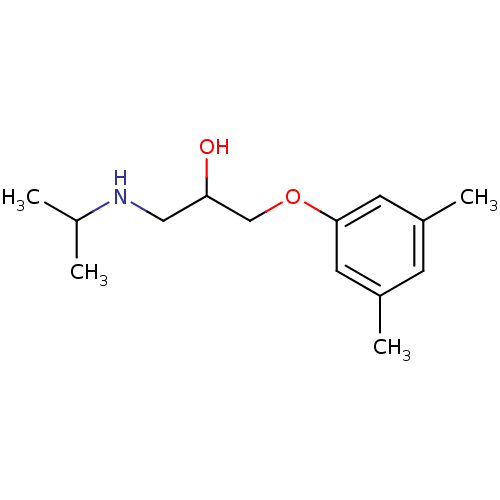
 CHEMBL1159714 Ko 707 BDBM50421719
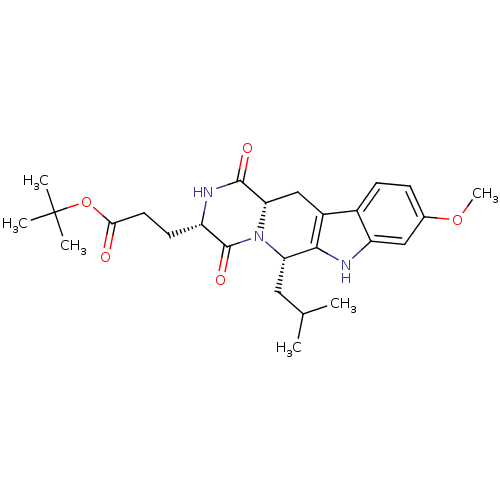 3-((3S,6S)-6-Isobutyl-9-methoxy-1,4-dioxo-1,2,3,4,6,7,12,12a-octahydro-pyrazino[1',2':1,6]pyrido[3,4-b]indol-3-yl)-propionic acid tert-butyl ester BDBM50305083 3-((3S,6S,12aS)-6-Isobutyl-9-methoxy-1,4-dioxo-1,2,3,4,6,7,12,12a-octahydro-pyrazino[1',2':1,6]pyrido[3,4-b]indol-3-yl)-propionic acid tert-butyl ester Ko143 Ko-143 US9695174, Ko143 CHEMBL488910
- Macabuag, N; Esmieu, W; Breccia, P; Jarvis, R; Blackaby, W; Lazari, O; Urbonas, L; Eznarriaga, M; Williams, R; Strijbosch, A; Van de Bospoort, R; Matthews, K; Clissold, C; Ladduwahetty, T; Vater, H; Heaphy, P; Stafford, DG; Wang, HJ; Mangette, JE; McAllister, G; Beaumont, V; Vogt, TF; Wilkinson, HA; Doherty, EM; Dominguez, C Developing HDAC4-Selective Protein Degraders To Investigate the Role of HDAC4 in Huntington's Disease Pathology. J Med Chem 65: 12445-12459 (2022)
- Abdel-Magid, AF Histone Deacetylase 4 (HDAC4) Inhibitors: A Promising Treatment for Huntington's Disease. ACS Med Chem Lett 4: 692-3 (2013)
- Dolan, BM; Duron, SG; Campbell, DA; Vollrath, B; Shankaranarayana Rao, BS; Ko, HY; Lin, GG; Govindarajan, A; Choi, SY; Tonegawa, S Rescue of fragile X syndrome phenotypes in Fmr1 KO mice by the small-molecule PAK inhibitor FRAX486. Proc Natl Acad Sci U S A 110: 5671-6
- Marek, L; Hamacher, A; Hansen, FK; Kuna, K; Gohlke, H; Kassack, MU; Kurz, T Histone deacetylase (HDAC) inhibitors with a novel connecting unit linker region reveal a selectivity profile for HDAC4 and HDAC5 with improved activity against chemoresistant cancer cells. J Med Chem 56: 427-36 (2013)
- Ontoria, JM; Altamura, S; Di Marco, A; Ferrigno, F; Laufer, R; Muraglia, E; Palumbi, MC; Rowley, M; Scarpelli, R; Schultz-Fademrecht, C; Serafini, S; Steinkühler, C; Jones, P Identification of novel, selective, and stable inhibitors of class II histone deacetylases. Validation studies of the inhibition of the enzymatic activity of HDAC4 by small molecules as a novel approach for cancer therapy. J Med Chem 52: 6782-9 (2009)
- Cameron, KO; Kung, DW; Kalgutkar, AS; Kurumbail, RG; Miller, R; Salatto, CT; Ward, J; Withka, JM; Bhattacharya, SK; Boehm, M; Borzilleri, KA; Brown, JA; Calabrese, M; Caspers, NL; Cokorinos, E; Conn, EL; Dowling, MS; Edmonds, DJ; Eng, H; Fernando, DP; Frisbie, R; Hepworth, D; Landro, J; Mao, Y; Rajamohan, F; Reyes, AR; Rose, CR; Ryder, T; Shavnya, A; Smith, AC; Tu, M; Wolford, AC; Xiao, J J Med Chem 59: 8068-81 (2016)
- Mandadapu, SR; Weerawarna, PM; Prior, AM; Uy, RA; Aravapalli, S; Alliston, KR; Lushington, GH; Kim, Y; Hua, DH; Chang, KO; Groutas, WC Bioorg Med Chem Lett 23: 3709-12 (2013)
- Clausen, JD; Kjellerup, L; Cohrt, KO; Hansen, JB; Dalby-Brown, W; Winther, AL Bioorg Med Chem Lett 27: 4564-4570 (2017)
- Shaw, S; Bian, Z; Zhao, B; Tarr, JC; Veerasamy, N; Jeon, KO; Belmar, J; Arnold, AL; Fogarty, SA; Perry, E; Sensintaffar, JL; Camper, DV; Rossanese, OW; Lee, T; Olejniczak, ET; Fesik, SW J Med Chem 61: 2410-2421 (2018)
- Kallander, LS; Lu, Q; Chen, W; Tomaszek, T; Yang, G; Tew, D; Meek, TD; Hofmann, GA; Schulz-Pritchard, CK; Smith, WW; Janson, CA; Ryan, MD; Zhang, GF; Johanson, KO; Kirkpatrick, RB; Ho, TF; Fisher, PW; Mattern, MR; Johnson, RK; Hansbury, MJ; Winkler, JD; Ward, KW; Veber, DF; Thompson, SK J Med Chem 48: 5644-7 (2005)
- Zankel, TC; Isbell, SL; Ko, AA US Patent US10308607 (2019)
- Ko, B; Jang, Y; Kim, MH; Lam, TT; Seo, HK; Jeong, P; Choi, M; Kang, KW; Lee, SD; Park, JH; Kim, M; Han, SY; Kim, YC Eur J Med Chem 262:
- Li, Z; Liao, C; Ko, BC; Shan, S; Tong, EH; Yin, Z; Pan, D; Wong, VK; Shi, L; Ning, ZQ; Hu, W; Zhou, J; Chung, SS; Lu, XP Bioorg Med Chem Lett 14: 3507-11 (2004)
- Ko, CC; Chen, YJ; Chen, CT; Liu, YC; Cheng, FC; Hsu, KC; Chow, LP J Biol Chem 289: 22078-89 (2014)
- Khanwelkar, RR; Chen, GS; Wang, HC; Yu, CW; Huang, CH; Lee, O; Chen, CH; Hwang, CS; Ko, CH; Chou, NT; Lin, MW; Wang, LM; Chen, YC; Hseu, TH; Chang, CN; Hsu, HC; Lin, HC; Shih, YC; Chou, SH; Tseng, HW; Liu, CP; Tu, CM; Hu, TL; Tsai, YJ; Chern, JW Bioorg Med Chem 18: 4674-86 (2011)
- Ratni, H; Ebeling, M; Baird, J; Bendels, S; Bylund, J; Chen, KS; Denk, N; Feng, Z; Green, L; Guerard, M; Jablonski, P; Jacobsen, B; Khwaja, O; Kletzl, H; Ko, CP; Kustermann, S; Marquet, A; Metzger, F; Mueller, B; Naryshkin, NA; Paushkin, SV; Pinard, E; Poirier, A; Reutlinger, M; Weetall, M; Zeller, A; Zhao, X; Mueller, L J Med Chem 61: 6501-6517 (2018)
- Nam, Y; Ryu, KD; Jang, C; Moon, YH; Kim, M; Ko, D; Chung, KS; Gandini, MA; Lee, KT; Zamponi, GW; Lee, JY Bioorg Med Chem 28: (2020)
- Choi, HG; Ko, E; Cho, J; Son, JB; Ko, YK; Park, J; Kim, SY; Kang, SY; Lee, S; Ryu, HY; Kim, ND; Kim, SB; Lee, S; Kim, D; Lee, SJ; Cho, S; Lee, K; Yu, K; Choi, M; Koo, JW; Hoe, H US Patent US11117892 (2021)
- Thomas, M; Brand, S; De Rycker, M; Zuccotto, F; Lukac, I; Dodd, PG; Ko, EJ; Manthri, S; McGonagle, K; Osuna-Cabello, M; Riley, J; Pont, C; Simeons, F; Stojanovski, L; Thomas, J; Thompson, S; Viayna, E; Fiandor, JM; Martin, J; Wyatt, PG; Miles, TJ; Read, KD; Marco, M; Gilbert, IH J Med Chem 64: 5905-5930 (2021)
- Cheng, MC; Li, CY; Ko, HC; Ko, FN; Lin, YL; Wu, TS J Nat Prod 69: 1305-9 (2006)
- Hillmann, P; Ko, GY; Spinrath, A; Raulf, A; von Kügelgen, I; Wolff, SC; Nicholas, RA; Kostenis, E; Höltje, HD; Müller, CE J Med Chem 52: 2762-75 (2009)
- Ko, H; Carter, RL; Cosyn, L; Petrelli, R; de Castro, S; Besada, P; Zhou, Y; Cappellacci, L; Franchetti, P; Grifantini, M; Van Calenbergh, S; Harden, TK; Jacobson, KA Bioorg Med Chem 16: 6319-32 (2008)
- Cheng, MC; Li, CY; Ko, HC; Ko, FN; Lin, YL; Wu, TS J Nat Prod 69: 1305-9 (2006)
- Ng, LT; Ko, HH; Lu, TM Bioorg Med Chem 17: 4360-6 (2009)
- Choi, H; Park, HJ; Shin, JC; Ko, HS; Lee, JK; Lee, S; Park, H; Hong, S Bioorg Med Chem Lett 22: 2195-9 (2012)
- Dolan, BM; Duron, SG; Campbell, DA; Vollrath, B; Shankaranarayana Rao, BS; Ko, HY; Lin, GG; Govindarajan, A; Choi, SY; Tonegawa, S Proc Natl Acad Sci U S A 110: 5671-6
- Nam, SJ; Ko, H; Ju, MK; Hwang, H; Chin, J; Ham, J; Lee, B; Lee, J; Won, DH; Choi, H; Ko, J; Shin, K; Oh, T; Kim, S; Rho, JR; Kang, H J Nat Prod 70: 1691-5 (2007)
- Ko, JH; Yeon, SW; Ryu, JS; Kim, TY; Song, EH; You, HJ; Park, RE; Ryu, CK Bioorg Med Chem Lett 16: 6001-5 (2006)
- Nishii, H; Chiba, T; Morikami, K; Fukami, TA; Sakamoto, H; Ko, K; Koyano, H Bioorg Med Chem Lett 20: 1405-9 (2010)
- Lee, W; Ko, KR; Kim, HK; Lee, DS; Nam, IJ; Lim, S; Kim, S J Nat Prod 81: 1343-1356 (2018)
- Ko, KS; Steffey, ME; Brandvold, KR; Soellner, MB ACS Med Chem Lett 4: 779-783 (2013)
- Cho, SM; Kim, Y; Jung, Y; Ko, M; Marko-Varga, G; Kwon, HJ J Med Chem 64: 15858-15867 (2021)
- Nam, M; Kim, T; Kwak, J; Seo, SH; Ko, MK; Lim, EJ; Min, SJ; Cho, YS; Keum, G; Baek, DJ; Lee, J; Pae, AN Eur J Med Chem 97: 245-58 (2015)
- Jackson, JJ; Shibuya, GM; Ravishankar, B; Adusumilli, L; Bradford, D; Brockstedt, DG; Bucher, C; Bui, M; Cho, C; Colas, C; Cutler, G; Dukes, A; Han, X; Hu, DX; Jacobson, S; Kassner, PD; Katibah, GE; Ko, MYM; Kolhatkar, U; Leger, PR; Ma, A; Marshall, L; Maung, J; Ng, AA; Okano, A; Pookot, D; Poon, D; Ramana, C; Reilly, MK; Robles, O; Schwarz, JB; Shakhmin, AA; Shunatona, HP; Sreenivasan, R; Tivitmahaisoon, P; Xu, M; Zaw, T; Wustrow, DJ; Zibinsky, M J Med Chem 65: 12895-12924 (2022)
- Ko, S; Lee, MK; Shin, D; Park, H Bioorg Med Chem 17: 7769-74 (2009)
- Lim, CJ; Woo, SE; Ko, SI; Lee, BH; Oh, KS; Yi, KY Bioorg Med Chem Lett 26: 4684-4686 (2016)
- Hwang, GJ; Jang, M; Son, S; Lee, B; Jang, JP; Lee, JS; Ko, SK; Hong, YS; Ahn, JS; Jang, JH J Nat Prod 84: 2420-2426 (2021)
- Carter, PH; Brown, GD; Cherney, RJ; Batt, DG; Chen, J; Clark, CM; Cvijic, ME; Duncia, JV; Ko, SS; Mandlekar, S; Mo, R; Nelson, DJ; Pang, J; Rose, AV; Santella, JB; Tebben, AJ; Traeger, SC; Xu, S; Zhao, Q; Barrish, JC ACS Med Chem Lett 6: 439-44 (2015)
- Walpole, C; Ko, SY; Brown, M; Beattie, D; Campbell, E; Dickenson, F; Ewan, S; Hughes, GA; Lemaire, M; Lerpiniere, J; Patel, S; Urban, L J Med Chem 41: 3159-73 (1998)
- K-M Chen, C; Hudock, MP; Zhang, Y; Guo, RT; Cao, R; No, JH; Liang, PH; Ko, TP; Chang, TH; Chang, SC; Song, Y; Axelson, J; Kumar, A; Wang, AH; Oldfield, E J Med Chem 51: 5594-607 (2008)
- Quang, TH; Ngan, NT; Ko, W; Kim, DC; Yoon, CS; Sohn, JH; Yim, JH; Kim, YC; Oh, H Bioorg Med Chem Lett 24: 5787-91 (2014)
- Ryu, CK; Kang, HY; Lee, SK; Nam, KA; Hong, CY; Ko, WG; Lee, BH Bioorg Med Chem Lett 10: 461-4 (2000)
- Kang, S; Kim, RY; Seo, MJ; Lee, S; Kim, YM; Seo, M; Seo, JJ; Ko, Y; Choi, I; Jang, J; Nam, J; Park, S; Kang, H; Kim, HJ; Kim, J; Ahn, S; Pethe, K; Nam, K; No, Z; Kim, J J Med Chem 57: 5293-305 (2014)
- Jeon, WS; Moon, K; Park, SH; Chun, H; Ko, YH; Lee, JY; Lee, ES; Samal, S; Selvapalam, N; Rekharsky, MV; Sindelar, V; Sobransingh, D; Inoue, Y; Kaifer, AE; Kim, K J Am Chem Soc 127: 12984-9 (2005)
- Kim, YK; Kwon, O; Park, H; Park, J; Choi, HG; Son, JB; Ko, E; Kim, SY; Lee, S; Kang, SY; Ko, YK; Park, J US Patent US11447480 (2022)
- Ferraris, D; Ko, YS; Pahutski, T; Ficco, RP; Serdyuk, L; Alemu, C; Bradford, C; Chiou, T; Hoover, R; Huang, S; Lautar, S; Liang, S; Lin, Q; Lu, MX; Mooney, M; Morgan, L; Qian, Y; Tran, S; Williams, LR; Wu, QY; Zhang, J; Zou, Y; Kalish, V J Med Chem 46: 3138-51 (2003)
- Lee, KO; Yoo, J; Lee, JH; Lee, M; Lee, K; Min, J US Patent US12110299 (2024)
- Raddatz, P; Jonczyk, A; Minck, KO; Rippmann, F; Schittenhelm, C; Schmitges, CJ J Med Chem 35: 3525-36 (1992)
- Khalil, NA; Ahmed, EM; Mohamed, KO; Nissan, YM; Zaitone, SA Bioorg Med Chem 22: 2080-9 (2014)
- Mohammed, KO; Nissan, YM Chem Biol Drug Des 84: 473-88 (2014)
- Bugge, S; Moen, IU; Sylte, KO; Sundby, E; Hoff, BH Eur J Med Chem 94: 175-94 (2015)
- Narayanan, D; Tran, KT; Pallesen, JS; Solbak, SMØ; Qin, Y; Mukminova, E; Luchini, M; Vasilyeva, KO; González Chichón, D; Goutsiou, G; Poulsen, C; Haapanen, N; Popowicz, GM; Sattler, M; Olagnier, D; Gajhede, M; Bach, A J Med Chem 65: 14481-14526 (2022)
- Yerdelen, KO; Koca, M; Anil, B; Sevindik, H; Kasap, Z; Halici, Z; Turkaydin, K; Gunesacar, G Bioorg Med Chem Lett 25: 5576-82 (2015)
- Pontius, A; Krick, A; Mesry, R; Kehraus, S; Foegen, SE; Mu¨ller, M; Klimo, K; Gerha¨user, C; Ko¨nig, GM J Nat Prod 71: 1793-1799 (2008)
- Mattei, P; Boehringer, M; Di Giorgio, P; Fischer, H; Hennig, M; Huwyler, J; Koçer, B; Kuhn, B; Loeffler, BM; Macdonald, A; Narquizian, R; Rauber, E; Sebokova, E; Sprecher, U Bioorg Med Chem Lett 20: 1109-13 (2010)
- Bosnar, M; Kragol, G; Koštrun, S; Vujasinovic, I; Bošnjak, B; Bencetic Mihaljevic, V; Marušic Ištuk, Z; Kapic, S; Hrvacic, B; Brajša, K; Tavcar, B; Jelic, D; Glojnaric, I; Verbanac, D; Culic, O; Padovan, J; Alihodžic, S; Erakovic Haber, V; Spaventi, R J Med Chem 55: 6111-23 (2012)
- Schwardt, O; Rabbani, S; Hartmann, M; Abgottspon, D; Wittwer, M; Kleeb, S; Zalewski, A; Smieško, M; Cutting, B; Ernst, B Bioorg Med Chem 19: 6454-73 (2011)
- ZakoSek, M; Mihevc, SP; Majdic, G; Ko{hacek over (s)}ak, U; Gobec, S US Patent US20230331674 (2023)
- ChEBML_1680081 Inhibition of human HDAC4
- ChEMBL_2287587 Inhibition of human HDAC4
- ChEMBL_390146 (CHEMBL868654) Inhibition of HDAC4
- ChEMBL_434814 (CHEMBL917042) Inhibition of HDAC4
- ChEMBL_461758 (CHEMBL927764) Inhibition of HDAC4
- ChEMBL_464960 (CHEMBL948013) Inhibition of HDAC4
- ChEMBL_468837 (CHEMBL947924) Inhibition of HDAC4
- ChEMBL_493109 (CHEMBL940372) Inhibition of HDAC4
- ChEMBL_496829 (CHEMBL1008842) Inhibition of HDAC4
- ChEMBL_564618 (CHEMBL964058) Inhibition of HDAC4
- ChEMBL_612150 (CHEMBL1073572) Inhibition of HDAC4
- ChEMBL_633819 (CHEMBL1119897) Inhibition of HDAC4
- ChEMBL_821471 (CHEMBL2038001) Inhibition of HDAC4
- ChEMBL_851450 (CHEMBL2156456) Inhibition of HDAC4
- ChEMBL_875953 (CHEMBL2188459) Inhibition of HDAC4
- ChEMBL_1506757 (CHEMBL3598916) Inhibition of human HDAC4
- ChEMBL_1763697 (CHEMBL4198944) Inhibition of human HDAC4
- ChEMBL_2265583 Inhibition of HDAC4 (unknown origin)
- ChEMBL_2266552 Inhibition of HDAC4 (unknown origin)
- ChEMBL_2275545 Inhibition of HDAC4 (unknown origin)
- ChEMBL_2292700 Inhibition of HDAC4 (unknown origin)
- ChEMBL_2299002 Inhibition of HDAC4 (unknown origin)
- ChEMBL_2317155 Inhibition of HDAC4 (unknown origin)
- ChEMBL_2331878 Inhibition of human recombinant HDAC4
- ChEMBL_2341426 Inhibition of HDAC4 (unknown origin)
- ChEMBL_2346010 Inhibition of human recombinant HDAC4
- ChEMBL_2346039 Inhibition of HDAC4 (unknown origin)
- ChEMBL_2373540 Inhibition of HDAC4 (unknown origin)
- ChEMBL_2424709 Inhibition of HDAC4 (unknown origin)
- ChEMBL_2447622 Inhibition of HDAC4 (unknown origin)
- ChEMBL_2456237 Inhibition of HDAC4 (unknown origin)
- ChEMBL_2459680 Inhibition of HDAC4 (unknown origin)
- ChEMBL_2467786 Inhibition of HDAC4 (unknown origin)
- ChEMBL_2477099 Inhibition of HDAC4 (unknown origin)
- ChEMBL_2482025 Inhibition of HDAC4 (unknown origin)
- ChEMBL_2488266 Inhibition of HDAC4 (unknown origin)
- ChEMBL_2488447 Inhibition of HDAC4 (unknown origin)
- ChEMBL_2496406 Inhibition of HDAC4 (unknown origin)
- ChEMBL_456670 (CHEMBL924051) Inhibition of human HDAC4
- ChEMBL_565676 (CHEMBL960034) Inhibition of human HDAC4
- ChEMBL_605914 (CHEMBL1068531) Inhibition of human HDAC4
- ChEMBL_1337848 (CHEMBL3240676) Inhibition of HDAC4 (unknown origin)
- ChEMBL_1444509 (CHEMBL3374209) Inhibition of HDAC4 (unknown origin)
- ChEMBL_1510867 (CHEMBL3606703) Inhibition of HDAC4 (unknown origin)
- ChEMBL_1552214 (CHEMBL3761216) Inhibition of HDAC4 (unknown origin)
- ChEMBL_1553006 (CHEMBL3760290) Inhibition of HDAC4 (unknown origin)
- ChEMBL_1763012 (CHEMBL4198259) Inhibition of HDAC4 (unknown origin)
- ChEMBL_1839055 (CHEMBL4339270) Inhibition of HDAC4 (unknown origin)
- ChEMBL_1867760 (CHEMBL4368735) Inhibition of HDAC4 (unknown origin)
- ChEMBL_1919951 (CHEMBL4422796) Inhibition of HDAC4 (unknown origin)
- ChEMBL_1928183 (CHEMBL4431255) Inhibition of HDAC4 (unknown origin)
- ChEMBL_1977522 (CHEMBL4610657) Inhibition of recombinant human HDAC4
- ChEMBL_1991271 (CHEMBL4625006) Inhibition of HDAC4 (unknown origin)
- ChEMBL_1992081 (CHEMBL4625816) Inhibition of HDAC4 (unknown origin)
- ChEMBL_2020067 (CHEMBL4673880) Inhibition of HDAC4 (unknown origin)
- ChEMBL_2076388 (CHEMBL4731922) Inhibition of HDAC4 (unknown origin)
- ChEMBL_2090268 (CHEMBL4771531) Inhibition of HDAC4 (unknown origin)
- ChEMBL_2121620 (CHEMBL4830767) Inhibition of HDAC4 (unknown origin)
- ChEMBL_2133293 (CHEMBL4842903) Inhibition of HDAC4 (unknown origin)
- ChEMBL_2149317 (CHEMBL5033715) Inhibition of HDAC4 (unknown origin)
- ChEMBL_2185159 (CHEMBL5097241) Inhibition of HDAC4 (unknown origin)
- ChEMBL_2186678 (CHEMBL5098760) Inhibition of HDAC4 (unknown origin)
- ChEMBL_2200958 (CHEMBL5113666) Inhibition of HDAC4 (unknown origin)
- ChEMBL_2203622 (CHEMBL5116330) Inhibition of HDAC4 (unknown origin)
- ChEMBL_2203643 (CHEMBL5116351) Inhibition of HDAC4 (unknown origin)
- ChEMBL_2215746 (CHEMBL5128878) Inhibition of HDAC4 (unknown origin)
- ChEMBL_2239670 (CHEMBL5153566) Inhibition of HDAC4 (unknown origin)
- ChEMBL_2260107 (CHEMBL5215118) Inhibition of HDAC4 (unknown origin)
- ChEMBL_422132 (CHEMBL907068) Inhibition of HDAC4 (mean IC50)
- ChEMBL_521106 (CHEMBL960367) Inhibition of human recombinant HDAC4
- ChEMBL_533706 (CHEMBL973328) Inhibition of flag-tagged HDAC4
- ChEMBL_718472 (CHEMBL1680136) Inhibition of human recombinant HDAC4
- ChEMBL_1845704 (CHEMBL4346131) Inhibition of recombinant HDAC4 (unknown origin)
- ChEMBL_2456341 Inhibition of GST-tagged HDAC4 (unknown origin)
- ChEMBL_585887 (CHEMBL1053558) Inhibition of human HDAC4 by fluorimetry
- ChEMBL_716693 (CHEMBL1670518) Inhibition of HDAC4 by fluorescence assay
- ChEMBL_856338 (CHEMBL2160545) Inhibition of HDAC4 by fluorimetric assay
- ChEMBL_878899 (CHEMBL2185050) Inhibition of HDAC4 by fluorometric assay
- ChEMBL_461212 (CHEMBL926151) Inhibition of HDAC4 expressed in 293T cells
- ChEMBL_543449 (CHEMBL1015997) Inhibition of recombinant HDAC4 by fluorimetric assay
- ChEMBL_690174 (CHEMBL1634304) Inhibition of human HDAC4 by fluorimetric assay
- ChEMBL_936030 (CHEMBL2318996) Inhibition of human HDAC4 by fluorescence assay
- ChEMBL_1684769 (CHEMBL4035248) Inhibition of HDAC4 (unknown origin) by fluorescence assay
- ChEMBL_1919924 (CHEMBL4422769) Inhibition of human HDAC4 using fluorogenic HDAC substrate
- ChEMBL_1992426 (CHEMBL4626161) Inhibition of HDAC4 (unknown origin) by FDL assay
- ChEMBL_2205798 (CHEMBL5118506) Inhibition of HDAC4 (unknown origin) by colorimetric method
- ChEMBL_2224654 (CHEMBL5138167) Inhibition of recombinant human HDAC4 using fluorogenic substrate
- ChEMBL_2266563 Inhibition of human recombinant HDAC4 incubated for 17 hrs
- ChEMBL_457994 (CHEMBL925325) Inhibition of human HDAC4 expressed in 293T cells
- ChEMBL_479642 (CHEMBL921443) Inhibition of human HDAC4 expressed in 293T cells
- ChEMBL_533715 (CHEMBL973337) Inhibition of flag-tagged HDAC4 by Biomol assay
- ChEMBL_612332 (CHEMBL1065584) Inhibition of human HDAC4 expressed in Escherichia coli
- ChEMBL_672868 (CHEMBL1267843) Inhibition of HDAC4 by in vitro deacetylation assay
- ChEMBL_2077878 (CHEMBL4733669) Inhibition of HDAC4 (unknown origin) by fluorescence based assay
- ChEMBL_2224637 (CHEMBL5138150) Inhibition of HDAC4 (unknown origin) using fluorescent peptide substrate
- ChEMBL_533714 (CHEMBL973336) Inhibition of flag-tagged HDAC4 by pull-down assay
- Inhibitory Effects of the Compounds on MEF2D and HDAC4 Protein Interactions Detection of MEF2D and HDAC4 interactions. In this mammalian two-hybrid assay, HDAC4 and MEF2D proteins were used. Two separate DNA constructs were made with MEF2D fused with the GAL4 DNA binding domain (GAL4-MEF2D) and with the MEF2-binding motif of HDAC4 (AA 155-220) fused with the viral transactivator VP-16 (HDAC4-VP16). Human epithelial carcinoma cells (HeLa) were co-transfected with the two DNA constructs (GAL4-MEF2D and HDAC4-VP16) and a reporter plasmid (Gal4Luc). The DNA constructs resulted in expression of the GAL4-MEF2D and HDAC4-VP16 fusion proteins within the cell. MEF2D and HDAC4 protein interactions were detected as a result of the GAL4-MEF2D and HDAC4-VP16 protein complex binding a DNA promoter on the reporter plasmid (Gal4Luc) and driving cellular expression of a luciferase gene. The measured luciferase protein signal was proportional to the amount of MEF2D and HDAC4 protein interactions occurring with the cell.
- ChEBML_1691852 Inhibition of recombinant human HDAC4 using fluorogenic substrate by fluorescence assay
- ChEMBL_1335254 (CHEMBL3238607) Inhibition of human HDAC4 using fluorogenic tetrapeptide RHKKAc as substrate
- ChEMBL_2488282 Inhibition of HDAC4 (unknown origin) incubated for 30 mins by ELISA
- ChEMBL_2498845 Inhibition of recombinant HDAC4 (unknown origin) using trifluoroacetyl lysine as substrate
- ChEMBL_477941 (CHEMBL936413) Inhibition of human HDAC4 in U937 cells by immunoprecipitation assay
- ChEMBL_596305 (CHEMBL1037400) Inhibition of human recombinant his tagged HDAC4 expressed in baculovirus
- ChEMBL_625341 (CHEMBL1111715) Inhibition of HDAC4 expressed in baculovirus system by fluorescent assay
- ChEMBL_856339 (CHEMBL2160546) Inhibition of HDAC4 by fluorimetric assay in presence of DTT
- ChEMBL_972537 (CHEMBL2410189) Inhibition of human recombinant HDAC4 by Michaelis-Menten equation analysis
- ChEMBL_1276443 (CHEMBL3088539) Inhibition of human recombinant HDAC4 after 30 mins by fluorescence assay
- ChEMBL_1331242 (CHEMBL3227884) Inhibition of human recombinant HDAC4 after 1 hr by luminescence assay
- ChEMBL_1433881 (CHEMBL3388842) Inhibition of human recombinant HDAC4 after 60 mins by fluorimetric assay
- ChEMBL_1478437 (CHEMBL3429375) Inhibition of recombinant HDAC4 (unknown origin) by homogeneous fluorescence release assay
- ChEMBL_1521756 (CHEMBL3626579) Inhibition of HDAC4 in human HeLa nuclear extracts by fluorometric assay
- ChEMBL_1522025 (CHEMBL3627132) Inhibition of recombinant human HDAC4 after 60 mins by fluorescence assay
- ChEMBL_1684740 (CHEMBL4035219) Inhibition of human HDAC4 using RHKKAc as substrate by fluorescence assay
- ChEMBL_2090142 (CHEMBL4771405) Inhibition of HDAC4 (unknown origin) by color de Lys colorimetric assay
- ChEMBL_2265807 Inhibition of human recombinant HDAC4 using fluorogenic substrate measured after 30 mins
- ChEMBL_2361872 Inhibition of human recombinant HDAC4 incubated for 30 mins by fluorimetry analysis
- ChEMBL_2456335 Inhibition of HDAC4 (unknown origin) using Boc-Lys-(Tfa)-AMC as substrate
- ChEMBL_500778 (CHEMBL973439) Inhibition of His-tagged HDAC4 catalytic domain expressed in Escherichia coli
- ChEMBL_558027 (CHEMBL953324) Inhibition of His-tagged HDAC4 catalytic domain expressed in Escherichia coli
- ChEMBL_643211 (CHEMBL1177022) Inhibition of human recombinant HDAC4 after 15 mins by fluorimetric assay
- ChEBML_87889 Inhibitory activity against histone deacetylase (HDAC4) prepared from mouse melanoma B16/BL6 cells
- ChEMBL_1684698 (CHEMBL4035177) Inhibition of human HDAC4 after 15 mins by trypsin-coupled fluorescence assay
- ChEMBL_1731843 (CHEMBL4147379) Inhibition of HDAC4 in human HeLa cells after 72 hrs by ELISA
- ChEMBL_2186687 (CHEMBL5098769) Inhibition of human HDAC4 expressed in HEK293T cells by scintillation counting analysis
- ChEMBL_2186765 (CHEMBL5098847) Inhibition of human HDAC4 using Boc-Lys(trifluoroacetyl)-AMC as flurogenic substrate
- ChEMBL_2243422 (CHEMBL5157632) Inhibition of HDAC4 (unknown origin) using trypsin and Ac-peptide as substrates
- ChEMBL_2288923 Inhibition of recombinant HDAC4 (unknown origin) incubated for 3 hrs by chemiluminescent assay
- ChEMBL_533716 (CHEMBL974269) Inhibition of flag-tagged HDAC4 expressed in HEK293 cells by Biomol assay
- ChEMBL_533717 (CHEMBL974270) Inhibition of HDAC4 catalytic domain expressed in HEK293 cells by Biomol assay
- ChEMBL_769060 (CHEMBL1832523) Competitive inhibition of HDAC4 using KI-104 as substrate by fluorescence assay
- ChEMBL_2476844 Inhibition of tetracycline-inducible FLAG-tagged human PARL stably transfected in HEK293T harboring FITR/PARL KO
- ChEBML_1571859 Inhibition of HDAC4 in human Jurkat E6-1 cells using Lys-TFA as substrate
- ChEMBL_1433101 (CHEMBL3386358) Inhibition of HDAC4 (unknown origin) using fluorogenic peptide as substrate by fluorescence assay
- ChEMBL_1571977 (CHEMBL3796505) Binding affinity to HDAC4 catalytic domain (unknown origin) by surface plasmon resonance assay
- ChEMBL_2159306 (CHEMBL5044056) Inhibition of HDAC4 (unknown origin) incubated for 30 mins by microplate reader assay
- ChEMBL_2184720 (CHEMBL5096802) Inhibition of human recombinant HDAC4 incubated for 45 mins by microplate reader assay
- ChEMBL_2241957 (CHEMBL5156167) Inhibition of recombinant human HDAC4 using fluorogenic substrate by fluorescence microplate reader assay
- ChEMBL_2346028 Inhibition of human recombinant HDAC4 using ArgHisLysLys(Ac) as substrate by fluorescence based analysis
- ChEMBL_2356013 Inhibition of HDAC4 (unknown origin) incubated for 30 mins by fluorescence based microplate analysis
- ChEMBL_2439393 Inhibition of HDAC4 (unknown origin) incubated for 30 mins by fluorescence plate reader assay
- ChEMBL_876035 (CHEMBL2182326) Inhibition of HDAC4 using p53 (379 to 382 residues) based fluorogenic peptide substrate
- ChEMBL_977175 (CHEMBL2416768) Inhibition of human recombinant HDAC4 using p53 residues 379-382 (RHKKAc) as substrate
- Two-Hybrid Assay Detection of MEF2D and HDAC4 interactions. In this mammalian two-hybrid assay, HDAC4 and MEF2D proteins were used as representative members of their respective protein families because the protein-protein interactions involved in the recruitment of class IIa HDACs by MEF2 were highly conserved. Two separate DNA constructs were made with MEF2D fused with the GAL4 DNA binding domain (GAL4-MEF2D) and with the MEF2-binding motif of HDAC4 (AA 155-220) fused with the viral transactivator VP-16 (HDAC4-VP16) (FIG. 1). Human epithelial carcinoma cells (HeLa) were co-transfected with the two DNA constructs (GAL4-MEF2D and HDAC4-VP16) and a reporter plasmid (Gal4Luc). The DNA constructs resulted in expression of the GAL4-MEF2D and HDAC4-VP16 fusion proteins within the cell. MEF2D and HDAC4 protein interactions were detected as a result of the GAL4-MEF2D and HDAC4-VP16 protein complex binding a DNA promoter on the reporter plasmid (Gal4Luc) and driving cellular expression of a luciferase gene.
- ChEMBL_480051 (CHEMBL927990) Inhibition of mouse PKCtheta in KO cells assessed as blockade of anti CD28-stimulated IL2 production
- ChEMBL_1571859 (CHEMBL3796125) Inhibition of HDAC4 in human Jurkat E6-1 cells using Lys-TFA as substrate
- ChEMBL_1571980 (CHEMBL3796508) Inhibition of HDAC4 catalytic domain (unknown origin) using Boc-Lys(TFA)-AMC as substrate
- ChEMBL_1799342 (CHEMBL4271634) Inhibition of human recombinant HDAC4 using fluorogenic trifluoroacetyl lysine as substrate by fluorescence assay
- ChEMBL_1920505 (CHEMBL4423350) Inhibition of human recombinant HDAC4 using fluorogenic HDAC substrate class 2A by fluorescence assay
- ChEMBL_2020078 (CHEMBL4673891) Inhibition of human HDAC4 using fluorogenic HDAC substrate incubated for 30 mins by fluorimetry
- ChEMBL_2035429 (CHEMBL4689587) Inhibition of HDAC4 (unknown origin) using Boc Lys(TFA) as substrate by fluorogenic assay
- ChEMBL_2035444 (CHEMBL4689602) Binding affinity to immobilized HDAC4 catalytic domain (unknown origin) by surface plasmon resonance assay
- ChEMBL_2135493 (CHEMBL4845103) Inhibition of HDAC4 (unknown origin) measured after 30 mins by fluorescence microplate reader assay
- ChEMBL_2270308 Inhibition of HDAC4 (unknown origin) using Fluor de lys as substrate by fluorescence based analysis
- ChEMBL_2345089 Inhibition of human recombinant HDAC4 using fluorogenic class IIa (Bos-Lys(trifluoroacetyl)-AMC) as substrate
- ChEMBL_512668 (CHEMBL969718) Inhibition of human recombinant HDAC4 using Fluor de Lys as substrate by fluorimetric assay
- ChEMBL_2020132 (CHEMBL4673945) Inhibition of human HDAC4 expressed in sf9 cells using Fluor deLys substrate by fluorescence method
- ChEMBL_2186705 (CHEMBL5098787) Inhibition of HDAC4 in human HeLa cells incubated for 1 hr by mass spectrometry method
- ChEMBL_2218709 (CHEMBL5132043) Inhibition of recombinant full length human HDAC4 expressed in insect Sf9 cells by EMSA analysis
- ChEMBL_2337901 Inhibition of recombinant human HDAC4 using HDAC substrate incubated for 30 mins by fluorescence based assay
- ChEMBL_2502697 Inhibition of human recombinant HDAC4 using AMC-K(TFA)GL as substrate by fluorescence based analysis
- ChEMBL_743700 (CHEMBL1767469) Inhibition of human HDAC4 using ArgHisLysLys(Ac) fluorogenic peptide as a substrate by fluorimetric assay
- ChEMBL_796808 (CHEMBL1943838) Inhibition of HDAC4 using carboxyfluorescein-labeled peptide as substrate after 17 hrs by fluorescence assay
- ChEMBL_972659 (CHEMBL2410762) Inhibition of HDAC4 (unknown origin) using Boc-Lys(trifluoroacetyl)-AMC as substrate by fluorescence assay
- ChEMBL_1781051 (CHEMBL4252568) Inhibition of HDAC4 (unknown origin) using fluorogenic substrate after 1 to 2 hrs by fluorescence assay
- ChEMBL_1982901 (CHEMBL4616163) Inhibition of human recombinant HDAC4 using AMC-K(TFA)GL as substrate by fluorescence based assay
- ChEMBL_2090153 (CHEMBL4771416) Inhibition of recombinant human HDAC4 using pan-HDAC substrate incubated for 3 hrs by fluorescence method
- ChEMBL_2090202 (CHEMBL4771465) Binding affinity to human full length N-terminal GST-tagged HDAC4 by surface plasmon resonance analysis
- ChEMBL_2135181 (CHEMBL4844791) Inhibition of human HDAC4 using fluorogenic substrate incubated for 1 hrs by fluorescence plate reader assay
- ChEMBL_2184710 (CHEMBL5096792) Inhibition of recombinant full length HDAC4 (unknown origin) using fluorophore conjugated substrate by microplate reader assay
- ChEMBL_2224650 (CHEMBL5138163) Inhibition of recombinant human HDAC4 using fluorescent substrate incubated for 30 mins by fluorescence based assay
- ChEMBL_2435553 Inhibition of human HDAC4 incubated for 10 mins followed by fluorogenic substrate addition by fluorescence based analysis
- ChEMBL_2443960 Inhibition of human recombinant HDAC4 using Boc-Lys(tri-fluoroacetyl)-AMC as substrate by fluorescence based analysis
- ChEMBL_2488462 Inhibition of human recombinant HDAC4 using fluorogenic HDAC substrate incubated for 20 mins by fluorescence based assay
- ChEMBL_2502563 Inhibition of HDAC4 (unknown origin) preincubated for 10 mins followed by substrate addition by fluorescence based assay
- ChEMBL_809820 (CHEMBL2014704) Inhibition of recombinant human HDAC4 using Fluor-de-Lys as substrate after 30 mins by spectrophotometry
- ChEMBL_2154863 (CHEMBL5039523) Agonist activity at STING KO human THP-1 dual cells incubated for 20 hrs by luciferase reporter gene assay
- ChEBML_1726229 Inhibition of HDAC4 (unknown origin) using Boc-Lys(acetyl)-AMC as substrate after 30 mins by fluorescence assay
- ChEMBL_1518397 (CHEMBL3620707) Inhibition of HDAC4 (unknown origin) using Boc-Lys(trifluoroacetyl)-AMC fluorogenic acetylated peptide substrate by fluorometric assay
- ChEMBL_1779296 (CHEMBL4236288) Inhibition of human recombinant HDAC4 using fluorogenic HDAC substrate class 2a after 30 mins by fluorimetrc method
- ChEMBL_1811464 (CHEMBL4310924) Binding affinity to HDAC4 catalytic domain (648 to 1057 residues) (unknown origin) by surface plasmon resonance analysis
- ChEMBL_1827407 (CHEMBL4327281) Inhibition of recombinant human HDAC4 using Boc-Lys(trifluoroacetyl)-AMC as substrate by homogeneous fluorescence release assay
- ChEMBL_2184731 (CHEMBL5096813) Inhibition of HDAC4 (unknown origin) using Acetyl-Lys(trifluoroacetyl)-AMC fluorogenic peptide as substrate by fluorescence assay
- ChEMBL_2238207 (CHEMBL5152103) Inhibition of human N-terminal flag-tag full-length wild-type HDAC4 by surface plasmon resonance assay
- ChEMBL_629205 (CHEMBL1121319) Inhibition of human HDAC4 catalytic domain expressed in Escherichia coli BL21 after 15 mins by fluorescence assay
- ChEMBL_785883 (CHEMBL1921152) Inhibition of human recombinant HDAC4 using fluorophore-conjugated substrate Boc-L-Lys(Ac)-AMC after 60 mins
- ChEMBL_2322358 Agonist activity at STING in human STHP1-Dual KO-STING cells incubated for 20 hrs by Quanti-luc reagent based assay
- ChEMBL_2354137 Agonist activity at STING in PMA-differentiated human THP1-Dual KO-STING cells incubated for 24 hrs by QUANTI-Blue assay
- ChEMBL_1452941 (CHEMBL3366593) Inhibition of human HDAC4 using fluorescent substrate Ac-KGLGK(Ac)-MCA after 30 mins by fluorescence plate reader
- ChEMBL_1455098 (CHEMBL3366354) Inhibition of HDAC4 (unknown origin) incubated for 30 mins in presence of BSA and DTT by fluorescence assay
- ChEMBL_1713039 (CHEMBL4123088) Inhibition of full length recombinant human HDAC4 using fluorescent-labeled peptide as substrate by electrophoretic mobility shift assay
- ChEMBL_1726229 (CHEMBL4141507) Inhibition of HDAC4 (unknown origin) using Boc-Lys(acetyl)-AMC as substrate after 30 mins by fluorescence assay
- ChEMBL_1896716 (CHEMBL4398751) Inhibition of human recombinant HDAC4 using fluorogenic HDAC substrate class 2a measured after 30 mins by fluorimetry assay
- ChEMBL_1899189 (CHEMBL4401304) Inhibition of recombinant human HDAC4 using fluorescently-labeled acetylated histone peptide as substrate by microfluidic mobility shift assay
- ChEMBL_2090170 (CHEMBL4771433) Inhibition of HDAC4 (unknown origin) using HDAC class IIa substrate (trifluoroacetyl-lysine-AMC) as substrate by fluorescent method
- ChEMBL_2157814 (CHEMBL5042564) Inhibition of full length human HDAC4 using FAM-labeled acetylated peptide as substrate by electrophoretic mobility shift assay
- ChEMBL_2184745 (CHEMBL5096827) Inhibition of recombinant HDAC4 (unknown origin) using acetyl-Lys(trifluoroacetyl)-AMC fluorogenic substrate by microtiter plate reader assay
- ChEMBL_2480271 Inhibition of recombinant human HDAC4 using Boc-Lys (Ac)-AMC as substrate incubated for 120 mins by fluorescence analysis
- ChEMBL_757636 (CHEMBL1804893) Inhibition of recombinant HDAC4 assessed as inhibition of fluorogenic aminocoumarin release from substrate by trypsin-coupled biochemical assay
- ChEMBL_1670959 (CHEMBL4020988) Inhibition of recombinant human full length HDAC4 using Fluor-de-Lys as substrate after 60 mins by spectrofluorimetric analysis
- ChEMBL_2090262 (CHEMBL4771525) Inhibition of human HDAC4 using (Boc-Lys(trifluoroacetyl)-AMC) as substrate measured after 2 hrs by Cheng-Prusoff analysis
- ChEMBL_2159149 (CHEMBL5043899) Inhibition of human recombinant HDAC4 using Boc-Lys(triflouroacetyI)-AMC substrate incubated for 2 hrs by fluorescence based assay
- ChEMBL_2203383 (CHEMBL5116091) Inhibition of recombinant human HDAC4 using fluorescent as substrate measured for 30 mins by fluorescence based microtiter plate assay
- ChEMBL_2217565 (CHEMBL5130697) Inhibition of recombinant HDAC4 (unknown origin) using Boc-Lys(TFA)-AMC as substrate by fluorescence based plate reader assay
- ChEMBL_2224669 (CHEMBL5138182) Inhibition of full-length recombinant human HDAC4 using Boc-Lys(trifluoroacetyl)-AMC peptide as substrate by fluorescence based assay
- ChEMBL_2361749 Inhibition of HDAC4 (unknown origin) using Boc-Lys-(trifluoroacetyl)-AMC as substrate incubated for 30 mins by fluorescence based analysis
- ChEMBL_2364799 Inhibition of recombinant full-length human HDAC4 using FAM-RHKK (trifluor-Ac)-NH2 as substrate by electrophoretic mobility shift assay
- ChEMBL_2452614 Inhibition of HDAC4 (unknown origin) using biotinylated histone H3 KAc peptide (1 to 21 residues) as substrate by HTRF assay
- ChEMBL_770951 (CHEMBL1838190) Inhibition of recombinant human HDAC4 using Boc-L-Lys(epsilon-trifluoroacetyl)-AMC as substrate by two-step fluorogenic assay
- ChEMBL_771089 (CHEMBL1838750) Inhibition of human HDAC4 catalytic domain (residues Thr648-Thr1057) expressed in Escherichia coli BL21using fluorogenic substrate by fluorescence assay
- ChEMBL_1560789 (CHEMBL3778486) Inhibition of recombinant HDAC4 (unknown origin) using AMC labeled AC-peptide as substrate incubated for 1 hr by fluorescence analysis
- ChEMBL_1844231 (CHEMBL4344658) Inhibition of HDAC4 (unknown origin) using biotinylated histone H3 KAc peptide (1 to 21 residues) as substrate by HTRF assay
- ChEMBL_2035439 (CHEMBL4689597) Inhibition of Class 2A HDAC4 in human Jurkat E6.1 cells using Boc-Lys-(TFA)-AMC as substrate by fluorogenic assay
- ChEMBL_2090186 (CHEMBL4771449) Inhibition of human HDAC4 expressed in baculovirus infected sf9 cells using (Boc-Lys(trifluoroacetyl)-AMC) as substrate by fluorimetric assay
- ChEMBL_2154142 (CHEMBL5038802) Inhibition of recombinant HDAC4 (unknown origin) using Ac-peptide-AMC as substrate incubated for 240 mins by microplate reader analysis
- ChEMBL_2486012 Inhibition of human recombinant HDAC4 preincubated for 1 hr followed by substrate addition and measured after 2 hrs by fluorescence assay
- ChEMBL_591999 (CHEMBL1050114) Inhibition of human recombinant N-terminal FLAG-tagged HDAC4 (612-1034) expressed in baculovirus after 10 mins by fluorimetric analysis
- ChEMBL_2473762 Inhibition of PRMT5 in human HCT-116 cells with MTAP KO assessed as decrease in SMDA level incubated for 48 hrs by immunofluorescence analysis
- ChEMBL_1484271 (CHEMBL3538487) Inhibition of HDAC4 (unknown origin) expressed in HEK293 cells using [3H]acetylated human histone H4 peptide as substrate by scintillation counting
- ChEMBL_1919898 (CHEMBL4422743) Inhibition of recombinant full-length human HDAC4 using Boc-Lys(trifluoroacetyl)-AMC as substrate measured after 2 hrs by fluorescence assay
- ChEMBL_2073886 (CHEMBL4729420) Inhibition of human recombinant HDAC4 using Boc-Lys-(epsilon-Tfa)-AMC fluorogenic substrate incubated for 90 mins by fluorescence based assay
- ChEMBL_2090131 (CHEMBL4771394) Inhibition of human HDAC4 expressed in baculovirus infected sf9 cells using (Boc-Lys(trifluoroacetyl)-AMC) as substrate by fluorescence-based assay
- ChEMBL_2090217 (CHEMBL4771480) Inhibition of human HDAC4 expressed in baculovirus infected sf9 cells using carboxyfluorescein (FAM)-labeled acetylated peptide substrate by microfluidic capillary electrophoresis
- ChEMBL_2163089 (CHEMBL5047950) Inhibition of HDAC4 (unknown origin) using Boc-Lys(TFA)-AMC as fluorogenic substrate incubated for 30 mins by fluorescence based assay
- ChEMBL_2171605 (CHEMBL5056739) Inhibition of human HDAC4 using Boc-Lys(acetyl)-AMC as fluorogenic substrate measured after 1 hr by flourescence plate reader method
- ChEMBL_2439307 Inhibition of recombinant human HDAC4 using acetylated luminogenic substrate incubated for 10 mins by ultra-glo recombinant firefly luciferase based luminescence assay
- ChEBML_1697941 Inhibition of recombinant human C-terminal GST-tagged HDAC4 expressed in baculovirus-infected insect cells using Boc-Lys(TFA)-AMC as substrate by fluorimeter
- ChEMBL_1450060 (CHEMBL3373901) Inhibition of human HDAC4 pre-incubated for 30 mins before substrate addition and measured after 30 mins by HDAC-Glo I/II assay
- ChEMBL_1919945 (CHEMBL4422790) Inhibition of recombinant human HDAC4 expressed in HEK293T cells using Ac-KGLGK(Ac)-MCA as substrate measured after 30 mins by fluorescence assay
- ChEMBL_2020120 (CHEMBL4673933) Inhibition of HDAC4 (unknown origin) using MAZ-1675 as substrate preincubated for 10 mins followed by substrate addition and shaken for 60 secs
- ChEMBL_2087786 (CHEMBL4769049) Inhibition of human recombinant HDAC4 expressed in baculovirus using fluorogenic peptide p53 residues 379-382 (RHKK(Ac)AMC) as substrate by Fluorescence analysis
- ChEMBL_2090249 (CHEMBL4771512) Inhibition of human full length C-terminal Flag tagged HDAC4 expressed in HEK293T cells using H3K9-myristoyl peptide as substrate by HPLC method
- ChEMBL_2184700 (CHEMBL5096782) Inhibition of HDAC4 (unknown origin) using MAZ-1675 as substrate preincubated for 10 mins followed by substrate addition by microtiter plate reader assay
- ChEMBL_2187516 (CHEMBL5099598) Inhibition of full length N-terminal GST/C-terminal his-tagged human recombinant HDAC4 (627 to 1084 residues) expressed in Sf9 insect cells
- ChEMBL_2452841 Inhibition of HDAC4 in human HeLa cells nuclear extract using BocLys(acetyl)-AMC as substrate incubated for 1 hr by fluorescence plate reader analysis
- ChEMBL_1452946 (CHEMBL3366598) Inhibition of human HDAC4 using fluorescent substrate Ac-KGLGK(Ac)-MCA after 30 mins by fluorescence plate reader in presence of 0.1 mM dithiothreitol
- ChEMBL_1547661 (CHEMBL3755712) Inhibition of N-terminal GST-tagged human HDAC4 expressed in baculovirus expression system using (Boc-Lys(trifluoroacetyl)-AMC) as substrate by plate reader analysis
- ChEMBL_1811449 (CHEMBL4310909) Inhibition of HDAC4 catalytic domain (648 to 1057 residues) (unknown origin) using Boc-Lys-TFA as substrate measured after 60 mins by fluorescence assay
- ChEMBL_1863769 (CHEMBL4364744) Inhibition of recombinant full length human HDAC4 expressed in sf9 insect cells using Ac-peptide-AMC as substrate after 1 hr by fluorescence assay
- ChEMBL_2053173 (CHEMBL4708174) Inhibition of recombinant full length human HDAC4 expressed in SF9 baculovirus using FAM- labelled acetylated peptide as substrate measured by Electrophoretic mobility shift assay
- ChEMBL_2184767 (CHEMBL5096849) Inhibition of full length human recombinant HDAC4 using Ac-LGK(TFA)-AMC fluorogenic peptide as substrate incubated for 2 hrs by microplate reader assay
- ChEMBL_2184823 (CHEMBL5096905) Inhibition of recombinant human HDAC4 expressed in baculovirus expression system using KI-104 as substrate incubated for 3 hrs by by fluorescence-based assay
- ChEMBL_2226643 (CHEMBL5140156) Inhibition of human HDAC4 using Boc-Lys(trifluoroacetyl)-AMC as fluorogenic substrate preincubated for 10 mins followed by substrate addition by fluorescence based analysis
- ChEMBL_2483155 Inhibition of human recombinant HDAC4 using Ac-Leu-Gly-Lys(Tfa)-AMC as substrate incubated for 24 hrs by fluorescence based Envision plate reader analysis
- ChEMBL_2160781 (CHEMBL5045531) Agonist activity at STING in human THP1 Dual KO-STING cells assessed as IRF reporter activation incubated for 20 hrs by quanti-blue SEAP reporter gene assay
- ChEMBL_2160782 (CHEMBL5045532) Agonist activity at STING in mouse RAW-Lucia ISG-KO-STING cells assessed as IRF reporter activation incubated for 20 hrs by quanti-blue SEAP reporter gene assay
- ChEMBL_2160784 (CHEMBL5045534) Agonist activity at STING in human THP1-Dual KO-STING cells assessed as NF-kappaB reporter activation incubated for 20 hrs by quanti-blue SEAP reporter gene assay
- ChEBML_1686577 Inhibition of human N-terminal GST-tagged/C-terminal His-tagged HDAC4 (627 to 1084 residues) expressed in baculovirus infected Sf9 insect cells by fluorescence assay
- ChEMBL_1452867 (CHEMBL3365884) Inhibition of human recombinant HDAC4 using non-histone trifluoroacetyl lysine substrate pre-incubated at room temperature for 15 mins before substrate addition by fluorimetric assay
- ChEMBL_1460073 (CHEMBL3368833) Inhibition of human HDAC4 expressed in HEK293T cells assessed as aminomethyl coumarin release using Ac-KGLGK(Ac)-MCA) substrate after 30 mins by FLIPR method
- ChEMBL_2367143 Inhibition of HDAC4 (unknown origin) using 6-carboxyfluorescein peptide as substrate preincubated with compound for 6 hrs followed by substrate addition by electrophoretic mobility shift assay
- ChEMBL_1431998 (CHEMBL3388103) Inhibition of N-terminal GST-tagged human HDAC4 (627 to 1085 residues) using fluorogenic acetyl-Lys(trifluoroacetyl)-AMC substrate incubated for 2 hrs by fluorescence assay
- ChEMBL_1476049 (CHEMBL3428545) Inhibition of human recombinant HDAC4 expressed in baculovirus infected insect S9 cells using Ac-Leu-GlyLys(Tfa)-AMC as substrate after 30 mins by fluorescence assay
- ChEMBL_1686577 (CHEMBL4037056) Inhibition of human N-terminal GST-tagged/C-terminal His-tagged HDAC4 (627 to 1084 residues) expressed in baculovirus infected Sf9 insect cells by fluorescence assay
- ChEMBL_1729081 (CHEMBL4144359) Inhibition of recombinant human N-terminal GST-tagged HDAC4 (612 to end residues) expressed in baculovirus infected Sf9 insect cells after 30 mins by fluorescence assay
- ChEMBL_2244141 (CHEMBL5158351) Inhibition of full length human recombinant HDAC4 expressed in Sf9 baculovirus system using FAM-labeled acetylated peptide as substrate by measuring fluorescence intensity by EMSA method
- ChEMBL_766015 (CHEMBL1828253) Inhibition of HDAC4 using Boc-Lys(TFA)-AMC as substrate incubated 30 mins before substrate addition measured after 30 mins post substrate addition by fluorescence assay
- ChEMBL_944721 (CHEMBL2340967) Inhibition of HDAC4 (unknown origin) assessed as fluorescence intensity measured after 60 mins incubation at room temperature by trypsin-free microfluidic lab-on-a-chip assay
- ChEMBL_1667346 (CHEMBL4017142) Inhibition of recombinant human N-terminal GST-tagged/C-terminal His-tagged HDAC4 expressed in insect cells using Boc-K(Ac)-AMC as substrate by fluorescence assay
- ChEMBL_1671283 (CHEMBL4021312) Inhibition of HDAC4 (unknown origin) using Boc-Lys (triflouroacetyl)-AMC as substrate incubated for 10 mins followed by substrate addition measured after 30 mins by fluorescence assay
- ChEMBL_2147962 (CHEMBL5032308) Inhibition of HDAC4 (unknown origin) assessed as release of 7-amino-4-methylcoumarin incubated in room temperature for 15 min measured by Spectra max microtitre plate reader
- ChEMBL_2499148 Inhibition of HDAC4 (unknown origin) using boc-(trifluoroacetyl)lysineAMC as substrate preincubated for 10 mins followed by substrate addition and measured after 30 mins by fluorescent based assay
- ChEBML_1684750 Inhibition of N-terminal GST-tagged human HDAC4 (627 to 1085 residues) expressed in baculovirus expression system using AMC-labeled RHKKAc as substrate after 2 hrs by fluorescence assay
- ChEMBL_1551394 (CHEMBL3762515) Inhibition of recombinant human HDAC4 using Boc-Lys(TFA)-AMC as substrate preincubated for 15 mins followed by substrate addition measured after 60 mins by fluorescence-based assay
- ChEMBL_1657750 (CHEMBL4007220) Inhibition of human HDAC4 using Boc-Lys(trifluoroacetyl)-AMC as substrate preincubated for 30 mins followed by substrate addition measured after 60 mins by trypsin-based fluorescence assay
- ChEMBL_1875450 (CHEMBL4376739) Inhibition of recombinant full length human HDAC4 expressed in baculovirus infected Sf9 cells using FAM-RHKK-TFAc as substrate incubated for 1.5 hrs by electrophoretic mobility shift assay
- ChEMBL_1927617 (CHEMBL4430689) Inhibition of recombinant C-terminal His-tagged/N-terminal GST-tagged human HDAC4 (627 to 1084 residues) expressed in baculovirus expression system using fluorogenic substrate by fluorescence assay
- ChEMBL_2090112 (CHEMBL4771375) Inhibition of HDAC4 (unknown origin) using MAZ-1675 as substrate preincubated for 10 mins followed by substrate addition and shaken for 60 secs and measured over 30 mins
- ChEMBL_2090198 (CHEMBL4771461) Inhibition of human HDAC4 using Boc-Lys(tri-fluoracetyl)-AMC as substrate preincubated for 30 mins followed by substrate addition and measured after 60 mins by colorimetric assay
- ChEMBL_2270684 Inhibition of human recombinant HDAC4 using Boc-Lys(Ac)-AMC as substrate preincubated for 15 mins followed by substrate addition and measured after 60 mins by fluorescence based analysis
- ChEMBL_2322171 Inhibition of human HDAC4 using Boc-Lys (trifluoroacety1)-AMC as substrate pretreated with compound for 1 hrs followed by substrate addition measured after 1 hrs by microplate reader analysis
- ChEMBL_2334228 Inhibition of human recombinant HDAC4 using Boc-Lys(Ac)-AMC as substrate preincubated for 15 mins followed by substrate addition and measured after 1 hr by fluorescence based analysis
- ChEMBL_2335053 Inhibition of HDAC4 (unknown origin) using Boc-Lys(TFA)-AMC as substrate preincubated for 1 hr followed by substrate addition and measured after 1 hr by fluorescence based method
- ChEMBL_2487611 Inhibition of HDAC4 (unknown origin) using Leu-Gly-Lys(TFA)-AMC as substrate preincubated for 5 mins followed by substrate addition measured after 30 mins by fluorescence based assay
- ChEMBL_2501165 Inhibition of human HDAC4 using Boc-Lys (tri-fluoroacetyl)-AMC as substrate incubated for 1 hr followed by substrate addition and further incubated for 2 hrs by fluorescence assay
- ChEMBL_1684750 (CHEMBL4035229) Inhibition of N-terminal GST-tagged human HDAC4 (627 to 1085 residues) expressed in baculovirus expression system using AMC-labeled RHKKAc as substrate after 2 hrs by fluorescence assay
- ChEMBL_1686595 (CHEMBL4037074) Inhibition of human HDAC4 expressed in human 293T cells preincubated for 15 mins in presence of [3H]acetyl-labeled histones measured after 30 mins by liquid scintillation counter method
- ChEMBL_1807965 (CHEMBL4307324) Inhibition of HDAC4 (unknown origin) using Ac-LeuGlyLys(tfa)-AMC as substrate preincubated for 5 mins followed by substrate addition and measured after 60 mins by fluorescence based assay
- ChEMBL_2090161 (CHEMBL4771424) Inhibition of human NH2-terminal His6-tagged HDAC4 expressed in sf9 cells using Boc-Lys(Ac)-AMC as substrate preincubated for 10 mins followed by substrate addition by fluorometry
- ChEMBL_2114958 (CHEMBL4823899) Inhibition of recombinant human HDAC4 using Boc-Lys(TFA)-AMC as substrate preincubated for 10 mins followed by substrate addition and measured after 30 mins by fluorescence-based assay
- ChEMBL_2212581 (CHEMBL5125530) Inhibition of human HDAC4 using fluorescent peptide Boc-Lys(trifluoroacetyl)-AMC as substrate preincubated for 10 mins followed by substrate addition and measured after 30 mins by fluorogenic assay
- ChEMBL_2277623 Inhibition of human HDAC4 in HeLa cells extract incubated for 5 mins followed by substrate addition and measured after 15 mins using Fluor-de-Lys as substrate by spectrofluorometric analysis
- ChEMBL_2341090 Inhibition of human HDAC4 expressed in baculovirus expression system in Sf9 cells using Boc-Lys(trifluoroacetyl)-AMC fluorogenic peptide as substrate and measured after 2 hrs by fluorescence based analysis
- ChEMBL_2496413 Inhibition of HDAC4 (unknown origin) assessed as release of fluorogenic AMC pre-incubated for 15 mins followed by addition of trypsin and substrate measured after 60 mins microplate reader analysis
- ChEMBL_2504198 Inhibition of HDAC4 (unknown origin) using Boc-Lys(acetyl)-AMC as substrate preincubated for 1 hrs followed by substrate addition and measured after 2 hrs by spectrophotometer based fluorometric assay
- ChEMBL_1867771 (CHEMBL4368746) Inhibition of HDAC4 in human HeLa nuclear extract using Boc-Lys(Ac)-AMC as substrate preincubated for 5 mins followed by substrate addition measured after 30 mins by fluorometric assay
- ChEMBL_2074038 (CHEMBL4729572) Inhibition of human HDAC4 expressed in HEK293/T17 cells pre-incubated for 10 mins before Boc-Lys(TFA)-AM substrate addition and measured after 30 mins by fluorescence-based assay
- ChEMBL_2081894 (CHEMBL4737685) Inhibition of recombinant human HDAC4 using Ac-LGK(TFA)-AMC as substrate pre-incubated for 15 mins followed by substrate addition and measured after 60 mins by fluorescence based assay
- ChEMBL_2154907 (CHEMBL5039567) Inhibition of recombinant human HDAC4 using Boc-Lys (trifluoroacetyl)-AMC as substrate preincubated for 1 hr followed by substrate addition and measured after 1 hr by micro plate reader analysis
- ChEMBL_2206588 (CHEMBL5119296) Inhibition of full length recombinant N-terminal GST-tagged human HDAC4 (612 to end residues)expressed in baculovirus infected Sf9 insect cells incubated for 50 mins by Glo- luminescence assay
- ChEMBL_2371727 Inhibition of HDAC4 (unknown origin) assessed as release of fluorogenic AMC preincubated for 15 mins followed by addition of trypsin and substrate measured after 60 mins Spectra max microplate reader analysis
- HDAC4 Assay Human recombinant HDAC4 was expressed in full length form (aa 2-1084) in Sf9 insect cells (obtained from ATCC) using baculovirus generated with Bac-to-Bac system (Invitrogen). Test compounds were serially diluted to reach final test concentrations from 0.000128 μM to 10 μM. HDAC4 and test compounds were incubated in 25 mM Tris buffer pH 8.0 containing 137 mM NaCl, 2.7 mM KCl, 1 mM MgCl2, 0.05% (w/v) bovine serum albumine and 0.005% (v/v) Triton-X-100 for 2 hours at room temperature in presence of 5 μM of acetyl-Gly-Ala-Lys(ε-trifluoroacetyl)-AMC (AMC=7-amino-4-methyl coumarin) in a final volume of 9 μl. Control wells with HDAC4 only (positive control) and without HDAC4 (negative control) were included on the microplate. Bovine trypsin (4.5 μl of a 300 nM solution) was added and the plate incubated for additional 15 minutes at room temperature. The plate was placed in a fluorescence microplate reader, and read at an excitation wavelength of 360 nm and an emission wavelength of 450 nm with a 10 nm bandpath. Fluorescence values for all wells containing HDAC4 (positive control and wells with test compound) were corrected by subtracting negative control fluorescence values, and IC50 values were calculated by fitting the dose-response curves to a 4-parameter logistic function.
- ChEMBL_1856772 (CHEMBL4357501) Inhibition of recombinant human His6/GST-tagged HDAC4 expressed in baculovirus infected High5 insect cells using Ac-Leu-Gly-Lys(Tfa)-AMC as substrate after 24 hrs by fluorescence based assay
- ChEMBL_1986253 (CHEMBL4619659) Inhibition of C-terminal GST-tagged human HDAC4 (101 to 1084 resides) expressed in baculovirus expression system using FAM-RHKK(TF-Ac)-NH2 substrate incubated for 1.5 hrs by EMSA method
- ChEMBL_2151953 (CHEMBL5036500) Inhibition of recombinant HDAC4 (unknown origin) using Boc-Lys(trifluoroacetyl)-AMC as substrate pre-incubated for 1 hr followed by substrate addition and measured after 2 hrs by fluorescence based assay
- Enzymatic Inhibitory Assay To further ascertain HDAC isoform selectivity of 12m, we conducted enzymatic inhibitory assays against HDAC1 (class I), HDAC8 (class I), HDAC6 (class IIb), HDAC4 (class IIa), and HDAC11 (class IV).
- ChEMBL_1436050 (CHEMBL3384102) Inhibition of human recombinant HDAC4 using (S)-[5-Acetylamino-1-(2-oxo-4-trifluorometyl-2Hchromen-7-ylcarbamoyl)pentl]carbami acid tert-Butyl Ester as substrate after 1 hr by fluorescent activity assay
- ChEMBL_1559110 (CHEMBL3774117) Inhibition of full length His6-tagged GST-fused recombinant human HDAC4 expressed in High5 insect cells using Ac-Lys-Tyr-Lys (e-acetyl)-AMC as substrate after 24 hrs by fluorescence assay
- ChEMBL_1812681 (CHEMBL4312255) Inhibition of recombinant human full length HDAC4 expressed in baculovirus infected Sf9 insect cells using Ac-peptide as substrate preincubated for 15 mins followed by substrate addition and measured after 1 hr
- ChEMBL_1845211 (CHEMBL4345638) Inhibition of HDAC4 (unknown origin) pre-incubated for 5 mins before fluorogenic substrate Boc-Lys (acetyl)-AMC or Boc-Lys (triflouroacetyl)-AMC addition and measured after 30 mins by fluorescence based assay
- ChEMBL_1845696 (CHEMBL4346123) Inhibition of recombinant human HDAC4 using Boc-Lys (trifluoroacetyl)-AMC as substrate preincubated for 1 hr followed by substrate addition and measured after 2 hrs by fluorescence based micro plate reader analysis
- ChEMBL_2207029 (CHEMBL5119737) Inhibition of recombinant HDAC4 (unknown origin) using Boc-Lys (trifluoroacetyl) AMC as substrate preincubated for 1 hr followed by substrate addition and measured after 2 hrs by fluorescence based microplate reader analysis
- ChEMBL_1822315 (CHEMBL4322079) Inhibition of recombinant human full length C-terminal GST-tagged HDAC4 (627 to end residues) expressed in baculovirus Sf9 insect cells using HDAC class 2a substrate incubated for 30 mins by fluorescence assay
- ChEMBL_1829483 (CHEMBL4329357) Inhibition of recombinant N-terminal GST-tagged /C-terminal His-tagged human HDAC4 (627 to 1084 residues) expressed in Baculovirus infected insect cells using Boc-Lys(trifluoroacetyl)-AMC as substrate by fluorimetric assay
- ChEMBL_1875124 (CHEMBL4376413) Inhibition of recombinant N-terminal GST-tagged and C-terminal His-tagged human HDAC4 expressed in baculovirus infected insect cells using RHK-K(Ac)-AMC as substrate after 60 mins by fluorimetry analysis
- ChEMBL_2090125 (CHEMBL4771388) Inhibition of human HDAC4 expressed in baculovirus infected sf9 cells using Boc-L-Lys-MCA as substrate preincubated for 15 mins followed by substrate addition and measured after 60 mins by fluorescence method
- ChEMBL_2499208 Inhibition of HDAC4 (unknown origin) expressed in baculovirus infected in Sf9 cells using RHKKAc as substrate preincubated for 5 to 10 mins followed by substrate addition measured after 2 hrs by fluorescence based assay
- ChEBML_1572331 Inhibition of human recombinant C-terminal His-tagged, N-terminal GST-tagged HDAC4 (627 to 1084 residues) expressed in insect cells using RHK-K(Ac)-AMC as substrate incubated for 60 mins by fluorescence assay
- ChEMBL_1678051 (CHEMBL4028194) Inhibition of recombinant human C-terminal His-tagged/N-terminal GST-tagged HDAC4 (627 to 1084 residues) expressed in insect cells using Boc-K(Ac)-AMC as substrate after 60 mins by fluorescence assay
- ChEMBL_1728627 (CHEMBL4143905) Inhibition of recombinant human N-terminal GST-tagged/C-terminal His-tagged HDAC4 (627 to 1084 residues) expressed in baculovirus infected Sf21 insect cells using (Boc-Lys(trifluoroacetyl)-AMC) as substrate by fluorescence assay
- ChEMBL_1854951 (CHEMBL4355680) Inhibition of recombinant human HDAC4 expressed in HEK293T/17 cells using Boc-Lys(TFA)-AMC as substrate preincubated for 10 mins followed by substrate addition and measured after 30 mins by fluorescence-based assay
- ChEMBL_2090207 (CHEMBL4771470) Inhibition of human HDAC4 expressed in baculovirus infected sf9 cells using acetyl-lysine tripeptide as substrate preincubated for 10 mins followed by substrate addition and shaken for 5 secs and measured over 30 mins
- ChEMBL_2135625 (CHEMBL4845235) Inhibition of N-terminal GST-tagged/C-terminal His-tagged human HDAC4 (627 to 1084 residues) expressed in baculovirus expression system using Ac-peptide-AMC as substrate incubated for 1 hr by fluorescence method
- ChEMBL_2146502 (CHEMBL5030848) Inhibition of recombinant human N-terminal GST-tagged/C-terminal His-tagged HDAC4 (627 to 1084 residues) expressed in baculovirus infected Sf9 insect cells using fluorogenic substrate measured after 60 mins by FRET assay
- ChEMBL_2334221 Inhibition of N-terminal GST-tagged full length human HDAC4 expressed in baculovirus system using FTS as substrate preincubated for 10 mins followed by substrate addition and measured after 2 hrs by fluorescence based analysis
- ChEMBL_1362741 (CHEMBL3294940) Inhibition of His-tagged human recombinant HDAC4 catalytic domain expressed in Escherichia coli using acetyl-lysine containing peptide as substrate preincubated for 10 mins followed by substrate addition measured after 60 mins by fluorescence assay
- ChEMBL_1571079 (CHEMBL3794865) Inhibition of human recombinant N-terminal GST-tagged C-terminal His-tagged HDAC4 (627 to 1084 residues) expressed in insect cells using Boc-K(TFA)-AMC as substrate incubated for 60 mins by fluorescence assay
- ChEMBL_1812817 (CHEMBL4312391) Inhibition of human N-terminal tagged human HDAC4 expressed in HEK293T/17 using Boc-[TFA-Lys]-AMC as substrate preincubated for 10 mins followed by substrate addition and measured after 60 mins by fluorescence assay
- ChEMBL_1902908 (CHEMBL4405130) Inhibition of recombinant human N-terminal GST-tagged and C-terminal His-tagged HDAC4 expressed in baculovirus infected insect cells using fluorogenic HDAC class2a as substrate measured after 1 to 2 hrs by fluorescence assay
- ChEMBL_1907407 (CHEMBL4409765) Inhibition of recombinant human N-terminal His6/SUMO-tagged/C-terminal SII-tagged HDAC4 expressed in Escherichia coli BL21 DE3 using Boc-Lys(TFA)-AMC as substrate incubated for 1 hr by fluorescence based assay
- ChEMBL_1911100 (CHEMBL4413546) Inhibition of recombinant full length human HDAC4 expressed in baculovirus infected sf9 cells using Ac-peptide-AMC as substrate preincubated for 15 mins followed by substrate addition and measured after 1 hr by fluorescence assay
- ChEMBL_1979302 (CHEMBL4612437) Inhibition of human recombinant HDAC4 expressed in Escherichia coli BL21(DE3) cells using Boc-Lys(TFA)-AMC as substrate preincubated for 5 followed by substrate addition and measured after 30 mins by fluorescence based assay
- ChEMBL_2092318 (CHEMBL4773581) Inhibition of recombinant human N-terminal GST-tagged HDAC4 (627 to end residues) expressed in baculovirus infected Sf9 insect cells using AcLeu-Gly-Lys(Tfa)-AMC as substrate measured after 30 mins by fluorescence assay
- ChEMBL_2119616 (CHEMBL4828682) Inhibition of recombinant human N-terminal GST-tagged and C-terminal His-tagged HDAC4 (627 to 1084 residues) expressed in Sf9 insect cells using Nepsilon-Trifluoroacetyl L-lysine as substrate by fluorescent microplate reader assay
- ChEMBL_2199365 (CHEMBL5111881) Inhibition of N-terminal GST-tagged/C-terminal His-tagged human HDAC4 (627 to 1084 residues) expressed in baculovirus expression system using trifluoroacetyl lysine as substrate incubated for 2 hrs by Multimode microplate reader analysis
- ChEMBL_2208063 (CHEMBL5121012) Inhibition of recombinant human N-terminal His6-SUMO-tagged C-terminal SII-tagged HDAC4 expressed in Escherichia coli (BL21) DE3 pLysS cells using BocLys(trifluoroacetyl)-AMC as substrate incubated for 30 mins by fluorescence assay
- ChEMBL_2243522 (CHEMBL5157732) Inhibition of HDAC4 (unknown origin) using FAM-RHKK(Ac)-NH2/FAM-RHKK(trifluoroacetyl)-NH2 as substrate preincubated for 15 mins followed by substrate addition and measured after 3 hrs by microfluidic chip based fluorescence assay
- ChEMBL_2243517 (CHEMBL5157727) Inhibition of recombinant human N-terminal GST-fused/C-terminal His-tagged HDAC4 (627 to 1084 residues) expressed in baculovirus infected Sf9 insect cells using fluorogenic HDAC class 2a substrate measured after 30 mins by fluorimetry
- ChEMBL_2456854 Inhibition of N-terminal GST-tagged and C-terminal His-tagged human HDAC4 (627 to 1084 end residues) expressed in baculovirus infected Sf9 cells using Ac-peptide as substrate incubated for 1 hr by plate reader analysis
- ChEMBL_1686562 (CHEMBL4037041) Inhibition of human recombinant N-terminal GST-tagged/C-terminal His-tagged HDAC4 expressed in baculovirus infected insect cells preincubated for 2 hrs followed by Fluor-de-Lys substrate addition measured after 30 mins by fluorescence assay
- ChEMBL_1919910 (CHEMBL4422755) Inhibition of recombinant human N-terminal GST-tagged/C-terminal His-tagged HDAC4 (627 to 1084 residues) expressed in baculovirus infected Sf21 insect cells using 7-AMC-labelled HDAC substrate measured after 30 mins by fluorescence assay
- ChEMBL_2090227 (CHEMBL4771490) Inhibition of human full length recombinant HDAC4 using p53 (379 to 382 residues) Ac-LGK(TFA)-AMC as substrate preincubated for 5 to 10 mins followed by substrate addition and measured after 2 hrs by fluorescence method
- Inhibition Assay Human recombinant HDAC4 was expressed in full length form (aa 2-1084) in Sf9 insect cells (obtained from ATCC) using baculovirus generated with Bac-to-Bac system (Invitrogen). Test compounds were serially diluted to reach final test concentrations from 0.000128 uM to 10 uM. HDAC4 and test compounds were incubated in 25 mM Tris buffer pH 8.0 containing 137 mM NaCl, 2.7 mM KCl, 1 mM MgCl2, 0.05% (w/v) bovine serum albumine and 0.005% (v/v) Triton-X-100 for 2 hours at room temperature in presence of 5 uM of acetyl-Gly-Ala-Lys(E-trifluoroacetyl)-AMC (AMC=7-amino-4-methyl coumarin) in a final volume of 9 ul. Control wells with HDAC4 only (positive control) and without HDAC4 (negative control) were included on the microplate. Bovine trypsin (4.5 ul of a 300 nM solution) was added and the plate incubated for additional 15 minutes at room temperature. The plate was placed in a fluorescence microplate reader, and read at an excitation wavelength of 360 nm.
- Inhibition Assay Human recombinant HDAC4 was expressed in full length form (aa 2-1084) in Sf9 insect cells (obtained from ATCC) using baculovirus generated with Bac-to-Bac system (Invitrogen). Test compounds were serially diluted to reach final test concentrations from 0.003 uM to 100 uM. HDAC4 and test compounds were incubated in 25 mM Tris buffer pH 8.0 containing 137 mM NaCl, 2.7 mM KCl, 1 mM MgCl2 and 0.05% (w/v) bovine serum albumine for 2 hours at room temperature in presence of 10 uM of acetyl-Gly-Ala-Lys(E-trifluoroacetyl)-AMC (AMC=7-amino-4-methyl coumarin) in a final volume of 200 ul. Control wells with HDAC4 only (positive control) and without HDAC4 (negative control) were included on the microplate. Bovine trypsin (10 ul of a 0.4 mg/ml solution) was added and the plate incubated for additional 15 minutes at room temperature. The plate was placed in a fluorescence microplate reader, and read at an excitation wavelength of 360 nm and an emission wavelength of 450 nm.
- ChEMBL_2052186 (CHEMBL4707187) Inhibition of recombinant human N-terminal GST-tagged and C-terminal His-tagged HDAC4 (627 to 1084 end residues) expressed in baculovirus infected Sf9 cells using fluorogenic HDAC class2a as substrate measured after 30 mins by fluorescence based assay
- ChEMBL_2090244 (CHEMBL4771507) Inhibition of HDAC4 (unknown origin) (648 to 1057 residues) expressed in Escherichia coli BL21(DE3) cells using Boc-Lys(TFA)-AMC as substrate preincubated for 5 mins followed by substrate addition and measured after 30 mins by fluorescence method
- ChEMBL_2188091 (CHEMBL5100173) Inhibition of recombinant human N-terminal GST-tagged/C-terminal His-tagged HDAC4 (627 to 1084 residues) expressed in baculovirus infected Sf9 insect cells using Boc-Lys (trifluoroacetyl)-AMC as substrate incubated for 90 mins by microplate reader analysis
- ChEMBL_1669866 (CHEMBL4019754) Inhibition of GST tagged human recombinant HDAC4 (H86 to 31G) expressed in Baculovirus infected Sf9 insect cells using Ac-Leu-Gly-Lys(Tfa)-AMC as substrate preincubated for 5 mins followed by substrate addition measured after 30 mins by fluorescence assay
- ChEMBL_2104902 (CHEMBL4813405) Inhibition of N-terminal GST-tagged/C-terminal His-tagged human recombinant HDAC4 (627 to 1084 residues) expressed in baculovirus-infected Sf9 cells assessed as reduction in 7-amino-4-methylcoumarin release measured every 5 mins by fluorescence based analysis
- ChEMBL_1591058 (CHEMBL3831143) Inhibition of N-terminal GST-tagged and C-terminal His-tagged human recombinant HDAC4 (627 to 1084 residues ) expressed in baculovirus coexpressed in fall armyworm Sf9 cells using carboxyfluorescein (FAM)-labeled acetylated/ trifluoroacetylated peptide as substrate after 60 mins by fluorescence assay
- ChEMBL_1674061 (CHEMBL4024090) Inhibition of recombinant human N-terminal GST-tagged/C-terminal His-tagged HDAC4 (627 to 1084 residues) expressed in baculovirus expression system using Boc-Lys(trifluoroacetyl)-AMC as substrate preincubated for 1 hr followed by substrate addition measured after 2 hrs by fluorescence assay
- ChEMBL_1728275 (CHEMBL4143553) Inhibition of N-terminal GST/C-terminal His-tagged recombinant human HDAC4 (648 to 1057 residues) expressed in baculovirus infected Sf9 insect cells using Boc-Lys(TFA)-AMC as substrate preincubated for 5 mins followed by substrate addition measured after 30 mins by fluorescence assay
- ChEMBL_2031687 (CHEMBL4685845) Inhibition of recombinant human N-terminal GST-tagged/C-terminal His-tagged HDAC4 (627 to 1084 residues) expressed in baculovirus expression system using Boc-Lys(TFA)-AMC as substrate preincubated for 5 mins followed by substrate addition and measured after 30 mins by fluorescence assay
- ChEMBL_2114400 (CHEMBL4823341) Inhibition of recombinant human N-terminal GST-fusion tagged/C-terminal GST-tagged HDAC4 (627 to 1084 residues) expressed in baculovirus infected insect cells using Boc-Lys(TFA)-AMC as substrate preincubated for 5 mins followed by substrate addition measured after 90 mins by fluorimetry
- ChEMBL_2359062 Inhibition of N-terminal GST-tagged/C-terminal His-tagged human HDAC4 (627 to 1084 residues) expressed in Sf9 insect cells using Boc-Lys(Tfa)-AMC as fluorogenic substrate preincubated for 60 mins followed by substrate addition and measured after 90 mins by microplate reader analysis
- ChEMBL_2456240 Inhibition of human recombinant TEV-8His-tagged HDAC4 (648 to 1057 residues) expressed in Escherichia coli (DE3) Rosetta cells using Boc-Lys-(Tfa)-AMC as substrate preincubated for 5 mins followed by substrate addition and measured after 90 mins by fluorescence based microplate reader analysis
- ChEMBL_1838324 (CHEMBL4338457) Inhibition of recombinant human N-terminal GST-fused and C-terminal His-tagged HDAC4 (627 to 1084 residues) expressed in baculovirus infected insect cells using Boc-Lys(TFa)-AMC as substrate preincubated for 5 mins followed by substrate addition and measured after 90 mins by fluorescence assay
- ChEMBL_2112637 (CHEMBL4821487) Inhibition of N-terminal GST-tagged and C-terminal His-tagged human HDAC4 (627 to 1084 residues) expressed in baculovirus infected Sf9 cells using Boc Lys(TFA)-AMC as substrate preincubated for 5 mins followed by substrate addition and further incubated for 30 mins by fluorogenic assay
- ChEMBL_2340973 Inhibition of N-terminal GST-tagged/C-terminal His-tagged human HDAC4 (627 to 1084 residues) expressed in baculovirus-infected Sf9 cells using Boc-Lys(trifluoroacety1)-AMC as substrate preincubated with enzyme for 1 hr followed by substrate addition and measured after 30 mins by fluorescence based analysis
- ChEMBL_2427793 Inhibition of C-terminal His-tagged/N-terminal GST-tagged human HDAC4 (627 to 1084 residues) expressed in baculovirus-infected Sf9 cells using Boc-Lys-(trifluoroacetyl)-AMC as substrate preincubated with enzyme for 1 hr followed by substrate addition and measured after 2 hrs by fluorescence analysis
- ChEMBL_1590566 (CHEMBL3829035) Inhibition of N-terminal GST/C-terminal His-tagged human recombinant HDAC4 (627 to 1084 residues) expressed in baculovirus infected insect Sf9 cells using Ac-peptide-AMC as substrate assessed as release of AMC preincubated for 15 mins followed by substrate addition measured after 1 hr by fluorescence assay
- ChEMBL_2361634 Inhibition of N-terminal GST-tagged/C-terminal His tagged human recombinant HDAC4 (627 to 1084 residues) expressed in baculovirus-infected Sf9 cells using Ac-Leu-Gly-Lys(trifluoroAc)-AMC as substrate preincubated with enzyme for 15 mins followed by substrate addition and measured after 60 mins by fluorescence based analysis
- Inhibition Assay A similar assay procedure as described in Test 2 was used for HDAC1. Human recombinant full length HDAC1 expressed in a baculovirus expression system was purchased from BPS BioSciences (San Diego, Calif., U.S.A.). The substrate used in the HDAC1 assay was 5 uM of acetyl-Gly-Ala-Lys(acetyl)-AMC. TEST 2: Human recombinant HDAC4 was expressed in full length form (aa 2-1084) in Sf9 insect cells (obtained from ATCC) using baculovirus generated with Bac-to-Bac system (Invitrogen). Test compounds were serially diluted to reach final test concentrations from 0.000128 uM to 10 uM. HDAC4 and test compounds were incubated in 25 mM Tris buffer pH 8.0 containing 137 mM NaCl, 2.7 mM KCl, 1 mM MgCl2, 0.05% (w/v) bovine serum albumine and 0.005% (v/v) Triton-X-100 for 2 hours at room temperature in presence of 5 uM of acetyl-Gly-Ala-Lys(E-trifluoroacetyl)-AMC (AMC=7-amino-4-methyl coumarin) in a final volume of 9 ul. Control wells with HDAC4 only (positive control).
- Inhibition Assay A similar assay procedure as described in Test 2 was used for HDAC6. Human recombinant full length HDAC6 expressed in a baculovirus expression system was purchased from BPS BioSciences (San Diego, Calif., U.S.A.). The substrate used in the HDAC1 assay was 5 uM of acetyl-Gly-Ala-Lys(acetyl)-AMC. TEST 2: Human recombinant HDAC4 was expressed in full length form (aa 2-1084) in Sf9 insect cells (obtained from ATCC) using baculovirus generated with Bac-to-Bac system (Invitrogen). Test compounds were serially diluted to reach final test concentrations from 0.000128 uM to 10 uM. HDAC4 and test compounds were incubated in 25 mM Tris buffer pH 8.0 containing 137 mM NaCl, 2.7 mM KCl, 1 mM MgCl2, 0.05% (w/v) bovine serum albumine and 0.005% (v/v) Triton-X-100 for 2 hours at room temperature in presence of 5 uM of acetyl-Gly-Ala-Lys(E-trifluoroacetyl)-AMC (AMC=7-amino-4-methyl coumarin) in a final volume of 9 ul. Control wells with HDAC4 only (positive control).
- HDAC4 Biochemical The Class I HDAC activity of Class IIa Histone Deacetylase (HDAC) inhibitors was quantified by measuring the cellular histone deacetylase enzymatic activity using the fluorogenic substrate, Boc-Lys(Ac)-AMC. This was performed according to the procedure in Example 17, using Boc-Lys(Ac)-AMC substrate in place of Boc-Lys(TFA)-AMC.
- ChEMBL_1897697 (CHEMBL4399732) Inhibition of C-terminal His-tagged/N-terminal GST-tagged recombinant human HDAC4 (627 to 1084 residues) expressed in Baculovirus infected insect cells using Boc-Lys(TFa)-AMC as substrate preincubated for 5 mins followed by substrate addition and further incubation for 90 mins measured after 15 mins by microplate reader based fluorescence assay
- In vitro HDACs Inhibition Fluorescence Assay In brief, 10 μL of enzyme solution (HeLa nuclear extracts, HDAC1, HDAC4, HDAC6, HDAC8, HDAC11) was mixed with various concentrations of target compounds (50 μL), SAHA, and PXD101, using 100% and none HDACs groups as control group. Afterincubation at 37 °C for 10 min, 40 μL of fluorogenic substrate (Boc-Lys(Ac)-AMC for HeLa nuclear extracts; Ac-Leu- GlyLyS(Ac)-AMC for HDAC1, HDAC6, and HDAC11; Ac-Leu-GlyLyS(Tfa)-AMC for HDAC4 and HDAC8) was added, and then, the mixture was incubated at 37 °C for 30 min. The mixture was stopped by addition of 100 μL of developer containing trypsin and TSA afterward. Over the next incubation at 37 °C for 20 min, fluorescence intensity was measured using a microplate reader at excitation and emission wavelengths of 390 and 460 nm, respectively.
- Inhibition Assay The potency of Class IIa Histone Deacetylase (HDAC) inhibitors is quantified by measuring the Histone Deacetylase 4 (HDAC4) catalytic domain enzymatic activity using the fluorogenic substrate, Boc-Lys(Tfa)-AMC. The substrate is deacetylated to Boc-Lys-AMC by HDAC4. Cleavage by trypsin results in the release of the fluorophore AMC from the deacetylated substrate. The fluorescence of the sample is directly related to the histone deacetylase activity in the sample.Serially dilute HDAC inhibitor compounds. Serial dilutions of the HDAC inhibitors and control reference compound (1-(5-(3-((4-(1,3,4-oxadiazol-2-yl)phenoxy)methyl)-1,2,4-oxadiazol-5-yl)thiophen-2-yl)-2,2,2-trifluoroethanone) are made by first resuspending the lyophilized compound to a final concentration of 10 mM in 100% dimethyl sulfoxide (DMSO). Stocks of 6 μl aliquots of the 10 mM compound in DMSO are prepared and stored at −2° C.
- Biochemical Assay The potency of Class IIa Histone Deacetylase (HDAC) inhibitors is quantified by measuring the Histone Deacetylase 4 (HDAC4) catalytic domain enzymatic activity using the Class IIa selective substrate, Boc-Lys(Tfa)-AMC. The substrate is deacetylated to Boc-Lys-AMC by HDAC4. Cleavage by trypsin results in the release of the fluorophore AMC from the deacetylated substrate. The fluorescence of the sample is directly related to the histone deacetylase activity in the sample. 2 ul (200x) of each diluted solution and each control (full activity: 100% DMSO alone or full inhibition 1 mM) is stamped into V-bottomed polypropylene 384-well compound plates using either the Bravo (384-well head from Agilent) or 12.5 ul 16-channel Matrix multi-channel pipette (Matrix Technologies Ltd). Each well with the 200x compound solution is diluted 1:20 by the addition of 38 ul assay buffer+DMSO (10.5% DMSO, 45 mM Tris-HCl, 123 mM NaCl, 2.4 mM KCl, and 0.9 mM MgCl2 at pH 8.0 and equilibrated to room temperature) just prior to the addition of the enzyme to the assay.
- hHDAC4 Inhibition Protocol The buffer assay used in the inhibition hHDAC4 assay is: Hepes 50 mM, KCl 100 mM, Tween 20 0.001%, BSA 0.01%; pH=7.4. Study compound and HDAC4 (BPS Bioscience 50004) enzyme 0.5 nM was added in a 384 well Microplate (Geriner 784209) and incubated during 5 minutes at RT. Later Acetylated Peptide B (Perkin Elmer CLS960007) 1 μM was added and incubated during 1 hour at RT. Finally, LBH589 (Reaction Biology Corp EP1009B) 1.4 μM was added to stop the reaction. The reaction was measured in a Caliper EzReader LabChip 3000 (Caliper, Hopkinton, MA) reader.
- HDAC4 Biochemical Assay 5 μL of each solution of 1:20 diluted compound from above was transferred to a clear bottomed, black, 384-well assay plate using the Bravo or the Janus (384-well MDT head from Perkin Elmer). Using a 16-channel Matrix multi-channel pipette, 35 μL of the working solution of HDAC4 catalytic domain enzyme (0.2 μg/mL in assay buffer) was transferred to the assay plate. The assay was then started by adding 10 μL of 5× (50 μM) substrate to the assay plates using either the Bravo, Janus or 16-channel Matrix multi-channel pipette. The assay plate was then shaken for two minutes on an orbital shaker at 900 rpm (rotations per minute). Next the plate was incubated for 15 minutes at 37° C. The reaction was stopped by adding 25 μL of 3× (30 μM) developer/stop solution to the assay plates using either the Bravo, Janus or a 16-channel Matrix multi-channel pipette. Assay plates were then shaken for 5 minutes on an orbital shaker at 1200 rpm. Next, the assay plates were incubated at 37° C. for 1 hour in a tissue culture incubator. Finally, the fluorescence was measured (Excitation: 355 nm, Emission: 460 nm) using PerkinElmer EnVision in top read mode.
- Determination of the value of binding affinity constant (KO between the compound and BRD4 BD2 protein The purity of BRD4 BD2 protein used in the experiment was greater than 95%, and the protein concentration was 46.33 uM. The 96-well plate was purchased from Corning (black, #3694). The multifunctional microplate reader was a product of TECAN, model: SPARK 10M. Buffer: 100 mM potassium phosphate (pH 6.5), 2% ethylene glycol (Sigma) and 0.01% Trition X-100 (Sigma). The experimental water was Millipore-Q pure water.The Ki value of the compound and BRD4 BD2 protein was measured according to the FP test procedures for detecting the Ki value of the compound and BRD4 BD1 protein except that the BRD4 BD1 protein was replaced with the BRD4 BD2 protein.
- Inhibition Assay Key enzyme kinetic parameters for one class I HDAC (HDAC8) and one class Ha HDAC (HDAC4) were determined using commercially available human recombinant HDAC enzymes (BPS Bioscience, San Diego, Calif.) and fluorogenic HDAC assay kits (BPS Bioscience). Kinetic parameters were determined by performing HDAC activity assays at varied concentrations of the HDAC substrate according to the manufacturer's protocol. Assay data were analyzed via non-linear regression (GraphPad Software, Inc., CA). Inhibition assays were used to determine the half maximal inhibitory concentration, IC50, for tropolone analogs in HDAC8 and HDAC6. The potent hydroxamic acid HDAC inhibitor, Trichostatin A (TSA), provided in the assay kit, served as a control for the assays. IC50 values for the tropolone analogs were converted to inhibition constants, Ki, for each of the inhibitors using the KM value in accordance with the techniques previously described by Cheng and Prusoff.
- HDAC Cell-Free Assays Briefly, recombinant HDACs and substrates were diluted in reaction buffer (50 mM Tris-HCl, pH 8.0, 137 mM NaCl, 2.7mM KCl, 1mM MgCl2, 1 mg/ml BSA, 1% dimethylsulfoxide). 5 nl of serial diluted CQ (in dimethyl sulfoxide) was added with the Echo 550 liquid handler (Labcyte Inc). According to the enzymatic specificity, a fluorogenic peptide from p53 residues 379-382 (RHKK(Ac)) was used as the substrate for Class I (HDAC1, -2, -3, and -5), Class IIb (HDAC6 and -10), and class IV HDACs (HDAC11), and a fluorogenic peptide from p53 residues 379-382 (RHK(Ac)K(Ac)) was used for HDAC8, whereas Boc-Lys(trifluoroacetyl)-AMC was used for Class IIA HDACs (HDAC4, -5, -7, and -9). The reaction was started by adding substrates into the reaction mixture and was stopped after 2 h of incubation at 30 °C. Substrate concentrations were analyzed at excitation and emission wavelengths of 360 and 460nm.
- Inhibition Assay The inhibitions of activities of HDAC enzymes by the compounds N1'-[3-fluoro-4-[[7-[4-(hydroxyamino)-4-oxobutoxy]-6-methoxy-4-quinolyl]oxy]phenyl]-N1-(4-fluoro phenyl)cyclopropane-1,1-dicarboxamide prepared in Example 9 and N1'-[3-fluoro-4-[[7-[6-(hydroxyamino)-6-oxohexyloxy]-6-methoxy-4-quinolyl]oxy]phenyl]-N1-(4-fluo rophenyl)cyclopropane-1,1-dicarboxamide prepared in Example 13 were measured by Reaction Biology Corporation (Reaction Biology Corp., One Great Valley Parkway, Suite 2, Malvern, PA 19355, USA . http://www.reactionbiology.com/pages/hdac.htm). The HDAC enzymes tested include the following 11 HDAC isoforms: HDAC1, HDAC2, HDAC3, HDAC4, HDAC5, HDAC6, HDAC7, HDAC8, HDAC9, HDAC10 and HDAC11.Specific steps were as follows: The compound of the present invention was dissolved in dimethyl sulfoxide (DMSO) to make a stock solution of 10 mM. The stock solution was diluted in 4-fold series starting from 10 mM to prepare 10 different dosages.
- Inhibitory Effects of the Compounds on MEF2D and P300 Protein Interactions Detection of MEF2D and P300 interactions. The same system that was used in Example 19 is used in here to detect MEF2D and P300 interactions. In this assay, two separate DNA constructs were made with MEF2D fused with the GAL4 DNA binding domain (GAL4-MEF2D) and P300 fused with the viral transactivator VP-16 (HDAC4-VP16). Human epithelial carcinoma cells (HeLa) were co-transfected with the two DNA constructs (GAL4-MEF2D and P300-VP16) and a reporter plasmid (Gal4Luc). The DNA constructs resulted in expression of the GAL4-MEF2D and P300-VP16 fusion proteins within the cell. MEF2D and P300 protein interactions were detected as a result of the GAL4-MEF2D and P300-VP16 protein complex binding a DNA promoter on the reporter plasmid (Gal4Luc) and driving cellular expression of a luciferase gene. The measured luciferase protein signal was proportional to the amount of MEF2D and P300 protein interactions occurring with the cell.
- HDAC Fluorescent Assays Activity against HDACs 1 to 11 was assessed by using an acetylated 7-amino-4-methylcoumarin (AMC)-labeled peptide substrate. A substrate based on residues 379–382 of p53 (Arg-His-Lys-Lys(Ac)) was used for assaying the activity of HDAC1, HDAC2, HDAC3, HDAC6, HDAC10 and HDAC11. For HDAC8, the diacetylated peptide substrate, based on residues 379–382 of p53 (Arg-His-Lys(Ac)- Lys(Ac)), was used. HDAC4, HDAC5, HDAC7 and HDAC9 assays used the class IIa HDAC–specific fluorogenic substrate (Boc-Lys(trifluoroacetyl)-AMC). The HDACs 1– 11 were purchased from BPS Bioscience Inc. (San Diego, California). All reactions were conducted with a HDAC substrate at 50 μM in assay buffer (50 mM Tris-HCl, pH 8.0, 137 mM NaCl, 2.7 mM KCl, 1 mM MgCl2, 1 mg/mL BSA) containing 1% DMSO final concentration. In this assay, a HDAC substrate was deacetylated by the HDAC. Trichostatin A (TSA) was then added to stop the HDAC activity, and the reaction was developed by the addition of trypsin
- HDAC Inhibition Assays This example describes in vitro inhibition properties of exemplary HDAC11 inhibitors for various HDACs. HDAC inhibition assays were performed using an electrophoretic mobility shift assay at Nanosyn, Inc. (Santa Clara, Calif.). Full length human recombinant HDAC proteins were expressed in the baculoviral system and purified by affinity chromatography. A human recombinant HDAC3 was co-expressed with nuclear receptor corepressor (Ncor2). The following peptide substrates were used: FAM-RHKK(Ac)-NH2 for HDAC3, HDAC6 and HDAC8; FITC-H3K27(Ac)-NH2 for HDAC1, HDAC2 and HDAC10; FAM-RHKK(tri-fluor-Ac)-NH2 for HDAC4, HDAC5, HDAC7, HDAC9 and HDAC11. Reactions consisting of compound, enzyme, and substrate were performed in reaction buffer (comprised of 100 mM HEPES, pH7.5, 25 mM KCl, 0.1% bovine serum albumin, 0.01% Triton X-100) at 25° C. and quenched by the addition of termination buffer (100 mM HEPES, pH7.5, 0.01% Triton X-100, 0.05% SDS). The fluorescence intensity of the electrophoretically separated de-acetylated product and substrate peptide were measured and analyzed using the LabChip 3000 microfluidic electrophoresis instrument (Perkin Elmer/Caliper Life Sciences). The IC50 values of inhibitors were determined by fitting the %-inhibition curves with 4 parameter dose-response model using XLfit 4 software (IDBS).
- Biochemical HDAC-4 Assay 5 μl of each solution of 1:20 diluted compound from above is transferred to a clear bottomed, black, 384-well assay plate using the Bravo or the Janus (384-well MDT head from Perkin Elmer). Using a 16-channel Matrix multi-channel pipette, 35 μl of the working solution of HDAC4 catalytic domain enzyme (0.2 μg/ml in assay buffer) is transferred to the assay plate. The assay is then started by adding 10 μl of 5× (50 μM) substrate to the assay plates using either the Bravo, Janus or 16-channel Matrix multi-channel pipette. The assay plate is then shaken for two minutes on an orbital shaker at 900 rpm (rotations per minute). Next the plate is incubated for 15 minutes at 37° C. The reaction is stopped by adding 25 μl of 3× (30 μM) developer/stop solution to the assay plates using either the Bravo, Janus or a 16-channel Matrix multi-channel pipette. Assay plates are then shaken for 5 minutes on an orbital shaker at 1200 rpm. Next, the assay plates are incubated at 37° C. for 1 hour in a tissue culture incubator. Finally, the fluorescence is measured (Excitation: 355 nm, Emission: 460 nm) using PerkinElmer EnVision in top read mode.
- Inhibition Assay 5 μl of each solution of 1:20 diluted compound from above is transferred to a clear bottomed, black, 384-well assay plate using the Bravo or the Janus (384-well MDT head from Perkin Elmer). Using a 16-channel Matrix multi-channel pipette, 35 pII of the working solution of HDAC4 catalytic domain enzyme (0.86 μg/ml in assay buffer) is transferred to the assay plate. The assay is then started by adding 10 μl of 5× (50 μM) substrate to the assay plates using either the Bravo, Janus or 16-channel Matrix multi-channel pipette. The assay plate is then shaken for two minutes on an orbital shaker at 900 rpm (rotations per minute). Next the plate is incubated for 15 minutes at 37° C. The reaction is stopped by adding 25 μl of 3× (30 μM) developer/stop solution to the assay plates using either the Bravo, Janus or a 16-channel Matrix multi-channel pipette. Assay plates are then shaken for 5 minutes on an orbital shaker at 1200 rpm. Next, the assay plates are incubated at 37° C. for 1 hour in a tissue culture incubator. Finally, the fluorescence is measured (Excitation: 355 nm, Emission: 460 nm) using PerkinElmer EnVision in top read mode.
- Determination of the value of binding affinity constant (KO between the compound and BRD4 BD1 protein The purity of BRD4 BD1 protein used in the experiment was greater than 95%, and the protein concentration was 43.4 uM. The 96-well plate was purchased from Corning (black, #3694). The multifunctional microplate reader was a product of TECAN, model: SPARK 10M. Buffer: 100 mM potassium phosphate (pH 6.5), 2% ethylene glycol (Sigma) and 0.01% Trition X-100 (Sigma). The experimental water was Millipore-Q pure water.The specific experimental steps were as follows.First, the compound to be tested was dissolved in ethylene glycol to prepare into a 10 mM standard stock solution. Subsequently, the standard stock solution of the compound to be tested was diluted into a working sample solution with the buffer in an EP tube and ready for use. The concentration of the prepared working sample solution was 5 times of the highest sample concentration required on the test plate (5×test compound solution).40 λL of a 5× test compound solution of a sample A was added to wells B1-B3 of a 96-well plate, and 40 μL of a 5× test compound solution of a sample B was added to wells B7-B9 of the 96-well plate, respectively. 20 uL of the buffer was added to the remaining wells, except for wells B1-B3 and B7-B9. Then, 20 uL of a solution was taken from wells B1-B3 to C1-C3, and this 2-fold dilution was repeated from C1-C3 until H4-H6; in the same way, 20 uL of a solution was taken from B7-B9 to C7-C9, this 2-fold dilution was repeated from C7-C9 until H10-H12. Finally, 80 uL of a mixed solution containing 2.5 nM Tracer and 37.5 nM BRD4 BD1 protein was added to each well.
- Biochemical Assay I. Compound handling: Testing compounds were dissolved in 100% DMSO to a specific concentration. The serial dilution was conducted by epMotion 5070 in DMSO. II. HDAC reaction buffer: 50 mM Tris-HCl, pH8.0, 137 mM NaCl, 2.7 mM KCl, and 1 mM MgCl2, Added fresh: 1 mg/ml BSA, 1% DMSO. III. Substrate: Fluorogenic HDAC General Substrate for HDAC1, 2, 3, 6, 10, 11 ans Sirt1, 2 and 3: Arg-His-Lys-Lys(Ac); HDAC8 only substrate: Arg-His-Lys(Ac)-Lys(Ac); Class2A Substrate (HDAC4, 5, 7 and 9): Acetyl-Lys(trifluoroacetyl)-AMC; Sirt5 substrate: Ac-Lys(succinyl)-AMC. IV. General Reaction Procedure: (Standard IC50 determination) a. Delivered 2× enzyme in wells of reaction plate except No Enzyme (No En) control wells. Add buffer in No En wells. b. Delivered compounds in 100% DMSO into the enzyme mixture by Acoustic technology (Echo550; nanoliter range). Spin down and pre-incubation. c. Delivered 2× Substrate Mixture (Fluorogenic HDAC Substrate and co-factor (500 μM of Nicotinamide adenine dinucleotide (NAD+) in all Sirt assay) in all reaction wells to initiate the reaction. Spin and shake. d. Incubated for 1-2 hr. at 30° C. with seal. e. Added Developer with Trichostatin A (or TMP269 or NAD+) to stop the reaction and to generate fluorescent color. f. Fluorescence was read (excitatory, 360; emission, 460) using the EnVision Multilabel Plate Reader (Perkin Elmer) g. Endpoint reading was taken for analysis after the development reaches plateau. V. Data Analysis: The percentages of enzyme activity (relative to DMSO controls) and IC50 values were calculated using the GraphPad Prism 4 program based on a sigmoidal dose-response equation.
- Enzymatic Activity Assay For each test compound, 100× concentrated DMSO solutions at 8 doses were prepared and then diluted in assay buffer (25 mM Tris-HCl, pH 8, 130 mM NaCl, 0.05% Tween-20, 10% Glycerol) to obtain 5× concentrated solutions in relation to the final concentrations (typical final concentration range 6.4-200000 nM or 0.18-50000 nM, final DMSO content 1%). Then 10 μL solution of each test compound concentration were placed on a 96-well plate in triplicate and 15 μL of 3.33× concentrated enzyme solution in the assay buffer containing 3.33× concentrated BSA (final BSA concentration 2 mg/mL for HDAC4, HDAC5 and HDAC9 or 1 mg/mL for other isoforms) and in the case of HDAC6-3.33× concentrated TCEP (final TCEP concentration 200 μM) were added to each well. After a period of preincubation (incubation times and temperatures vary for different isoforms and are shown in table 1) 25 μL of solution containing the substrate were added. As substrate, FLUOR DE LYS deacetylase substrate (Enzo Life Sciences, cat: BML-KI104, FdL), FLUOR DE LYS -Green substrate (Enzo Life Sciences, cat: BML-KI572, FdL_G) or Boc-Lys(Tfa)-AMC (Bachem, cat: 4060676.005, Tfal) 2× concentrated solution in assay buffer were used. Following a reaction period (reaction times and temperatures vary for different isoforms and are reported in Table 1), 50 μL of the development solution consisting of concentrate FLUOR DE LYS developer I (Enzo Life Sciences, ca: BML-KI105), diluted 200 times in buffer (50 mM Tris-HCl, pH 8, 137 mM NaCl, 2.7 mM KCl, 1 mM MgCl2) plus 2 μM TSA was added and, after 25 minutes at room temperature in the dark, using the Victor 1420 Multilabel Counter Perkin Elmer Wallac instrument, the fluorescence reading was carried out. Enzymatic activity on recombinant human HDAC6 and HDAC1 was evaluated (Table 2) for each synthesized compound. All compounds tested resulted virtually inactive (IC50 > 30 μM) on HDAC1.
- Histone Deacetylase Assay The inhibitory activities of compounds of present invention were determined using biochemical HDAC assays (Reaction Biology Corp. biochemical assay services). Compound with indicated doses was tested in the biochemical assays of HDAC 1, HDAC2, HDAC3, HDAC4, HDAC5, HDAC6, HDAC7, HDAC 8, HDAC9, HDAC10, and HDAC11 enzyme.Compounds were tested in singlicate 10-dose IC50 mode with 3-fold serial dilution starting at 10 μM against 11 HDACs. HDAC reference compounds Trichostatin A (TSA) and TMP269 were tested in a 10-dose IC50 with 3-fold serial dilution starting at 10 μM.Substrate for HDAC1,2,3,6,10: Fluorogenic peptide from p53 residues 379-382 (RHKK(Ac)AMC). Substrate for HDAC4,5,7,9, and 11: Fluorogenic HDAC Class2a Substrate (Trifluoroacetyl Lysine). Substrate for HDAC 8: Fluorogenic peptide from p53 residues 379-382 (RHK(Ac)K(Ac)AMC).General Reaction Procedure: (Standard IC50 determination) a. 2× enzyme was added to wells of reaction plate except to No Enzyme (No En) control wells. Add buffer in No En wells. b. Compounds to be tested in 100% DMSO were added to the enzyme mixture by Acoustic technology (Echo550; nanoliter range). The mixture was spinned down and preincubated. c. 2× Substrate Mixture (Fluorogenic HDAC Substrate and co-factor (500 μM of Nicotinamide adenine dinucleotide (NAD<+>) in all Sirt assay) were added to all reaction wells to initiate the reaction. The plates were spinned and shaken. d. The plates were incubated for 1-2 hr. at 30° C. with seal. e. Developer with Trichostatin A (or TMP269 or NAD<+>) was added to stop the reaction and to generate fluorescent color. f. Fluorescence was read (excitatory, 360; emission, 460) using the EnVision Multilabel Plate Reader (Perkin Elmer) g. Endpoint reading was taken for analysis after the development reaches plateau.Data Analysis: The percentages of enzyme activity (relative to DMSO controls) and IC50 values were calculated using the GraphPad Prism 4 program based on a sigmoidal dose-response equation. The blank (DMSO) value was entered as 1.00E-12 of concentration for curve fitting.