Query String: SHP099
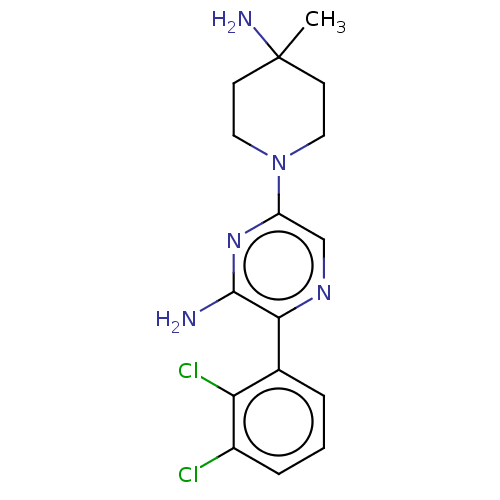 US10093646, Compound 1 US12281118, Example SHP099 US10301278, Example 00003 US11702392, Compound SHP-099 US10336774, Example 01 US11401259, Compound 1 US12053470, Compound 1 US10774065, Example 00003 BDBM38019 US20240270753, Compound SHP099 US10858359, SHP099 US20230348467, Compound SHP-099
- Phosphatase Activity Inhibition Assay (Determination of IC50) (a) The positive control SHP099 was prepared according to the reported literature (J Med Chem 2016, 59 (17), 7773-82); and the positive control TNO155 was prepared according to the reported literature.(b) 6,8-difluoro-4-methylumbelliferyl phosphate (DiFMUP) was used as the reaction substrate, and a solution of full-length SHP2 (Metl-Arg 593) (diluted to 0.5 nM in the reaction solution) and the peptide H2N-LN(PY)IDLDLV(dPEG8)LST(pY)ASINFQK-amide were incubated together in the reaction solution (60 mM 3,3-4-(2-hydroxyethyl)-1-piperazinethanesulfonic acid (HEPES), pH=7.2, 75 mM NaCl, 75 mM KCl, 1 mM EDTA, 0.05% Tween-20, 5 mM dithiothreitol (DTT)) for 30 to 60 minutes to activate the SHP2, and DMSO (1% (V/V) or the compound (10 μM to 0.1 nM) was added to the mixture, and the incubation continued at room temperature for 20 minutes. DiFMUP (25 μM, the total volume of the reaction solution was 50 μL) was added, and the reaction started. The fluorescence intensity of the reaction solution was detected by using the Envision multifunctional microplate reader (PerkinElmer) (Excitation light 355 nm, emission light 460 nm). Three duplicate wells were set for each dose. The fluorescence value of the control well (DMSO) was set to 100%.
- Test of Inhibitory Activity Assay (1) Preparing 1×Reaction Buffer according to the BPS Biosciences' Instructions for Use of the SHP2 enzyme. (2) Preparing a compound concentration gradient: Test the test compound at 10 μM under 3× dilution for 10 concentrations, diluting to a 100% dimethyl sulfoxide solution at a 100× final concentration in a 384-well plate, and diluting the compound with Precision 4× for 10 concentrations. Transferring 250 nL of the compound at the 100× final concentration to a target plate OptiPlate-384F using a dispenser Echo 550. Adding 250 nL of dimethyl sulfoxide to a positive control and 250 nL of 1 mM SHP099 to a negative control. (3) Preparing the activation peptide solution at a 5× final concentration with the 1×Reaction Buffer, adding 5 μL of the solution to a reaction plate, respectively, and centrifuging at 1000 rpm for 1 min. (4) Preparing an enzyme solution at a 2.5× final concentration with the 1×Reaction Buffer, adding 10 μL of the solution to the reaction plate, respectively, centrifuging at 1000 rpm for 1 min, and incubating at room temperature for 60 min. (5) Preparing a substrate peptide solution at a 2.5× final concentration with the 1×Reaction Buffer, centrifuging at 1000 rpm for 1 min, and incubating at room temperature for 30 min. (6) Adding 30 μL of stop test solution to stop the reaction, centrifuging at 1000 rpm for 60 see, and mixing well by shaking. (7) Reading the conversion rate with a Caliper EZ Reader. (7) Data analysis:%Inhibition=Conversion%_max-Conversion%_sampleConversion%_max-Conversion%_min×100Wherein: Conversion %/_sample is the reading of a conversion rate of a sample; Conversion %_min: mean of negative control wells, which represents the reading of a conversion rate in absence of enzyme activity wells; Conversion %_max: mean of a ratio of positive control wells, which represents the reading of a conversion rate in absence of compound inhibition wells.