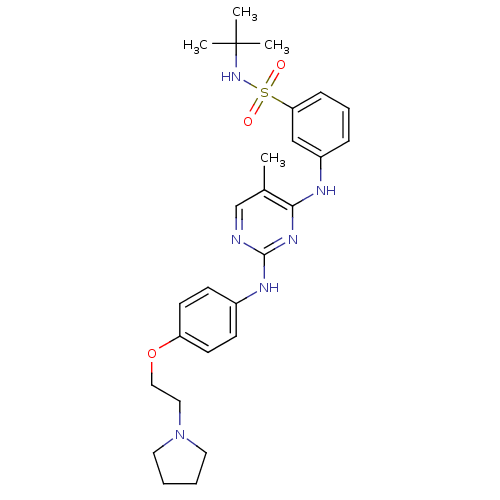
 US11384069, Example T-5 CHEMBL1287853 N-tert-butyl-3-(5-methyl-2-(4-(2-(pyrrolidin-1-yl)ethoxy)phenylamino)pyrimidin-4-ylamino)benzenesulfonamide US10730860, TABLE 1.3 BDBM50332294 US20240140952, Compound Fedratinib US20250257069, Compound Fedratinib US11203595, TABLE 1.3 US10766894, Compound TABLE 1.3 US10112907, Example 00018
- Davis, RR; Li, B; Yun, SY; Chan, A; Nareddy, P; Gunawan, S; Ayaz, M; Lawrence, HR; Reuther, GW; Lawrence, NJ; Schönbrunn, E Structural Insights into JAK2 Inhibition by Ruxolitinib, Fedratinib, and Derivatives Thereof. J Med Chem 64: 2228-2241 (2021)
- Zhao, C; Zhang, Y; Zhang, J; Li, S; Liu, M; Geng, Y; Liu, F; Chai, Q; Meng, H; Li, M; Li, J; Zheng, Y; Zhang, Y Discovery of Novel Fedratinib-Based HDAC/JAK/BRD4 Triple Inhibitors with Remarkable Antitumor Activity against Triple Negative Breast Cancer. J Med Chem 66: 14150-14174 (2023)
- Qiu, Q; Chi, F; Zhou, D; Xie, Z; Liu, Y; Wu, H; Yin, Z; Shi, W; Qian, H Exploration of Janus Kinase (JAK) and Histone Deacetylase (HDAC) Bispecific Inhibitors Based on the Moiety of Fedratinib for Treatment of Both Hematologic Malignancies and Solid Cancers. J Med Chem 66: 5753-5773 (2023)
- In Vitro Kinase Assays Biological activities of the MMT3-72 and its active metabolite MMT3-72-M2 were evaluated against JAK1, JAK2, JAK3 and TYK2 using kinase assays (FIG. 3 , Table 1). The compound MMT3-72 showed modest inhibitory activities against JAK1 and JAK2 (199.3 nM and 448.3 nM, respectively) and poor inhibitory activities against JAK3 and TYK2 (6821 nM and 2976 nM, respectively). However, the active metabolite MMT3-72-M2 showed strong inhibitory activities against JAK1 (2.0 nM), JAK2 (16.3 nM), and TYK2 (55.2 nM), but only weak inhibitory activities against JAK3 (701.3 nM). In comparison, fedratinib strongly inhibited JAK1 (10.1 nM) and JAK2 (15.6 nM), but poorly inhibited JAK3 and TYK2. The inhibitory profiles of JAK1, 2, and TYK2 of MMT3-72-M2 may have advantages to treat UC since JAK2/TYK2/IL-12/IL-23 signaling is strongly implicated in UC, while JAK1 isoform has long been identified as potential target in treating IBD as seen in Upadacitinib. In addition, MMT3-72-M2 showed poor inhibitory activities against JAK3 that may also be preferred in treating UC to reduce the unwanted adverse effects. Tofacitinib inhibited JAK3 with an IC50 of 1.6 nM and showed serious adverse effects. JAK3 inhibition has been shown to potentially lead to lymphopenia and thus hypothetically to an increased risk of infection.