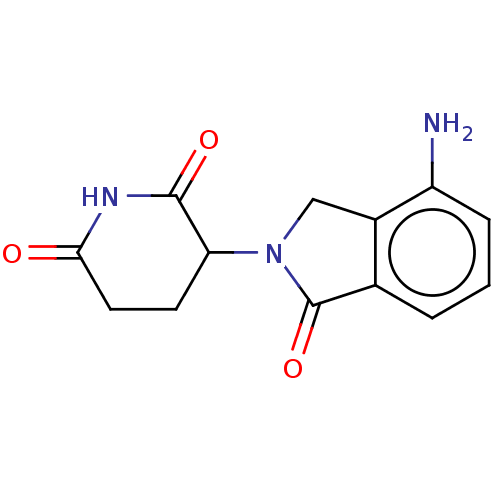
 BDBM65454 CC-5013 US11530219, Compound Lenalidomide Lenalidomide US9694015, 6.1 US20250129088, Compound Lenalidomide US20250215012, Example Lenalidomide US20250243210, Compound Lena-NH2 191732-72-6 Revimid Revlimid
- Lopez-Girona, A; Mendy, D; Ito, T; Miller, K; Gandhi, AK; Kang, J; Karasawa, S; Carmel, G; Jackson, P; Abbasian, M; Mahmoudi, A; Cathers, B; Rychak, E; Gaidarova, S; Chen, R; Schafer, PH; Handa, H; Daniel, TO; Evans, JF; Chopra, R Cereblon is a direct protein target for immunomodulatory and antiproliferative activities of lenalidomide and pomalidomide. Leukemia 26: 2326-35 (2012)
- Zhang, F; Wu, Z; Chen, P; Zhang, J; Wang, T; Zhou, J; Zhang, H Discovery of a new class of PROTAC BRD4 degraders based on a dihydroquinazolinone derivative and lenalidomide/pomalidomide. Bioorg Med Chem 28: (2020)
- ChEMBL_1985380 (CHEMBL4618786) Binding affinity to CBRN (unknown origin) incubated for 60 mins by lenalidomide displacement assay
- ChEMBL_2364122 Displacement of BODIPY-lenalidomide from human N-terminal NanoLuc-fused CRBN expressed in HEK293T cells incubated for 2 hrs by NanoBRET assay
- ChEMBL_1823469 (CHEMBL4323233) Binding affinity to cereblon in human MDA-MB-468 cells assessed as reduction in cell growth inhibition measured after 4 days in presence of 10 uM lenalidomide
- ChEMBL_1823470 (CHEMBL4323234) Binding affinity to cereblon in human MDA-MB-468 cells assessed as reduction in cell growth inhibition measured after 4 days in presence of 30 uM lenalidomide
- ChEMBL_1823471 (CHEMBL4323235) Binding affinity to cereblon in human MDA-MB-468 cells assessed as reduction in cell growth inhibition measured after 4 days in presence of 100 uM lenalidomide
- ChEMBL_1823466 (CHEMBL4323230) Binding affinity to cereblon in human MDA-MB-231 cells assessed as reduction in cell growth inhibition measured after 4 days in presence of 10 uM of lenalidomide
- ChEMBL_1823467 (CHEMBL4323231) Binding affinity to cereblon in human MDA-MB-231 cells assessed as reduction in cell growth inhibition measured after 4 days in presence of 30 uM of lenalidomide
- ChEMBL_1823468 (CHEMBL4323232) Binding affinity to cereblon in human MDA-MB-231 cells assessed as reduction in cell growth inhibition measured after 4 days in presence of 100 uM of lenalidomide
- ChEMBL_1823460 (CHEMBL4323224) Binding affinity to cereblon in human RV4:11 cells expressing wild type p53 assessed as reduction in cell growth inhibition measured after 4 days in presence of 10 uM lenalidomide
- ChEMBL_1823461 (CHEMBL4323225) Binding affinity to cereblon in human RV4:11 cells expressing wild type p53 assessed as reduction in cell growth inhibition measured after 4 days in presence of 30 uM lenalidomide
- ChEMBL_1823462 (CHEMBL4323226) Binding affinity to cereblon in human RV4:11 cells expressing wild type p53 assessed as reduction in cell growth inhibition measured after 4 days in presence of 100 uM lenalidomide
- ChEMBL_1823463 (CHEMBL4323227) Binding affinity to cereblon in human RV4:11/IRMI-2 cells harboring p53 hotspot mutation Y236H/R249G assessed as reduction in cell growth inhibition measured after 4 days in presence of 10 uM lenalidomide
- ChEMBL_1823464 (CHEMBL4323228) Binding affinity to cereblon in human RV4:11/IRMI-2 cells harboring p53 hotspot mutation Y236H/R249G assessed as reduction in cell growth inhibition measured after 4 days in presence of 30 uM lenalidomide
- ChEMBL_1823465 (CHEMBL4323229) Binding affinity to cereblon in human RV4:11/IRMI-2 cells harboring p53 hotspot mutation Y236H/R249G assessed as reduction in cell growth inhibition measured after 4 days in presence of 100 uM lenalidomide
- Lenalidomide Assay Compounds in Atto565-Lenalidomide displacement assay were dispensed in a 384-well microplate (Corning, 4514) using D300e Digital Dispenser (HP) normalized to 1% DMSO into 10 nM Atto565-Leanlidomide, 100 nM DDB1deltaB-CRBN, 50 mM Tris pH 7.5, 200 mM NaCl, 0.1% Pluronic F-68 solution (Sigma). Compound titrations were incubated for 60 min at RT. The change in fluorescence polarization was monitored using a PHERAstar FS microplate reader (BMG Labtech) for 1 h in 120 s cycles. Data from three independent replicates (n=3) was used to estimate IC50 values using variable slope equation in GraphPad Prism 7. Compounds 9, 10, and 11 are potent binders of CRBN with IC50 comparable to FDA approved lenalidomide, while being inactive in degradation of IKZF1
- Determination of CRBN-Binding Affinity of Compounds 1. According to the instructions of the CEREBLON BINDING kits, the compounds to be tested of the present invention and lenalidomide were serially diluted using diluent #9 (1×) solution to obtain a final concentration of 2 M for both the tested compounds and lenalidomide solution.2. 2.5 μL of the above 2 M of the tested compounds and lenalidomide solution, as well as the same volume of diluent #9 (1×) solution were taken and added to each well of a 96-well plate, respectively. Then, 2.5 μL of (human Cereblon WT GST-tagged protein) solution was added to each well. Finally, 5 μL of the uniformly mixed thalidomide-Red reagent and GST Eu antibody working solution were added to each of the above wells. The final concentration of the tested compounds and lenalidomide in each well is 0.5 μM.3. The blank control wells were sequentially added with 2.5 μL of diluent #9 (1×) solution, 2.5 μL of ligand binding buffer, and 5 μL of uniformly mixed thalidomide-Red reagent and GST Eu antibody working solution.4. After sealing and incubating the solutions in the above wells at room temperature for 3 hours, the absorbance values at emission wavelengths of 620 nm and 665 nm were detected by the HTRF method using a Spark microplate reader (V3.1 SP1).
- Determination of CRBN-Binding Affinity of Compounds 1. According to the instructions of the CEREBLON BINDING kits, the compounds to be tested of the present invention and lenalidomide were serially diluted using diluent #9 (1×) solution to obtain a final concentration of 2 μM for both the tested compounds and lenalidomide solution.2.2.5 μL of the above 2 μM of the tested compounds and lenalidomide solution, as well as the same volume of diluent #9 (1×) solution (solvent control group, Std0) were taken and added to each well of a 96-well plate, respectively. Then, 2.5 μL of (human Cereblon WT GST-tagged protein) solution was added to each well. Finally, 5 μL of the uniformly mixed thalidomide-Red reagent and GST Eu antibody working solution were added to each of the above wells. The final concentration of the tested compounds and lenalidomide in each well is 0.5 μM.3. The blank control wells were sequentially added with 2.5 μL of diluent #9 (1×) solution, 2.5 μL of PROTAC binding buffer, and 5 μL of uniformly mixed thalidomide-Red reagent and GST Eu antibody working solution.4. After sealing and incubating the solutions in the above wells at room temperature for 3 hours, the absorbance values at emission wavelengths of 620 nm and 665 nm were detected by the HTRF method using a Spark microplate reader (V3.1 SP1).
- CRBN Affinity Test CRBN affinity experiments were performed to evaluate the binding affinity of AST-DT-135, AST-DT-218, and AST-DT-220 to CRBN proteins. First, CRBN proteins were expressed in E. coli and purified, and then the purified CRBN proteins were dissolved in a buffer solution (PBS). AST-DT-135, AST-DT-218, AST-DT-220, and lenalidomide hydrate were each dissolved in a solvent, and the CRBN proteins were dispensed into a 96-well plate, and then the CRBN proteins and AST-DT-135, AST-DT-218, AST-DT-220, and a lenalidomide hydrate were each mixed and reacted. After the mixture was sufficiently mixed and reacted, the binding strength at each concentration was measured to collect data, and a binding curve was created therefrom, and the KD (equilibrium dissociation constant) values were derived therefrom.
- Fluorescence thermal melt assay Thermal stabilities of CRBN-DDB1 in the presence or absence of phthalimide, thalidomide, lenalidomide and pomalidomide were done in the presence of Sypro Orange in a microplate format according to Pantoliano et al. Two ug of protein in 20 ul of assay buffer (25mM Tris HCl, pH 8.0, 150mM NaCl, 2 uM Sypro Orange) were subjected to stepwise increase of temperature from 20 to 70 °C and the fluorescence was read at every 1 °C on an ABIPrism 7900HT (Applied Biosystems, Carlsbad, CA, USA). Compounds were dissolved in DMSO (1% final in assay) and tested in quadruplicate at a concentration range between 30 nM to 1000 uM; controls contained 1% DMSO only.
- Crbn Fluorescence Polarization Assay In this competitive fluorescent polarization assay Cy5 conjugated lenalidomide analog (Cy5—O-Len)1 was used as a fluorescent probe. 6XHis-CRBN-DDB1 protein (200 nM) and Cy5—O-Len probe (30 nM) were combined in 20 mM HEPES pH 7, 150 mM NaCl, 0.005% Tween-20 assay buffer. 20 μL of this assay cocktail was dispensed into wells of Corning 3821 black 384-well plates. Compounds were transferred to the assay plate from a dose-response plate using a Pintool on a Biomek FXP Laboratory Automation Workstation (Beckman Coulter). The plates were incubated in the dark for 1 hour at room temperature and then read on an Envision plate reader (PerkinElmer, Massachusetts, USA). IC50 values were determined using a proprietary software RISE (Robust Investigation of Screening Experiments), developed in house on the Pipeline Pilot platform (Biovia, v. 17.2.0). Data represent the mean of three independent determinations.
- CRBN Fluorescence Polarization Assay In this competitive fluorescent polarization assay Cy5 conjugated lenalidomide analog (Cy5-O-Len)13 was used as a fluorescent probe. 6×His-CRBN-DDB1 protein (200 nM) and Cy5-O-Len probe (30 nM) were combined in 20 mM HEPES pH 7, 150 mM NaCl, 0.005% Tween-20 assay buffer. 20 μL of this assay cocktail was dispensed into wells of Corning 3821 black 384-well plates. Compounds were transferred to the assay plate from a dose-response plate using a Pintool on a Biomek FXP Laboratory Automation Workstation (Beckman Coulter). The plates were incubated in the dark for 1 hour at room temperature and then read on an Envision plate reader (PerkinElmer, Massachusetts, USA). IC50 values were determined using a proprietary software RISE (Robust Investigation of Screening Experiments), developed in house on the Pipeline Pilot platform (Biovia, v. 17.2.0). Data represent the mean of three independent determinations.
- Binding Activity of the Compounds Disclosed by the Invention to E3 Ubiquitin Ligase CRBN The detection is based on homogeneous time-resolved fluorescence (HTRF) technology. When the donor and the acceptor are close, the donor can transfer energy to the acceptor, exciting it to emit light at 665 nm.The donor used in this kit was Europium-labeled GST antibody (GST Eu Cryptate Antibody), and the acceptor was thalidomide labeled with XL665 (Thalidomide-Red reagent). The donor binded to the CRBN protein containing the GST tag. The disclosed compounds in the present, along with lenalidomide and pomalidomide, competitively binded to the CRBN protein with thalidomide. The binding activity of the compounds was determined based on the fluorescence value emitted at 665 nm. The stronger the binding affinity of the compounds, the weaker the signal.The donor and acceptor were diluted 50 times using the binding buffer from the kit (PROTAC binding buffer 1). The CRBN protein was diluted 45 times. The disclosed compound solution at 8 mM was diluted 10 times with the diluent from the kit (1× diluent), followed by a five-fold gradient dilution, performed 7 times sequentially.5 μl of compound, 5 μl of diluted CRBN protein and 10 μl of donor-receptor mixture in equal volume were sequentially added to wells of a white 384-well plate (PE, Part number: 6008280). Incubate at room temperature for 3 hours.The ratio of the emission signals from the acceptor and donor in each individual well is calculated.
- Homogenous Time-Resolved Fluorescence (HTRF) Assay A one pot detection solution of CRBN-DDB1 (2.5 nM), Anti-His Terbium Cryptate Gold (1×, PerkinElmer Cat. #: 61HI2TLB), and Cy5-Thalidomide (100 nM, Tenova Cat.: T52461) was prepared in 20 mM HEPES, 20 mM NaCl, 0.2 mM TCEP, 0.2 mM EDTA, and 0.005% Tween20 was dispensed to each assay plate. Compounds were stored in dry, ambient temperatures at 10 mM. An 11-point, 1:3 dilution series was prepared from 10 mM stock concentrations in Echo-compatible LDV plates. 10 nL of each compound dilution series was dispensed into assays wells using an Echo 650 (Labcyte Inc. USA). 20 nL of 10 mM Lenalidomide was transferred into the active-control wells for the assay and 20 nL of DMSO was transferred into the neutral-control wells. The assay was then allowed to incubate for 30 min at ambient temperature after transferring compound. Plate measurements were taken on a Pherastar FSX (BMG Labtech, Germany) using the HTRF Red filter (Ex. 337 nm, em1: 620 nm, em2: 665 nm) (Flashes: 50, Integration time: 60-400 us, Z-height: 10 mm, Ratio-multiplier: 10,000). The HTRF signal was then subsequently normalized to the neutral and active controls. Analysis and EC50 values were derived using KNIME analytics (KNIME Zurich) transformation and fitting within Collaborative Drug Discovery (Collaborative Drug Discovery USA). Ki was derived from the geometric mean of the EC50 values using the Cheng-Prustoff transformation.