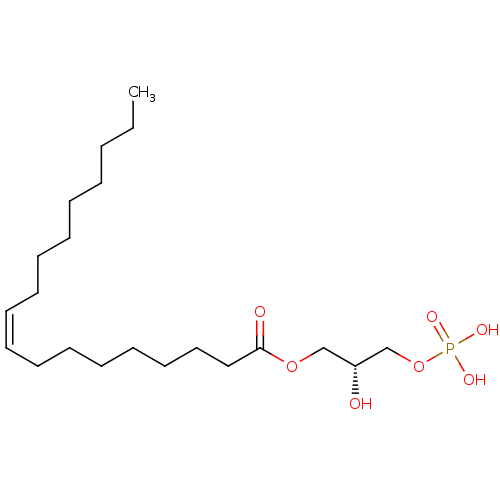
 (R)-Octadec-9-enoic acid 2-hydroxy-3-phosphonooxy-propyl ester lysophosphatidic acid BDBM50148348 1-oleoyl lysophosphatidic acid CHEMBL117021
- Buffham, W; Canning, H; Davenport, R; Farnaby, W; Mack, S; Parmar, A; Wright, S Amide derivatives as lysophosphatidic acid receptor antagonists US Patent US10100018 (2018)
- Ma, T; Wu, L; Zhang, X Lysophosphatidic acid receptor 1 (LPAR1) inhibitor compounds US Patent US11365185 (2022)
- Xu, Y; Aoki, J; Shimizu, K; Umezu-Goto, M; Hama, K; Takanezawa, Y; Yu, S; Mills, GB; Arai, H; Qian, L; Prestwich, GD Structure-activity relationships of fluorinated lysophosphatidic acid analogues. J Med Chem 48: 3319-27 (2005)
- Cheng, PTW; Kaltenbach, RF; Zhang, H; Shi, J; Tao, S; Li, J; Kennedy, LJ; Walker, SJ; Shi, Y; Wang, Y; Dhanusu, S; Reddigunta, R; Kumaravel, S; Jusuf, S; Smith, D; Krishnananthan, S; Li, J; Wang, T; Heiry, R; Sum, CS; Kalinowski, SS; Hung, CP; Chu, CH; Azzara, AV; Ziegler, M; Burns, L; Zinker, BA; Boehm, S; Taylor, J; Sapuppo, J; Mosure, K; Everlof, G; Guarino, V; Zhang, L; Yang, Y; Ruan, Q; Xu, C; Apedo, A; Traeger, SC; Cvijic, ME; Lentz, KA; Tirucherai, G; Sivaraman, L; Robl, J; Ellsworth, BA; Rosen, G; Gordon, DA; Soars, MG; Gill, M; Murphy, BJ Discovery of an Oxycyclohexyl Acid Lysophosphatidic Acid Receptor 1 (LPA J Med Chem 64: 15549-15581 (2021)
- Abdel-Magid, AF Lysophosphatidic Acid Receptor 1 Antagonists for the Treatment of Fibrosis. ACS Med Chem Lett 10: 1378-1379 (2019)
- Meduri, B; Pujar, GV; Durai Ananda Kumar, T; Akshatha, HS; Sethu, AK; Singh, M; Kanagarla, A; Mathew, B Lysophosphatidic acid (LPA) receptor modulators: Structural features and recent development. Eur J Med Chem 222: (2021)
- Khiar-Fernández, N; Zian, D; Vázquez-Villa, H; Martínez, RF; Escobar-Peña, A; Foronda-Sainz, R; Ray, M; Puigdomenech-Poch, M; Cincilla, G; Sánchez-Martínez, M; Kihara, Y; Chun, J; López-Vales, R; López-Rodríguez, ML; Ortega-Gutiérrez, S Novel Antagonist of the Type 2 Lysophosphatidic Acid Receptor (LPA J Med Chem 65: 10956-10974 (2022)
- González-Gil, I; Zian, D; Vázquez-Villa, H; Hernández-Torres, G; Martínez, RF; Khiar-Fernández, N; Rivera, R; Kihara, Y; Devesa, I; Mathivanan, S; Del Valle, CR; Zambrana-Infantes, E; Puigdomenech, M; Cincilla, G; Sanchez-Martinez, M; Rodríguez de Fonseca, F; Ferrer-Montiel, AV; Chun, J; López-Vales, R; López-Rodríguez, ML; Ortega-Gutiérrez, S A Novel Agonist of the Type 1 Lysophosphatidic Acid Receptor (LPA J Med Chem 63: 2372-2390 (2020)
- Di Giorgio, P; Hert, J; Hunziker, D; Kuehne, H; Mattei, P; Rudolph, M Bicyclic compounds as autotaxin (ATX) and lysophosphatidic acid (LPA) production inhibitors US Patent US10654857 (2020)
- Yamamoto, T; Fujita, K; Asari, S; Chiba, A; Kataba, Y; Ohsumi, K; Ohmuta, N; Iida, Y; Ijichi, C; Iwayama, S; Fukuchi, N; Shoji, M Synthesis and evaluation of isoxazole derivatives as lysophosphatidic acid (LPA) antagonists. Bioorg Med Chem Lett 17: 3736-40 (2007)
- Hunziker, D; Hert, J; Kuehne, H; Mattei, P; Rudolph, M Condensed [1,4] diazepine compounds as autotaxin (ATX) and lysophosphatidic acid (LPA) production inhibitors US Patent US10669285 (2020)
- Hong, F; Hollenback, D; Singer, JW; Klein, P Diamino-C,N-diarylpyridine positional isomers as inhibitors of lysophosphatidic acid acyltransferase-beta. Bioorg Med Chem Lett 15: 4703-7 (2005)
- Gududuru, V; Zeng, K; Tsukahara, R; Makarova, N; Fujiwara, Y; Pigg, KR; Baker, DL; Tigyi, G; Miller, DD Identification of Darmstoff analogs as selective agonists and antagonists of lysophosphatidic acid receptors. Bioorg Med Chem Lett 16: 451-6 (2005)
- Kawamoto, Y; Seo, R; Murai, N; Hiyama, H; Oka, H Identification of potent lysophosphatidic acid receptor 5 (LPA5) antagonists as potential analgesic agents. Bioorg Med Chem 26: 257-265 (2018)
- Santos, WL; Heasley, BH; Jarosz, R; Carter, KM; Lynch, KR; Macdonald, TL Synthesis and biological evaluation of phosphonic and thiophosphoric acid derivatives of lysophosphatidic acid. Bioorg Med Chem Lett 14: 3473-6 (2004)
- Jiang, G; Inoue, A; Aoki, J; Prestwich, GD Phosphorothioate analogs of sn-2 radyl lysophosphatidic acid (LPA): metabolically stabilized LPA receptor agonists. Bioorg Med Chem Lett 23: 1865-9 (2013)
- Xu, Y; Jiang, G; Tsukahara, R; Fujiwara, Y; Tigyi, G; Prestwich, GD Phosphonothioate and fluoromethylene phosphonate analogues of cyclic phosphatidic acid: Novel antagonists of lysophosphatidic acid receptors. J Med Chem 49: 5309-15 (2006)
- Durgam, GG; Tsukahara, R; Makarova, N; Walker, MD; Fujiwara, Y; Pigg, KR; Baker, DL; Sardar, VM; Parrill, AL; Tigyi, G; Miller, DD Synthesis and pharmacological evaluation of second-generation phosphatidic acid derivatives as lysophosphatidic acid receptor ligands. Bioorg Med Chem Lett 16: 633-40 (2005)
- Gong, B; Hong, F; Kohm, C; Bonham, L; Klein, P Synthesis and SAR of 2-arylbenzoxazoles, benzothiazoles and benzimidazoles as inhibitors of lysophosphatidic acid acyltransferase-beta. Bioorg Med Chem Lett 14: 1455-9 (2004)
- Terakado, M; Suzuki, H; Hashimura, K; Tanaka, M; Ueda, H; Kohno, H; Fujimoto, T; Saga, H; Nakade, S; Habashita, H; Takaoka, Y; Seko, T Discovery of ONO-7300243 from a Novel Class of Lysophosphatidic Acid Receptor 1 Antagonists: From Hit to Lead. ACS Med Chem Lett 7: 913-918 (2016)
- Heasley, BH; Jarosz, R; Lynch, KR; Macdonald, TL Initial structure-activity relationships of lysophosphatidic acid receptor antagonists: discovery of a high-affinity LPA1/LPA3 receptor antagonist. Bioorg Med Chem Lett 14: 2735-40 (2004)
- Gong, B; Hong, F; Kohm, C; Jenkins, S; Tulinsky, J; Bhatt, R; De Vries, P; Singer, JW; Klein, P Synthesis, SAR, and antitumor properties of diamino-C,N-diarylpyrimidine positional isomers: inhibitors of lysophosphatidic acid acyltransferase-beta. Bioorg Med Chem Lett 14: 2303-8 (2004)
- Qian, Y; Hamilton, M; Sidduri, A; Gabriel, S; Ren, Y; Peng, R; Kondru, R; Narayanan, A; Truitt, T; Hamid, R; Chen, Y; Zhang, L; Fretland, AJ; Sanchez, RA; Chang, KC; Lucas, M; Schoenfeld, RC; Laine, D; Fuentes, ME; Stevenson, CS; Budd, DC Discovery of highly selective and orally active lysophosphatidic acid receptor-1 antagonists with potent activity on human lung fibroblasts. J Med Chem 55: 7920-39 (2012)
- Heasley, BH; Jarosz, R; Carter, KM; Van, SJ; Lynch, KR; Macdonald, TL A novel series of 2-pyridyl-containing compounds as lysophosphatidic acid receptor antagonists: development of a nonhydrolyzable LPA3 receptor-selective antagonist. Bioorg Med Chem Lett 14: 4069-74 (2004)
- Durgam, GG; Virag, T; Walker, MD; Tsukahara, R; Yasuda, S; Liliom, K; van Meeteren, LA; Moolenaar, WH; Wilke, N; Siess, W; Tigyi, G; Miller, DD Synthesis, structure-activity relationships, and biological evaluation of fatty alcohol phosphates as lysophosphatidic acid receptor ligands, activators of PPARgamma, and inhibitors of autotaxin. J Med Chem 48: 4919-30 (2005)
- ChEMBL_302402 (CHEMBL829647) Binding affinity towards Lysophosphatidic acid 1 (LPA1) receptor
- ChEMBL_304755 (CHEMBL829353) Binding affinity towards Lysophosphatidic acid 3 (LPA3) receptor
- ChEMBL_304965 (CHEMBL827843) Inhibitory concentration against Lysophosphatidic acid 1 (LPA1) receptor
- ChEBML_100168 Inhibitory activity against Lysophosphatidic acid acyltransferase-beta expressed in Sf9 insect cell membranes
- ChEMBL_303184 (CHEMBL829678) Binding affinity for Lysophosphatidic acid receptor 2 expressed in RH7777 rat hepatoma cells
- ChEMBL_303205 (CHEMBL829831) Binding affinity for Lysophosphatidic acid receptor 1 expressed in RH7777 rat hepatoma cells
- ChEMBL_303206 (CHEMBL829832) Binding affinity for Lysophosphatidic acid receptor 3 expressed in RH7777 rat hepatoma cells
- ChEBML_100169 Inhibitory concentration against human lysophosphatidic acid acyltransferase-beta (LPAAT-beta) expressed in Sf9 insect cell membranes
- ChEMBL_321473 (CHEMBL880414) Inhibitory activity against Lysophosphatidic acid acyltransferase-beta enzyme over-expressed in Sf9 insect cell membrane
- ChEBML_100173 Agonistic activity against lysophosphatidic acid receptor 1 using [35S]GTP-gamma-S as radioligand tested in vitro
- ChEBML_100176 Agonistic activity against lysophosphatidic acid receptor 2 using [35S]GTP-gamma-S as radioligand tested in vitro
- ChEBML_100180 Agonistic activity against lysophosphatidic acid receptor 3 using [35S]GTP-gamma-S as radioligand tested in vitro
- ChEMBL_100172 (CHEMBL707057) Agonistic activity against lysophosphatidic acid receptor 1 receptor using [35S]GTP-gamma-S as radioligand tested in vitro
- ChEBML_100179 In vitro antagonism of LPA-evoked [35S]GTP-gamma-S binding to lysophosphatidic acid receptor 3 in HEK293T cell lines
- ChEBML_100171 In vitro ability to antagonize LPA-evoked [35S]GTP-gamma-S binding to lysophosphatidic acid receptor 1 in HEK293T cell lines
- ChEMBL_455638 (CHEMBL903636) Antagonist activity at LPA1 receptor in rat hepatic stellate cells assessed as inhibition of lysophosphatidic acid-induced intracellular calcium influx
- ChEMBL_100170 (CHEMBL707055) In vitro ability to antagonize LPA-evoked [35S]GTP-gamma-S binding to lysophosphatidic acid receptor 1 in HEK293T cell lines
- ChEMBL_100171 (CHEMBL707056) In vitro ability to antagonize LPA-evoked [35S]GTP-gamma-S binding to lysophosphatidic acid receptor 1 in HEK293T cell lines
- ChEMBL_455637 (CHEMBL903635) Antagonist activity at human recombinant LPA1 receptor expressed in CHOK1 cells assessed as inhibition of lysophosphatidic acid-induced intracellular calcium influx
- ChEMBL_1452484 (CHEMBL3362833) Antagonist activity at human LPA1R expressed in Chem-1 cells assessed as inhibition of lysophosphatidic acid-induced calcium mobilization by FLIPR assay
- ChEBML_1690006 Inhibition of ATX in rat plasma assessed as reduction in plasma lysophosphatidic acid 18:2 levels after 2 hrs by LC-MS/MS method
- FS-3 Assay Autotaxin Inhibitor Screening Kits are available from Echelon Biosciences, Logan, Utah, USA [http://echelon-inc.com/, accessed 6 Oct. 2011]. Using the methods of Gierse et al [A novel autotaxin inhibitor reduces lysophosphatidic acid levels in plasma and the site of inflammation, Journal of Pharmacology and Experimental Therapeutics, vol 334(1), 310-317 (2010). The FS-3 assay to identify ATX inhibitors was preformed as follows: 3 ul of standard inhibitor (referred to as PF-8380 in Gierse et al above) and test compounds were added to an assay plate. To each assay well, containing test compounds or standard, 24 ul of human Autotaxin enzyme (2 nM) was added. The assay plate was then centrifuged at 1000 rpm for 1 minute and allowed to incubate at 37° C. for 30 minutes. Following the incubation period each plate was read in a fluorescence plate reader (Spectra Max M5: excitation: 494 nm and emission: 520 nm) and IC50 values were derived from inhibition of FS-3 fluorescence (as described above).
- Receptor Assay Engagement of the LPA5 receptor by its ligand, oleoyl-L- ±-lysophosphatidic acid (LPA), leads to the release of intracellular stores of calcium into the cytoplasm mediated through a Gq-driven increase in inositol triphosphate (IP3) levels. Gq is a heterotrimeric G protein subunit that activates phospholipase C.The ability of test compounds to prevent LPA-driven intracellular release of stored calcium from RH7777 cells expressing human LPA5 receptors was assayed by stimulating the cells with LPA in the presence of various test compounds to measure the test compounds' antagonism, i.e. activity in vitro. Approximately 10,000 cells in normal culture medium (Minimal Essential Media, 10% Foetal Calf Serum) were dispensed per assay well in a black clear bottom poly-D-lysine coated 384 well plate (Corning). Cells were allowed to settle for thirty minutes at room temperature before being incubated overnight at 37° C., 5% CO2. Sixteen to twenty hours after dispensing, the cells were loaded with a calcium-sensitive fluorescent dye by replacing the culture medium with assay buffer (1x Hanks buffered saline, 25 mM HEPES, 0.1% w/v fatty acid free BSA (bovine serum albumin), pH7.4) containing 1.25 mM probenecid and 1x Calcium 5 Reagent (Molecular Devices). Cells were incubated at 37° C. for one hour to allow for dye uptake.
- Receptor Assay Engagement of the LPA1 receptor by its ligand, oleoyl-L- ±-lysophosphatidic acid (LPA), leads to the release of intracellular stores of calcium into the cytoplasm mediated through a Gq-driven increase in inositol triphosphate (IP3) levels. Gq is a heterotrimeric G protein subunit that activates phospholipase C. The ability of test compounds to prevent LPA-driven intracellular release of stored calcium from RH7777 cells expressing human LPA1 receptors was assayed by stimulating the cells with LPA in the presence of various test compounds to measure the test compounds' antagonism, i.e. activity in vitro. Approximately 10,000 cells in normal culture medium (Dulbecco's Modified Eagle Media, 10% Foetal Calf Serum) were dispensed per assay well in a black clear bottom collagen coated 384 well plate (Beckton Dickinson). Cells were allowed to settle for thirty minutes at room temperature before being incubated overnight at 37° C., 5% CO2. Sixteen to twenty hours after dispensing, the cells were loaded with a calcium-sensitive fluorescent dye by replacing the culture medium with assay buffer (1x Hanks buffered saline, 25 mM HEPES, 0.1% w/v fatty acid free BSA (bovine serum albumin), pH7.4) containing 1.25 mM probenecid and 1x Calcium 5 Reagent (Molecular Devices). Cells were incubated at 37° C. for one hour to allow for dye uptake.
- In Vitro LPA1 Receptor Assay Engagement of the LPA1 receptor by its ligand, oleoyl-L-α-lysophosphatidic acid (LPA), leads to the release of intracellular stores of calcium into the cytoplasm mediated through a Gq-driven increase in inositol triphosphate (IP3) levels. Gq is a heterotrimeric G protein subunit that activates phospholipase C.The ability of test compounds to prevent LPA-driven intracellular release of stored calcium from RH7777 cells expressing human LPA1 receptors was assayed by stimulating the cells with LPA in the presence of various test compounds to measure the test compounds' antagonism, i.e. activity in vitro. Approximately 10,000 cells in normal culture medium (Dulbecco's Modified Eagle Media, 10% Foetal Calf Serum) were dispensed per assay well in a black clear bottom collagen coated 384 well plate (Beckton Dickinson). Cells were allowed to settle for thirty minutes at room temperature before being incubated overnight at 37° C., 5% CO2. Sixteen to twenty hours after dispensing, the cells were loaded with a calcium-sensitive fluorescent dye by replacing the culture medium with assay buffer (1× Hanks buffered saline, 25 mM HEPES, 0.1% w/v fatty acid free BSA (bovine serum albumin), pH7.4) containing 1.25 mM probenecid and 1× Calcium 5 Reagent (Molecular Devices). Cells were incubated at 37° C. for one hour to allow for dye uptake. To test for antagonist activity, test compounds at a final concentration range between 0.32 nM-10 μM (diluted in assay buffer) were added to the assay wells and allowed to incubate for twenty five minutes. After incubation with test compounds the assay plate was placed in a FLIPR Tetra system (Molecular Devices) and LPA (diluted in assay buffer) was added to give a final concentration equivalent to its determined EC80 against LPA1 receptor. Ligand-dependent changes in intracellular calcium levels were determined by measuring changes in fluorescence of the dye over 515-575 nM following excitation over 470-495 nM.
- Choline Release Assasy The purpose of this assay is to detect autotaxin inhibition using a choline release assay.Test compound (10 mM stocks in 100% DMSO) is serially diluted in 100% DMSO resulting in 10 concentrations of 100× inhibitor in half area 96 well plates (Corning 3992). Each of these 10 wells in 100% DMSO is diluted 1:33.33 in assay buffer in round bottom 96 well plates (Fisher 12565502) resulting in 3× concentrations in well containing 3% DMSO. The assay buffer is 50 mM Tris pH8.0, 5 mM KCl, 1 mM CaCl2, 1 mM MgCl2, 0.01% TRITON X-100 (Sigma T9284) and 0.01% fatty acid free bovine serum albumin (Sigma A8806). A 20 μl aliquot of each 3× test compound is then added to black flat bottom 96 well plates (Corning 3991) in singlicate. A 20 μl aliquot per well of 3× recombinant human autotaxin, (Echelon, E-4000) (full length human autotaxin with a C-terminal His tag transfected into 293E cells and purified via nickel chelate and size exclusion chromatography) is then added to every well except for the no enzyme control wells. A 20 μl aliquot per well of assay buffer is added to the no enzyme control wells. A 20 μl aliquot of a 3× cocktail containing choline oxidase (Sigma C5896), horseradish peroxidase (Sigma P8125), amplex ultrared (Invitrogen A36006) and the autotaxin substrate lysophosphatidylcholine (LPC) 16:0 (Avanti Polar Lipids 855675P) is added to each well while avoiding exposure to light. The final concentrations in the well of choline oxidase, horseradish peroxidase, amplex ultrared and LPC 16:0 are 0.4 units/ml, 4 units/ml, 40 μM and 30 μM respectively. The plate is then sealed with aluminum foil seals and incubated at 37° C. for 1 hour in a Labline Imperial III incubator. During this incubation, LPC is cleaved by autotaxin resulting in Lysophosphatidic Acid (LPA) 16:0 and choline. The choline that is released is oxidized by choline oxidase resulting in betaine and hydrogen peroxide. The hydrogen peroxide reacts with the horseradish peroxide and amplex ultrared to form the fluorescent molecule resorufin.
- ATX biochemical assay ATX (Autotaxin) is a 125 KDa glycoprotein with lysophospholipase D (LPLD) activity that generates the bioactive lipid lysophosphatidic acid (LPA) from lysophosphatidylcholine (LPC). The ATX biochemical assay utilizes a FRET (fluorescence resonance energy transfer) technology platform. The fluorescence signal of FRET substrate FS-3 is quenched due to intra-molecular FRET of a fluorophore to a non-fluorescing quencher (Ferguson, C. G., et al., Org Lett. 2006 May 11; 8(10): 2023-2026, which is incorporated by reference in its entirety). ATX catalyzes the hydrolysis of the substrate which separates the dabsyl quencher from the fluorescein reporter, which becomes fluorescent. The reaction is monitored by a SpectraMax M5 (Molecular Devices, Sunnyvale, Calif.) with at excitation wavelength 485 nm and emission wavelength 535 nm.ReagentsFatty acid free-BSA (Sigma A8806): 10 mg/mL in H2O, stored at 4° C.2×ATX assay buffer: 100 mM Tris, 280 mM NaCl, 10 mM KCl, 2 mM CaCl2, 2 mM MgCl2, pH 7.4.Human ATX protein: expressed and purified in house. Stored at −80° C.Substrate FS-3 (Echelon, L-2000): 100 μg in 77.74 μL H2O (1 mM stock), stored at −20° C.384-well flat bottom plates Corning #3575.AssayCompound dilution All compounds were provided at 10 mM in 100% DMSO. In the first well, 2 μL of 10 mM compound was added to 78 μL of DMSO (1:40 dilution). In subsequent wells 3-fold dilution (total 10 dilutions) were performed.1×ATX assay buffer was made up with a final concentration of 1 mg/mL fatty acid free-BSA using 2×ATX assay buffer, 10 mg/ml fatty acid free-BSA and ddH2O.ATX protein was diluted with 1×ATX assay buffer to a concentration of 1.32 μg/mL (1.32×). 38 μL was added per well to the assay plate. The final concentration of ATX in the reaction as 1.0 μg/mL.2 μL per well of compounds was transferred to provide the desired concentration. The plate was centrifuged, then incubated at room temperature for 30 minutes on the shaker.FS-3 was diluted with 1×ATX assay buffer to a concentration of FS-3 of 10 μM (5×). Then, 10 μL was added per well to the assay plate. The final concentration of FS-3 in the reaction was 2 μM. The plate was centrifuged. The plate was kept shaking at room temperature for 2 hours. Because FS-3 substrate is light sensitive, plates were kept covered and protected from light.Fluorescence was measured using SpectraMax M5 (excitation at 485 nm/emission at 538 nm, top read).