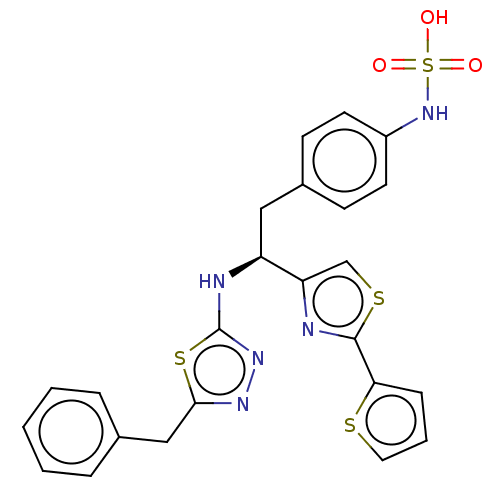
 US20240299367, No. AA98 BDBM359188 US11666558, Example AA98 US12064420, Compound AA98 US10220048, Compound AA98 US10952992, No. AA98 US11413242, Compound AA98
- ChEMBL_328617 (CHEMBL863865) Inhibitory activity against anti-CD3 mAb-induced IL2 production in human whole blood
- ChEMBL_708504 (CHEMBL1666318) Inhibition of Mab 12G5 binding to wild type CXCR4 expressed in HEK293 cells
- ChEMBL_2084624 (CHEMBL4765887) Inhibition of PI3Kdelta in human whole blood assessed as reduction in anti-FCepsilonR1 mAb-stimulated basophil activation preincubated for 60 mins followed by anti-FCepsilonR1 mAb stimulation and measured after 25 mins by flow cytometry analysis
- ChEMBL_2084637 (CHEMBL4765900) Inhibition of PI3K p110delta in human basophil assessed as reduction in anti-FCepsilonR1 mAb-stimulated basophil activation preincubated for 60 mins followed by anti-FCepsilonR1 mAb stimulation and measured after 25 mins by flow cytometry analysis
- ChEMBL_1972859 (CHEMBL4605677) Inhibition of SYK in human whole blood assessed as reduction in anti-FCepsilonR1 mAb-induced basophil activation by measuring decrease in CD63 surface expression incubated for 60 mins followed by anti-FCepsilonR1 mAb stimulation for 20 mins by flow cytometry analysis
- ChEMBL_2084641 (CHEMBL4765904) Inhibition of PI3K p110delta in human basophil assessed as reduction in anti-FCepsilonR1 mAb-induced basophil activation preincubated for 60 mins followed by anti-FCepsilonR1 mAb stimulation and measured after 25 mins in presence of 25% serum by flow cytometry analysis
- ChEMBL_2185227 (CHEMBL5097309) Displacement of mAb(D38C6)-BTN from human recombinant PKAc alpha incubated for 15 mins by microplate reader assay
- ChEMBL_2289255 Displacement of 12G5 mAb from CXCR4 (unknown origin) expressed in CHO cells incubated for 40 mins by spectrophotometric method
- ChEMBL_2380660 Displacement of 12G5 mAb from CXCR4 in human SUP-T1 cells incubated for 2 hrs by flow cytometry analysis
- ChEMBL_789883 (CHEMBL1925190) Inhibition of acid-induced matriptase activation in human 184A1N4 cells using mAb M69 by cell-based ELISA like assay
- ChEMBL_44679 (CHEMBL884098) Inhibitory activity against CX3C chemokine receptor 4-specific monoclonal antibody 12G5 (mAb-12G5) binding to human chemokinin receptor CXCR4 in lymphocytic SUP-T1 cells
- GTP-KRAS and cRAF Interaction Assay GppNp-loaded HIS-KRAS(G12D, aa 1-169) was pre-incubated with a compound in the presence of 200 uM GTP in a 384-well plate (Greiner) for 15 min, then cRAF RBD(GST tag, aa 50-132, CreativeBioMart), MAb Anti GST-d2 (Cisbio) and MAb Anti 6HIS-Tb cryptate Gold (Cisbio) were added to the assay wells (Final concentration: 2.0 nM GppNp-loaded HIS-KRAS(G12D), 100 uM GTP, 35 nM cRAF RBD, 1 ug/mL MAb Anti GST-d2, 52.5 ng/mL MAb Anti 6HIS-Tb cryptate Gold) and incubated for 2 hours at 25 C. Wells containing same percent of DMSO served as vehicle control, and wells without KRAS served as low control. HTRF signals were read on Tecan Spark multimode microplate reader and HTRF ratios were calculated under manufacturer's instructions. The percent of activation of compounds treated wells were normalized between vehicle control and low control. Then the data were analyzed using a 4-parameter logistic model to calculate IC50 values.
- ChEMBL_1364325 (CHEMBL3293719) Antagonist activity at human histamine H4 receptor expressed in gamma-irradiated recombinant CHO cells assessed as inhibition of forskolin/histamine-induced intracellular cAMP accumulation preincubated for 30 mins followed by Eu chelate-labeled cAMP/anti-cAMP mAb addition measured after 1 hr by TR-FRET immunoassay
- Aurora Kinase Inhibition Assay The compounds were tested for their ability to inhibit the phosphorylation of serine 10 of histone-H3 by purified recombinant murine Aurora-A enzyme. The phosphorylation of serine 10 was detected colorimetrically using Phospho-Histone H3 (Ser10) (6G3) Mouse mAb (9706, Cell Signaling Technologies, Danvers, MA).
- Inhibitory Effect of Compounds Disclosed Herein on ATR Enzyme The following method was used to determine the inhibitory effect of the compounds disclosed herein on ATR enzyme. The experimental method was briefly described as follows:I. Experimental Materials and Instruments1. ATR enzyme (Eurofins Pharma Discovery Services, 14-953-M)2. GST-tag P53 protein (Eurofins Pharma Discovery Services, 14-952-M)3. 384-well plate (Thermo Scientific, 267462)4. U-shaped bottom 96-well plate (Corning, 3795)5. MAb Anti-phospho p53-Eu cryptate (Cisbio, 61P08KAE)6. MAb Anti GST-d2 (Cisbio, 61GSTDLF)7. ATP solution (Promega, V916B)8. EDTA (Thermo Scientific, AM9260G)9. HEPES (Gibco, 15630-080)10. Microplate reader (BMG, PHERAsta)II. Experimental Procedures1 nM ATR enzyme, 50 nM P53 protein, 7.435 μM ATP and small molecule compounds of different concentrations (serially 3-fold diluted from 1 μM to the 11th concentration) were mixed and incubated at room temperature for 2 h. A terminating buffer (12.5 mM HEPES, 250 mM EDTA) was added. The mixture was well mixed before 0.42 ng/well of mAb anti-phospho p53-Eu cryptate and 25 ng/well of mAb anti GST-d2 were added. The mixture was incubated overnight at room temperature, and the fluorescence signals at 620 nm and 665 nm were detected using a PHERAstar system. Data were processed using GraphPad software.
- KRAS(G12C) and SOS1 Binding Assay 1× buffer preparation (ready-to-use): Hepes: 5 mM; NaCl: 150 mM; EDTA: 10 mM; Igepal: 0.0025%; KF: 100 mM; DTT: 1 mM; BSA: 005%;The test compounds were 5-fold diluted with DMSO using a multi-channel pipette to the 8th concentration, i.e., diluted from 1 mM to 0.064 μM.The test compound was diluted by gradient with 1× buffer to a working solution with 2% DMSO. 5 μL/well of the working solution was added to corresponding wells, and the corresponding concentration gradient was 20 μM to 0.00128 nM. Duplicate experiment was set. The working solution was centrifuged at 1000 rpm for 1 minute.A mixed working solution of KRAS(G12C) (200 nM) and Mab Anti GST-Eu cryptate (1 ng/μL) was prepared with 1× buffer, and the mixed working solution was incubated at 25° C. for 5 minutes, and 2.5 μL/well of the mixed working solution was added to the corresponding wells.A mixed working solution of SOS1 (80 nM) and Mab Anti 6HIS-XL665 (8 g/μL) was prepared with 1× buffer, and 2.5 μL/well of the mixed working solution was added to the corresponding wells. 2.5 μL of Mab Anti 6HIS-XL665 (8 g/μL) diluent was added to blank wells. At this time, the final concentration gradient of the compound was diluted from 10 μM to 0.64 nM, KRAS(G12C) (500 nM), MAb Anti GST-Eu cryptate (0.25 ng/μL), SOS1 (20 nM), Mab Anti 6HIS-XL665 (2 g/μL), the reaction system was placed at 25° C. for 60 minutes. After the reaction was completed, the multimode microplate reader was used to read HTRF.
- Dose Response of primary screening hit compounds for Identification of VLA-4 Allosteric Modulators University of New Mexico Assay Overview: Assay Support Project Title:HTS for Identification of VLA-4 Allosteric Modulators 1 R01 HL081062-01 PI:Larry Sklar PhD and Alex Chigaev PhD Assay Implementation: Peter Simons PhD, Susan Young MS, Yang Wu PhD, Terry Foutz, Stephanie Sedillo, Anna Waller PhD, Mark Carter MS Assay Background and Significance: We have developed a novel ligand induced binding site (LIBS) mAb assay for integrin HTS using phycoerythrin (PE) labeled HUTS-21 mAb. The novel assay is a result of an R01 (HL081062) which has taken advantage of compounds identified through an earlier project X01MH077638 (entitled "MLSCN Assay for Allosteric Regulators of the VLA-4 Integrin") that screened a portion of the MLSMR for allosteric regulators of VLA-4. This approach uses an improved assay to search for novel integrin ligands that block the binding of traditional ligands and do not in themselves induce the LIBS mAb binding site. Molecules of this type are unknown for VLA-4. A
- KRAS G12C-GDP Exchange Assay 1. Serially 4×-diluted compounds (10 concentration points in total) were separately premixed with KRAS G12C-GDP (ICE, Kras 20191018) in a reaction buffer (25 mM Hepes PH7.4, 125 mM NaCl, 5 mM MgCl2, 0.01% Tween20, and 0.1% BSA) in the reaction wells for 1 h. 2. A mixture of SOS (Pharmaron, ZZY-20190823), cRAF (Pharmaron, ZZY-20190823), GTP (Sigma, A6885-100MG), MAb Anti 6HIS-d2/MAb Anti GST-Eu (Cisbio, 61HISDLB/61GSTKLB) was added for a catalyzed reaction for 2 h.3. The fluorescence signals of the emitted light at 615 nm and 665 nm under 320 nm excitation light were read by Biotek Microplate Reader (Synergy4).4. The IC50 (median inhibitory concentration) of the compound was obtained by the following non-linear fitting formula: Y=Bottom+(Top−Bottom)/(1+10{circumflex over ( )}((Log IC50−X)*Hill Slope)), and the data were analyzed by Graphpad 6-0 software.
- SAR Confirmatory Dose Response LIBS Assay for Allosteric Ligands of the VLA-4 Integrin University of New Mexico Assay Overview: Assay Support: 1 R01 HL081062-01 Project Title: HTS for Identification of VLA-4 Allosteric Modulators (MLPCN) PI: Larry Sklar Screening Center / PI: UNM Center for Molecular Discovery / Larry Sklar Chemistry Center / PI: Vanderbilt Specialized Chemistry Center / Jeff Aube Assay Implementation: Peter Simons, Yang Wu, Susan Young, Terry Foutz, Stephanie Sedillo, Anna Waller, Annette Evangelisti, Mark Carter, Oleg Ursu, Cristian Bologa Assay Background and Significance: We have developed a novel ligand induced binding site (LIBS) mAb assay for integrin HTS using phycoerythrin (PE) labeled HUTS-21 mAb. The novel assay is a result of an R01 (HL081062) which has taken advantage of compounds identified through an earlier project X01MH077638 (entitled "MLSCN Assay for Allosteric Regulators of the VLA-4 Integrin") that screened a portion of the MLSMR for allosteric regulators of VLA-4 (AIDs 528, 529). The approach described here uses an assay
- HPK1-SLP76 TR-FRET ASSAY HPK1-Catalytic domain enzyme is preincubated for 30 minutes with varying concentrations of investigational test compounds, or DMSO reference. HPK1 activity is initiated by the addition of ATP and results in phosphorylation of a His-tagged SLP-76 protein substrate. Following a 60-minute reaction time, the reaction is quenched and FRET partners Eu-anti-His Ab and phospho-SLP-76 (Ser376) (D7S1K) XP Rabbit mAb (AF 647 Conjugate) are added to detect the phosphorylated His-tagged SLP-76 product.
- HTRF Assay PDE4B2 activity is detected using the LANCE Ultra cAMP homogeneous time resolved fluorescence resonance energy transfer (TR-FRET) assay from Perkin Elmer. The assay is based on the competition between the europium (Eu) chelate-labeled cAMP tracer and sample cAMP for binding sites on cAMP-specific monoclonal antibodies (mAb) labelled with the ULight dye. The assay is carried out in 384-well low volume plates in a volume of 10 μl. Human recombinant PDE4B2 (80 pM) is incubated for 2 h with 3 nM cAMP in buffer containing 1×HBSS, 5 mM HEPES, 3 mM MgCl2, 0.1% BSA, pH 7.4 with or without test compounds. The enzymatic reactions are efficiently stopped by the addition of 500 μM IBMX present in the combined Stop/Detection buffer containing europium (Eu) chelate-labeled cAMP tracer and cAMP-specific monoclonal antibodies (mAb) labelled with the ULight dye. Samples are then further incubated for 1 h before plates are read at ex 340 nm and em at 665 nm and 615 nm on an EnVision reader. IC50 values are determined from competition curves using a non-linear curve fitting program.
- HTRF assay PDE4B2 activity is detected using the LANCE Ultra cAMP homogeneous time resolved fluorescence resonance energy transfer (TR-FRET) assay from Perkin Elmer. The assay is based on the competition between the europium (Eu) chelate-labeled cAMP tracer and sample cAMP for binding sites on cAMP-specific monoclonal antibodies (mAb) labelled with the ULight dye. The assay is carried out in 384-well low volume plates in a volume of 10 μl. Human recombinant PDE4B2 (80 pM) is incubated for 2 h with 3 nM cAMP in buffer containing 1×HBSS, 5 mM HEPES, 3 mM MgCl2, 0.1% BSA, pH 7.4 with or without test compounds. The enzymatic reactions are efficiently stopped by the addition of 500 μM IBMX present in the combined Stop/Detection buffer containing europium (Eu) chelate-labeled cAMP tracer and cAMP-specific monoclonal antibodies (mAb) labelled with the ULight dye. Samples are then further incubated for 1 h before plates are read at ex 340 nm and em at 665 nm and 615 nm on an EnVision reader. IC50 values are determined from competition curves using a non-linear curve fitting program.
- Biochemical Assay Compounds disclosed herein were tested for blocking of human IL-17A (Cat: C774, novoprotein) protein with its receptor human IL-17RA (Cat: C153, novoprotein) in an assay based on Homogeneous Time Resolved Fluorescence. 0.4 nM recombinant human IL-17A protein was pre-incubated with a serial dilution of compounds disclosed herein (maximum concentration is 10 uM, 2.7-fold serially diluted, 10 points) at room temperature for 3 hours in an assay buffer containing 20 mM HEPES, pH 7.5, 50 mM NaCl, 0.1% BSA, 0.2 mM DTT, 0.005% Tween 20. Then 0.3 nM recombinant human IL-17RA was added to plate and further incubated at room temperature for 1 hour. After that Mab Anti-6His Tb cryptate Gold (Cat: 61HI2TLB, Cisbio Bioassays) and MAb Anti Human IgG-XL665 (Cat: 61HFCXLB, Cisbio Bioassays) were added to plate and further incubated at room temperature for 1 hour. The HTRF signals (ex337 nm, em620 nm/665 nm) were read on BMG PHERAstar FSX instrument. The inhibition percentage of human IL-17A interaction with its receptor human IL-17RA in presence of increasing concentrations of compounds was calculated based on the ratio of fluorescence at 620 nm to that at 665 nm. The IC50 for each compound was derived from fitting the data to the four-parameter logistic equation by Dotmatics.
- Biochemical Functional Assay The KRAS (aa 1-169) G12C, C51S, C80L, C118S with a His-tag was expressed, purified and loaded with GDP in house. All protein and substrate solutions were prepared in assay buffer containing 25 mM HEPES pH7.5, 10 mM MgCl2, and 0.01% Triton X-100. Purified GDP-loaded KRAS (aa 1-169) G12C, C51S, C80L, C118S protein was pre-incubated with a serially diluted compound at 24° C. for 3 hrs. Purified SOS1 (aa 564-1049) protein, GTPYS (Sigma) and GST-cRaf RBD (aa 1-149) were then added to each well and incubated at 24° C. for additional 3 hrs. This addition initiates the nucleotide exchange reaction and transition of inactive GDP loaded KRAS G12C to active GTPγS KRAS G12C which binds to GST-cRaf RBD. Following the incubation, Mab Anti-6HIS-Tb cryptate (Cisbio) and Mab Anti GST-XL665 (Cisbio) were added and further incubated at 24° C. for 3 hrs. The binding interaction between active GTPγS KRAS G12C and GST-cRaf RBD brings the Tb and XL665 into close proximity enabling an increased FRET signal (Ex337 nm, Em665 nm/620 nm). The inhibition percentage of nucleotide exchange reaction in presence of increasing concentrations of compounds was calculated based on the ratio of fluorescence at 665 nm to that at 620 nm detected on a BMG PHERAstar FSX instrument.
- Biochemical Functional Assay The KRAS (aa 1-169) G12C, C51S, C80L, C118S with a His-tag was expressed, purified and loaded with GDP in house. All protein and substrate solutions were prepared in assay buffer containing 25 mM HEPES pH7.5, 10 mM MgCl2, and 0.01% Triton X-100. Purified GDP-loaded KRAS (aa 1-169) G12C, C51S, C80L, C118S protein was pre-incubated with a serially diluted compound at 24° C. for 3 hrs. Purified SOS1 (aa 564-1049) protein, GTPyS (Sigma) and GST-cRaf RBD (aa 1-149) were then added to each well and incubated at 24° C. for additional 3 hrs. This addition initiates the nucleotide exchange reaction and transition of inactive GDP loaded KRAS G12C to active GTPyS KRAS G12C which binds to GST-cRaf RBD. Following the incubation, Mab Anti-6HIS-T cryptate (Cisbio) and Mab Anti GST-XL665 (Cisbio) were added and further incubated at 24° C. for 3 hrs. The binding interaction between active GTPyS KRAS G12C and GST-cRaf RBD brings the Tb and XL665 into close proximity enabling an increased FRET signal (Ex337 nm, Em665 nm/620 nm). The inhibition percentage of nucleotide exchange reaction in presence of increasing concentrations of compounds was calculated based on the ratio of fluorescence at 665 nm to that at 620 nm detected on a BMG PHERAstar FSX instrument.
- SOS1 GDP TR-FRET Assay This assay was used to identify compounds which competitively interact with the binding of KRAS protein to SOS1 in the presence of GDP. GST-tagged WT KRAS (amino acids 1-188), GST-tagged KRAS (amino acids 1-188) G12D and His- tagged SOS1 protein (amino acids 564-1049) was expressed in E. coli and purified. All protein and reaction solutions were prepared in assay buffer containing DPBS pH7.5, 0.1% BSA, and 0.05% Tween 20. Purified GST-tagged WT KRAS or KRAS G12D protein (37.5 nM final assay concentration) and GDP (Sigma, 10 μM final assay concentration) mixture, a serially diluted compound (top final concentration is 50 uM or 10 uM, 3-fold serially diluted, 10 points) and His-tagged SOS1 protein (18 nM final assay concentration) were added into the assay plates (384 well microplate, black, Corning) sequentially. Plates are incubated at 24° C. for 1 hr. Following the incubation, Mab Anti-6His-Tb cryptate (Cisbio) and Mab Anti GST-D2 (Cisbio) were added and further incubated at 24° C. for another 1 hr. The TR-FRET signals (ex337nm, em665nm/620nm) were read on BMG PHERAstar FSX instrument. The inhibition percentage of KRAS protein binding with SOS1 in presence of increasing concentrations of compounds was calculated based on the ratio of fluorescence at 665 nm to that at 620 nm.
- Biological Assay CB1 and CB2 receptors are Gi-coupled GPCR. Activation of CB1 and CB2 receptors results in a decrease in cAMP production. An inverse agonist of the CB1 or CB2 receptor results in the opposite effect, an increase of cAMP production. The principle of this assay is based on HTRF technology (Homogeneous Time-Resolved Fluorescence). The method is a competitive immunoassay between native cAMP produced by cells and the cAMP labeled with the fluorophore d2. The tracer binding is quantified by a Mab anti-cAMP labeled with Eu3+TBP-NHS Cryptate (supplied as part of the assay kit). The specific signal (i.e. energy transfer) is inversely proportional to the concentration of cAMP in the standard or sample.
- Homogeneous Time Resolved Fluorescence Assay (HTRF) The assay for the determination of Pim activity is based on the formation of phosphorylated biotinylated-BAD peptide at the Serine 112 residue (S112) and employs HTRF® (homogeneous time resolved fluorescence) technology to detect the product in a 384-well plate format. The phosphorylation of biotinylated-BAD (S112) peptide by full length recombinant Pim-1, Pim-2, or Pim-3 protein was detected with streptavidin:Allophycocyanin (APC) conjugate and a europium (Eu) labeled antibody directed against phosphorylated-BAD (S112). Excitation of Eu by a high energy laser light (337 nm) leads to a transfer of energy to the APC molecule, and results in an emission at 665 nm. The fluorescence is directly proportional to the amount of phosphorylated BAD peptide present in the reaction. Compounds were prepared in DMSO by conducting 3-fold serial dilutions to give a 22-point dosing curve having a high dose of 1 μM. A reference compound was included on each assay plate [Costar 3658] in order to validate that plate; on one plate of every assay run, two additional reference compounds were included. The Reaction Buffer consisted of 45 mM Hepes, pH 7.0, 15 mM NaCl, and 1 mM MgCl. The quench/detection buffer consisted of 50 mM Tris, 100 mM NaCl, 0.05% BSA, 0.1% Tween and 3 mM EDTA. Biotinylated BAD peptide (Biopeptide), 10 mM ATP (Sigma), Labeled p-BAD (S112) mAb (Cell Signalling and Perkin Elmer) [with 0.05% BSA and 2 mM DTT added] streptavidin:Allophycocyanin [Perkin Elmer]. Final concentrations either Pim-1 enzyme [5 pM], or Pim-2 enzyme [0.5 pM], DMSO [1%], BLC BAD (S112) [0.5 μM], ATP [1.5 μM], streptavidin:Allophycocyanin [0.002 mg/mL] and biotinylated-BAD (S112) mAb [100 pM]. Initial incubations were carried out at RT (22° C.) for 30 min for both Pim-1 and for Pim-2. Pim enzyme is added to compound in buffer, and plates are incubated of 30 min. Biotinylated BAD and ATP are added and plates are incubated for 1 h. A mixture of labeled p-BAD (S112) mAb and quench/detection buffer are added and incubated for 2 h. Fluorescence was measured by an HTRF® Envision microplate reader.
- KRAS-BRAF with CYPA (50 nM) Interaction Assay In this example, TR-FRET was also used to measure the compound or compound-CYPA dependent disruption of the KRAS G12C-BRAF complex. This protocol was also used to measure disruption of KRAS G12D or KRAS G12V binding to BRAF by a compound of the invention, respectively. In assay buffer containing 25 mM HEPES PH=7.4 (4-(2-hydroxyethyl)-1-piperazineethanesulfonic acid, Thermo, 15630080), 0.002% Tween20, 0.1% BSA, 100 mM NaCl, 5 mM MgCl2, 10 μM GMPPNP (Guanosine 5′-[β,γ-imido]triphosphate trisodium salt hydrate, Sigma, G0635), tagless CYPA, GMPPNP loaded 6His-KRAS proteins, and GST-BRAFRBD were mixed in a well of a 384-well assay plate at final concentrations of 50 nM, 6.25 nM and 1 nM, respectively. Compound was present in plate wells as a 16-point 3-fold dilution series starting at a final concentration of 10 μM and incubated for 3 hours. A mixture of MAb Anti-6His-XL665 (Cisbio, 61HISXLB) and Mab anti-GST-TB cryptate (Cisbio, 61GSTTLB) was then added at a final concentration of 6.67 nM and 0.21 nM, respectively, and the plate was incubated for an additional 1.5 hours. TR-FRET signal was read on a PHERstar FSX microplate reader (Ex320 nm, Em 665/615 nm). Compounds that facilitate disruption of the KRAS-BRAF complex were identified as those eliciting a decrease in the TR-FRET ratio relative to DMSO control wells.
- KRAS-BRAF with CYPA (500 nM) Interaction Assay In this example, TR-FRET was also used to measure the compound or compound-CYPA dependent disruption of the KRAS G12C-BRAF complex. This protocol was also used to measure disruption of KRAS G12D or KRAS G12V binding to BRAF by a compound of the invention, respectively. In assay buffer containing 25 mM HEPES PH=7.4 (4-(2-hydroxyethyl)-1-piperazineethanesulfonic acid, Thermo, 15630080), 0.002% Tween20, 0.1% BSA, 100 mM NaCl, 5 mM MgCl2, 10 μM GMPPNP (Guanosine 5′-[β,γ-imido]triphosphate trisodium salt hydrate, Sigma, G0635), tagless CYPA, GMPPNP loaded 6His-KRAS proteins, and GST-BRAFRBD were mixed in a well of a 384-well assay plate at final concentrations of 50 nM, 6.25 nM and 1 nM, respectively. Compound was present in plate wells as a 16-point 3-fold dilution series starting at a final concentration of 10 μM and incubated for 3 hours. A mixture of MAb Anti-6His-XL665 (Cisbio, 61HISXLB) and Mab anti-GST-TB cryptate (Cisbio, 61GSTTLB) was then added at a final concentration of 6.67 nM and 0.21 nM, respectively, and the plate was incubated for an additional 1.5 hours. TR-FRET signal was read on a PHERstar FSX microplate reader (Ex320 nm, Em 665/615 nm). Compounds that facilitate disruption of the KRAS-BRAF complex were identified as those eliciting a decrease in the TR-FRET ratio relative to DMSO control wells.
- Homogeneous Time Resolved Fluorescence (HTRF) DCAF15 interactions with test compounds were monitored using HTRF competition assays (Cisbio, Bedford, MA). Test compounds were first collected in a 384-well microplate (cat. #781280, Grenier Bio-One, Monroe, NC) as 10 mM stocks in 100% dimethyl sulfoxide (DMSO). A second stock plate (cat. #781280, Grenier Bio-One, Monroe, NC) was prepared through 3-fold serial dilution in DMSO of the afore-mentioned stocks using a Mosquito HTS dispenser (mosquito@ HTS, SPT Labtech, Boston, MA). 0.2 μL of these diluted stocks were then dispensed into a 384-well Optiplate (cat. #6007290, Perkin Elmer, Waltham, MA) in duplicate wells, to assemble the assay plate. The tracer molecule containing an Alexa Fluor 647 probe was prepared in 25 mM HEPES pH 7.5, 100 mM NaCl, 0.1 mg/ml BSA, 0.005% Tween 20, 0.5 mM TCEP (dilution buffer) to 612 nM (2.04×). Separately, His-tagged DCAF15 complex was prepared at 32 nM (4×) in the dilution buffer, and mAb Anti-6His-Eu cryptate Gold (cat. #61H12KLA, Cisbio, Bedford, MA) at 4× dilution in the detection buffer (cat. #61DB9RDF, Cisbio, Bedford, MA). These two solutions were mixed and incubated for 15 min at room temperature. 9.8 μL of the tracer solution and 10 μL of the DCAF15/mAb Anti-6His-Eu cryptate Gold mixture were added sequentially to each well in the assay plate. Reaction mixtures with no DCAF15 added were included as positive controls. The final mixture was incubated for an hour at room temperature and spun down briefly before data collection at 615 nm and 666 nm using EnVision 2104 Multilabel Plate Reader (Perkin Elmer, Bedford, MA).
- SOS1 Catalyzed Nucleotide Exchange Assay HIS-KRAS (G12C, aa 2-185, Sino biological) was diluted to 5 μM in EDTA buffer (20 mM HEPES, pH 7.4, 50 mM NaCl, 10 mM EDTA, 0.01% (v/v) Tween-20) and incubated for 30 min at 25° C. The EDTA pretreated HIS-KRAS (G12C) was diluted to 12 nM in assay buffer (25 mM HEPES, pH 7.4, 120 mM NaCl, 5 mM MgCl2, 1 mM DTT, 0.01% (v/v) Tween 20, 0.1% (w/v) BSA) containing 120 nM GDP (Sigma) and MAb Anti 6HIS-Tb cryptate Gold (Cisbio) and incubated for 1 hour at 25° C. to prepare GDP-loaded HIS-KRAS (G12C). The GDP-loaded HIS-KRAS (G12C) was pre-incubation with diluted compounds in a 384-well plate (Greiner) for 1 hour, then purified SOS1 ExD (Flag tag, aa 564-1049) and BODIPY™ FL GTP (Invitrogen) were added to the assay wells (Final concentration: 3 nM HIS-KRAS (G12C), 2 μM SOS1 ExD, 80 nM BODIPY™ FL GTP, 21 ng/mL MAb Anti 6HIS-Tb cryptate Gold) and incubated for 4 hours at 25° C. TR-FRET signals were then read on Tecan Spark multimode microplate reader. The parameters were F486: Excitation 340 nm, Emission 486 nm, Lag time 100 μs, Integration time 200 μs; F515: Excitation 340 nm, Emission 515 nm, Lag time 100 μs, Integration time 200 μs. TR-FRET ratios for each individual wells were calculated by equation: TR-FRET ratio=(Signal F515/Signal F486)*10000. Then the data were analyzed using a 4-parameter logistic model to calculate IC50 values.
- ERα TR-FRET Test 1x Tris-HCl (Sigma, PHG0002) protein buffer was prepared and mixed for later use. The compound to be detected was prepared into a stock solution with a concentration of 2 mM and then subjected to serial 3-fold gradient dilution, resulting in a total of 10 concentrations. The diluted compounds were respectively added to a reaction plate by means of Echo 550, with 100 nL per well, and at the same time 5 nL of estradiol (Sigma, 491187; final concentration 1.5 nM) was added to each well.Preparation of 1x protein mixed solution: firstly, 2x GST-ERalpha-LBD (Invitrogen, A15677)/MAb anti-GST-Eu (Cisbio, 61GSTKLA) mixed solution was prepared according to the following table.Final Working Concentration ofconcentration concentration stock solutionSubstance (nM) (nM) (nM)GST-ERalpha-LBD 2 4 20100MAb anti-GST-Eu 2.5 ng/well 50 nl/well 50 ug/ml2x biotin-SRC2/streptavidin-XL665 (Cisbio, 610SAXLA) mixed solution was prepared.Final Working Concentration ofconcentration concentration stock solutionSubstance (nM) (nM) (nM)Biotin-SRC2 75 150 1000000Streptavidin-XL665 50 ng/well 50 nl/well 1 mg/mlThe above 2x GST-NR-LBD/ MAb anti-GST-Eu solution and 2x biotin-SRC2/streptavidin-XL665 solution were uniformly mixed at a volume ratio of 1:1; and the 1x protein mixed solution was added to each well of a 384-well plate, with 20 uL being added per well, the 384-well plate was put into a centrifuge and centrifuged at room temperature at 1000 rpm for 10 seconds, and it was taken out, then left to stand at room temperature for 3 h, and then read by EnVision multifunctional microplate reader.The values at 665 and 615 (nm) were read out, and with the value at 615 as the correction value, the final value was expressed as the value at 665/the value at 615.
- In Vitro Assay: IC50 Measurements for Binding to CRBN/DDB1 The binding potency was determined using HTRF assay technology (Perkin Elmer). Compounds were serially diluted in DMSO and 0.2 μL volume was transferred to white 384-well plate. The reaction was conducted in total volume of 20 μL with addition of 2 nM His tagged CRBN+DDB-DLS7+CXU4 (Wuxi, catalogue #RP210521GA) to compounds followed by addition of 60 nM Fluorescent probe Cy5-labeled Thalidomide (Tenova Pharma, catalogue #T52461), and 0.4 nM of MAb Anti-6HIS Tb cryptate Gold (Cisbio, catalogue #61HI2TLA in the assay buffer (50 mM HEPES pH 7.5, 1 mM TCEP, 0.01% Brij-35, 50 mM NaCl, and 0.1% BSA). After one hour incubation at room temperature, the HTRF signals were read on Envision reader (Perkin Elemer). Data were analyzed using XLfit using four parameters dose response curve to determine IC50s.
- In vitro Assay: IC50 Measurements for binding to CRBN/DDB1 The binding potency was determined using HTRF assay technology (Perkin Elmer). Compounds were serially diluted in DMSO and 0.2 μL volume was transferred to white 384-well plate. The reaction was conducted in total volume of 20 μL with addition of 2 nM His tagged CRBN+DDB−DLS7+CXU4 (Wuxi, catalogue #RP210521GA) to compounds followed by addition of 60 nM Fluorescent probe Cy5-labeled Thalidomide (Tenova Pharma, catalogue #T52461), and 0.4 nM of MAb Anti-6HIS Tb cryptate Gold (Cisbio, catalogue #61HI2TLA in the assay buffer (50 mM HEPES pH 7.5, 1 mM TCEP, 0.01% Brij-35, 50 mM NaCl, and 0.1% BSA). After one hour incubation at room temperature, the HTRF signals were read on Envision reader (Perkin Elemer). Data was analyzed using XLfit using four parameters dose response curve to determine IC50s.
- HTRF Assay PD-L1 His protein was prepared and added at the final concentration of 6 nM in the White opaque 384 well plate (Corning cat #3824BC). PD-L1 small molecule inhibitors were diluted by 3-fold starting from 1 μM and a final concentration of 0.00001 μM and added to the well. PD-1 Fc protein was added at the final concentration of 6 nM. PD-L1 His protein, PD-L1 small molecule inhibitors, and PD1 Fc proteins were added to the well in this order, with each 5 ml volume, and were incubated for 15 minutes at room temperature. PAb anti-Human IgG-XL665 (Cisbio, cat #61HFCXLA) and Mab anti-6HIS Tb cryptate Gold (Cisbio, cat #61HI2TLA) were mixed at 6.7 nM and 0.35 nM respectively, and total 5 μL volume of mixture was added to the well and incubated at room temperature overnight. The plate was read using PerkinElmer Envision plate reader and data was analyzed by Prism 6 software.
- HTRF Assay PD-L1 His protein was prepared and added at the final concentration of 6 nM in the White opaque 384 well plate (Corning cat #3824BC). PD-L1 small molecule inhibitors were diluted by 3-fold starting from 20 μM and a final concentration of 0.001 μM and added to the well. PD-1 Fc protein was added at the final concentration of 6 nM. PD-L1 His protein, PD-L1 small molecule inhibitors, and PD1 Fc proteins were added to the well in this order, with each 5 μl volume, and were incubated for 15 minutes at room temperature. PAb anti-Human IgG-XL665 (Cisbio, cat #61HFCXLA) and Mab anti-6HIS Tb cryptate Gold (Cisbio, cat #61HI2TLA) were mixed at 6.7 nM and 0.35 nM respectively, and total 5 μl volume of mixture was added to the well and incubated at room temperature for 1 hour. The plate was read using PerkinElmer Envision plate reader and data was analyzed by Prism 6 software.
- In Vitro Inhibition Assay The reagents used have the following composition: Enzyme buffer (EB): 50 mM HEPES (pH: 7.0) (Sigma H7523), 100 mM NaCl (Sigma S7653), NaN.sub.3 at 0.01% (Sigma S8032), BSA at 0.005% (Sigma A2153), 0.05 mM sodium orthovanadate (Calbiochem 567540). Detection buffer (DB): 50 mM HEPES (pH: 7.0), BSA at 0.1%, 0.8 M KF (Fluka 60239), 20 mM EDTA (Sigma E5134).The peptide used is the one described in Biochemistry, 2005, 44, 8533-8542; A-21-K(biotin)NH.sub.2, obtained from NeoMPS (reference SP081233). All the HTRF reagents Mab PT66-K (61T66KLB) and streptavidin-XL665 (610SAXLB), and the SEB reagent, are purchased from Cisbio.The test is carried out in a 384-well plate (Greiner 784076). The serial dilutions are carried out in pure DMSO, and then an intermediate one-in-three dilution in water is carried out, with 1 microliter of each concentration being distributed, all these operations being performed using the Zephyr apparatus (Caliper Life Sciences).
- Androgen Receptor Binding Assay Small molecules were tested for androgen receptor (AR) binding using a modification of the LanthaScreen TR-FRET Androgen Receptor Coactivator Assay (Thermofisher cat # A15878) where the fluorescein-labeled coactivator peptide was replaced with Fluormone AL-Red (Thermofisher cat #PV4294) to improve assay signal. Briefly, compounds were serially diluted in DMSO then transferred into assay buffer (Thermofisher cat # PV4295+5 mM DTT) at a 1:10 dilution. 10 μl of compound was transferred to a 96 half-area black well plate (Corning cat #3694) in duplicate. 5 μl of AR-LBD protein (5 nM stock in assay buffer; Thermofisher cat #3009) was added to each well. In addition 5 μl of a prepared stock of Fluormone AL-Red (20 nM) and terbium-labeled anti-GST monoclonal antibody (mAb) (30 nM; Thermofisher cat # PV3550) in assay buffer was also added to each well. Plates were incubated at room temperature (RT) for 6 hours then TR-FRET emission ratio was measured using an EnVision Multilabel Plate Reader (Perkinelmer #2104-0010)
- Bcl-2 TR-FRET Assay Compounds disclosed herein were tested for blocking of Bcl-2 protein with its ligand in an assay based on Time-Resolved Fluorescence Resonance Energy Transfer (TR-FRET) methodology. Recombinant human 0.05 nM Bcl-2 protein was pre-incubated with a serial dilution of compounds disclosed herein (top final concentration is 1 uM or 0.1 uM or 0.02 uM or 0.01 uM, 10 points) at room temperature for 0.5 hour in an assay buffer containing 20 mM potassium phosphate buffer, pH 7.5, 50 mM NaCl. 1 mM EDTA, 0.05% Tween-20, 0.01% BSA. Then the FITC labeled Bak peptide Ac-GQVGRQLAIIGDK(FITC)INR-amide (0.5 nM) and MAb Anti 6His Tb cryptate Gold were added to plate and further incubated at room temperature for 1 hour. The TR-FRET signals (337 nm-520 nm-490 nm) were read on BMG PHERAstar FSX instrument. The inhibition percentage of Bcl-2 interaction with its ligand in presence of increasing concentrations of compounds was calculated based on the TR-FRET signals.
- Bcl-2-D103Y Biochemical Assay Selected compounds disclosed herein were tested for blocking of Bcl-2D 103Y protein with its ligand in an assay based on time-resolved fluorescence resonance energy transfer methodology. 0.05 nM recombinant human Bcl-2 D103Y protein was pre-incubated with a serial dilution of compounds disclosed herein (top final concentration is 1 uM, 4-fold serially diluted, 10 points) at room temperature for 0.5 hour in an assay buffer containing 20 mM potassium phosphate buffer, pH 7.5, 50 mM NaCl, 1 mM EDTA. 0.05% Tween-20, 0.01% BSA. Then 2 nM FITC labeled Bak peptide Ac-GQVGRQLAIIGDK(FITC)INR-amide and Mab Anti-6His Tb cryptate Gold was added to plate and further incubated at room temperature for 1 hour. The TR-FRET signals (ex337 nm, em490 nm/520 nm) were read on BMG PHERAstar FSX instrument. The inhibition percentage of Bcl-2 D103Y interaction with its ligand in presence of increasing concentrations of compounds was calculated based on the ratio of fluorescence at 490 nm to that at 520 nm.
- Estrogen Receptor Binding Assay Small molecules were tested for estrogen receptor (ER) alpha binding using a modification of the LanthaScreen TR-FRET Estrogen Receptor Alpha Coactivator Assay (Thermofisher cat # A15885) where the fluorescein-labeled coactivator peptide was replaced with Fluormone ES2 Green (Thermofisher cat # PV6045) to improve assay signal. Briefly, compounds were serially diluted in DMSO then transferred into assay buffer (Thermofisher cat # PV4295+5 mM DTT) at a 1:10 dilution. 10 μl of compound was transferred to a 96 half-area black well plate (Corning cat #3694) in duplicate. 5 μl of ER-LBD protein (5 nM stock in assay buffer; Thermofisher cat #4542) was added to each well. In addition 5 μl of a prepared stock of Fluormone ES2 Green (12 nM) and terbium-labeled anti-GST monoclonal antibody (mAb) (8 nM; Thermofisher cat # PV3550) in assay buffer was also added to each well. Plates were incubated at room temperature (RT) for 4 hours, and then TR-FRET emission ratio was measured using an EnVision Multilabel Plate Reader (Perkinelmer #2104-0010).
- HTRF Assay PD-L1 His protein was prepared and added at the final concentration of 6 nM in the White opaque 384 well plate (Corning cat #3824BC). PD-L1 small molecule inhibitors were diluted by 3-fold starting from 20 μM and a final concentration of 0.001 μM and added to the well. PD-1 Fc protein was added at the final concentration of 6 nM. PD-L1 His protein, PD-L1 small molecule inhibitors, and PD1 Fc proteins were added to the well in this order, with each 5 μl volume, and were incubated for 15 minutes at room temperature. PAb anti-Human IgG-XL665 (Cisbio, cat #61HFCXLA) and Mab anti-6HIS Tb cryptate Gold (Cisbio, cat #61HI2TLA) were mixed at 6.7 nM and 0.35 nM respectively, and total 5 μl volume of mixture was added to the well and incubated at room temperature for 1 hour. The plate was read using PerkinElmer Envision plate reader and data was analyzed by Prism 6 software.
- Progesterone Receptor Binding Assay Small molecules were tested for progersterone receptor (PR) binding using a modification of the LanthaScreen TR-FRET Progesterone Receptor Coactivator Assay (Thermofisher cat # A15903) where the fluorescein-labeled coactivator peptide was replaced with Fluormone AL-Red (Thermofisher cat # PV4294) to improve assay signal. Briefly, compounds were serially diluted in DMSO, then transferred into assay buffer (Thermofisher cat # PV4301+5 mM DTT) at a 1:10 dilution. 10 μl of compound was transferred to a 96 half-area black well plate (Corning cat #3694) in duplicate. 5 μl of PR-LBD protein (4 nM stock in assay buffer; Thermofisher cat # P2899) was added to each well. In addition 5 μl of a prepared mixture of Fluormone AL-Red (12 nM) and terbium-labeled anti-GST monoclonal antibody (mAb) (20 nM; Thermofisher cat # PV3550) in assay buffer was also added to each well. Plates were incubated at room temperature (RT) for 2 hours, and then TR-FRET emission ratio was measured using an EnVision Multilabel Plate Reader (Perkinelmer #2104-0010).
- Bcl-2-G101V TR-FRET Assay Compounds disclosed herein were tested for blocking of Bcl-2-G101V protein with its ligand in an assay based on time-resolved fluorescence resonance energy transfer methodology. 0.1 nM recombinant human Bcl-2-G101V protein was pre-incubated with a serial dilution of compounds disclosed herein (top final concentration is 10 uM or 1 uM or 0.1 uM, 4-fold or 3-fold serially diluted, 10 points) at room temperature for 0.5 hour in an assay buffer containing 20 mM potassium phosphate buffer, pH 7.5, 50 mM NaCl, 1 mM EDTA, 0.05% Tween-20, 0.01% BSA. Then 5 nM FITC labeled Bak peptide Ac-GQVGRQLAIIGDK(FITC)INR-amide and Mab Anti-6His Tb cryptate Gold was added to plate and further incubated at room temperature for 1 hour. The TR-FRET signals (ex337 nm, em490 nm/520 nm) were read on BMG PHERAstar FSX instrument. The inhibition percentage of Bcl-2-G101V interaction with its ligand in presence of increasing concentrations of compounds was calculated based on the ratio of fluorescence at 490 nm to that at 520 nm.
- PARG Biochemical Assay Briefly, PARG in vitro assays were conducted in a total volume of 15 μL in a standard 384-well format. A total of 5 μL of human full length PARG (AstraZeneca), used at a final reaction concentration of 65 pM, was added to 5 μL of Bt-NAD ribosylated PARP1 substrate (AstraZeneca) at a final reaction concentration of 4.8 nM in assay buffer (50 mM Tris pH 7.4, 0.1 mg mL−1 BSA, 3 mM EDTA, 0.4 mM EGTA, 1 mM DTT, 0.01% Tween 20, 50 mM KCl). The reaction was incubated at RT for 10 min, and then 5 μL of detection reagent was added. Detection reagent consists of 42 nM mAb anti-6HIS XL665 (CisBio: 61HISXLB) and2.25 nM streptavidin europium cryptate (CisBio: 610SAKLB), both at 3× working stock concentrations (final concentrations of 14 nM and 0.75 nM, respectively), in detection buffer (50 mM Tris pH 7.4, 0.1 mg mL−1 BSA and 100 mM KF). Following incubation at RT for 60 min in the dark, TR-FRET signal was measured at λEx 340 nm and λEm 665 nm and λEm
- HPK1-SLP76 TR-FRET ASSAY Compounds are serially diluted (3-fold in 100% DMSO) across a 384-well polypropylene source plated from column 3 to column 12 and column 13 to column 22, to yield 10 concentration dose responses for each test compound. Columns 1, 2, 23 and 24 contain either only DMSO or a pharmacological known control inhibitor. Once titrations are made, 7.5 nL of the compounds on 384 well plates are transferred by acoustic dispersion into a 384-well assay plate (Corning 3820) to assay the HPK1 enzyme.The HPK1 kinase biochemical assay was developed using commercially available HTRF reagents. The assay contains the following reagents: 1) Assay Buffer: 50 mM HEPES (pH 7.5), 10 mM MgCl2,1mMEGTA,0.01%Brij-35,0.05 % BSA and 0.5 mM TCEP; 2) Enzyme Solution: HPK1 (Carna); 3) Substrate Solution: ATP and Full Length SLP76 with His-Tag; 4) Stop and Detection Solution: EDTA, LANCE Eu-W1024 Anti-6xHis Ab (Perkin Elmer) and Phospho-SLP-76 (Ser376) (D7S1K) XP Rabbit mAb (AF 647 Conjugate) (Cell Signaling Technologies). Enzyme, Substrate and Stop/Detection solutions are prepared in assay buffer. Enzyme solution (75pM HPK1 Final), 5μL/well, is added to 384-well assay plate and incubated with 7.5nL of compound or DMSO for 30 minutes. Kinase reaction is initiated with addition of 2.5 μL of substrate solution (ATP 10uM and SLP7610 nM Final) and allowed to proceed for 60 minutes. Enzyme addition and compound pre-incubation are initiated by the addition of 5 μL of HPK1 enzyme solution (at one and a half times its final concentration of 75pM) to all wells using a BioRaptr. Plates are incubated at room temperature for 30 minutes. Reactions are initiated by addition of 2.5 μL of 3x substrate solution (10 nM SLP76 and 10 uM ATP FInal) using BioRaptr. Plates are incubated at room temperature for one hour. Reactions are quenched, and activity detected by addition of 2.5 μL of 4x stop and detection solution (10 mM EDTA, 0.75 nM LANCE Eu-W1024 Anti-6xHis Ab and 0.75 nM Phospho-SLP-76 (Ser376) (D7S1K) XP Rabbit mAb (AF 647 Conjugate) Final) to all wells using the BioRaptr. Following a one-hour incubation, the HTRF signal is measured on the Envision plate reader set for 320nm excitation and dual emission detection at 615nM (Eu) and 665nM (AF647).
- ARH3 Assay ARH3 In vitro selectivity assays were conducted in a total volume of 15 ul in a standard 384 well format. 5 ul of Human Full Length ARH3 (Enzo Life Sciences: ALX-201-292), used at a final reaction concentration of 17.5 nM, was added to 5 ul of Ribosylated PARP substrate (also produced internally by Astra Zeneca) at final reaction concentration of 4.5 nM in assay buffer (50 mM Tris pH7.4, 0.1 mg/ml BSA, 3 mM EDTA, 0.4 mM EGTA, 1 mM DTT, 0.01% Tween 20, 50 mM KCl). The reaction was incubated at room temperature for 30 minutes and then 5 ul detection reagent was added. Detection Reagent consists of 42 nM MAb Anti-6HIS XL665 (CisBio: 61HISXLB) and 2.25 nM Streptavidin Europium Cryptate (CisBio: 610SAKLB), both at 3× working stock concentrations (final concentrations of 14 nM and 0.75 nM respectively), in a detection buffer of 50 mM Tris pH7.4, BSA at 0.1 mg/ml and KF at 100 mM. Following incubation at room temperature for 60 minutes in the dark, TR-FRET signal was measured at Ex 340 and Em 665 and Em 620. A ratio was calculated as Em665/EM620x104 for each well and used to calculate percent inhibition for test compounds.
- ARH3 Assay ARH3 In vitro selectivity assays were conducted in a total volume of 15 ul in a standard 384 well format. 5 ul of Human Full Length ARH3 (Enzo Life Sciences: ALX-201-292), used at a final reaction concentration of 17.5 nM, was added to 5 ul of Ribosylated PARP substrate (also produced internally by Astra Zeneca) at final reaction concentration of 4.5 nM in assay buffer (50 mM Tris pH7.4, 0.1 mg/ml BSA, 3 mM EDTA, 0.4 mM EGTA, 1 mM DTT, 0.01% Tween 20, 50 mM KCl). The reaction was incubated at room temperature for 30 minutes and then 5 ul detection reagent was added. Detection Reagent consists of 42 nM MAb Anti-6HIS XL665 (CisBio: 61HISXLB) and 2.25 nM Streptavidin Europium Cryptate (CisBio: 610SAKLB), both at 3× working stock concentrations (final concentrations of 14 nM and 0.75 nM respectively), in a detection buffer of 50 mM Tris pH7.4, BSA at 0.1 mg/ml and KF at 100 mM. Following incubation at room temperature for 60 minutes in the dark, TR-FRET signal was measured at Ex 340 and Em 665 and Em 620. A ratio was calculated as Em665/EM620×104 for each well and used to calculate percent inhibition for test compounds.
- Bcl-2-G101V Biochemical Assay Selected compounds disclosed herein were tested for blocking of Bcl-2-G101 protein with its ligand in an assay based on time-resolved fluorescence resonance energy transfer methodology. 0.05 nM of Recombinant human Bcl-2-G101V protein was pre-incubated with a serial dilution of compounds disclosed herein (maximum concentration is 10 μM, 4-fold serially diluted, 10 points; or maximum concentration is 1 uM, 3-fold serially diluted, 10 points) at room temperature for 0.5 hour in an assay buffer containing 20 mM potassium phosphate buffer, pH 7.5, 50 mM NaCl, 1 mM EDTA, 0.05% Tween-20, 0.01% BSA. Then 5 nM of the FITC labeled Bak peptide Ac-GQVGRQLAIIGDK(FITC)INR-amide and Mab Anti-6His Tb cryptate Gold was added to plate and further incubated at room temperature for 1 hour. The TR-FRET signals (ex337 nm, em490 nm/520 nm) were read on BMG PHERAstar FSX instrument. The inhibition percentage of Bcl-2-G101V interaction with its ligand in presence of increasing concentrations of compounds was calculated based on the ratio of fluorescence at 490 nm to that at 520 nm. The IC50 for each compound was derived from fitting the data to the four-parameter logistic equation by Graphpad Prism software or Dotmatics.
- PARG Assay PARG In vitro assays were conducted in a total volume of 15 ul in a standard 384 well format. 5 ul of Human Full Length PARG (Produced internally by Astra Zeneca), used at a final reaction concentration of 80 μM, was added to 5 ul of Ribosylated PARP substrate (also produced internally by Astra Zeneca) at final reaction concentration of 4.5 nM in assay buffer (50 mM Tris pH7.4, 0.1 mg/ml BSA, 3 mM EDTA, 0.4 mM EGTA, 1 mM DTT, 0.01% Tween 20, 50 mM KCl). The reaction was incubated at room temperature for 10 minutes and then 5 ul detection reagent was added. Detection Reagent consists of 42 nM MAb Anti-6HIS XL665 (CisBio: 61 HISXLB) and 2.25 nM Streptavidin Europium Cryptate (CisBio: 610SAKLB), both at 3× working stock concentrations (final concentrations of 14 nM and 0.75 nM respectively), in a detection buffer of 50 mM Tris pH7.4, BSA at 0.1 mg/ml and KF at 100 mM. Following incubation at room temperature for 60 minutes in the dark, TR-FRET signal was measured at Ex 340 and Em 665 and Em 620. A ratio was calculated as Em665/EM620×104 for each well and used to calculate percent inhibition for test compounds.
- PARG Assay PARG In vitro assays were conducted in a total volume of 15 ul in a standard 384 well format. 5 ul of Human Full Length PARG (Produced internally by Astra Zeneca), used at a final reaction concentration of 80 pM, was added to 5 ul of Ribosylated PARP substrate (also produced internally by Astra Zeneca) at final reaction concentration of 4.5 nM in assay buffer (50 mM Tris pH7.4, 0.1 mg/ml BSA, 3 mM EDTA, 0.4 mM EGTA, 1 mM DTT, 0.01% Tween 20, 50 mM KCl). The reaction was incubated at room temperature for 10 minutes and then 5 ul detection reagent was added. Detection Reagent consists of 42 nM MAb Anti-6HIS XL665 (CisBio: 61HISXLB) and 2.25 nM Streptavidin Europium Cryptate (CisBio: 610SAKLB), both at 3× working stock concentrations (final concentrations of 14 nM and 0.75 nM respectively), in a detection buffer of 50 mM Tris pH7.4, BSA at 0.1 mg/ml and KF at 100 mM. Following incubation at room temperature for 60 minutes in the dark, TR-FRET signal was measured at Ex 340 and Em 665 and Em 620. A ratio was calculated as Em665/EM620×104 for each well and used to calculate percent inhibition for test compounds.
- PARG assay PARG In vitro assays were conducted in a total volume of 15 ul in a standard 384 well format. 5 ul of Human Full Length PARG (Produced internally by Astra Zeneca), used at a final reaction concentration of 80 μM, was added to 5 ul of Ribosylated PARP substrate (also produced internally by Astra Zeneca) at final reaction concentration of 4.5 nM in assay buffer (50 mM Tris pH7.4, 0.1 mg/ml BSA, 3 mM EDTA, 0.4 mM EGTA, 1 mM DTT, 0.01% Tween 20, 50 mM KCl). The reaction was incubated at room temperature for 10 minutes and then 5 ul detection reagent was added. Detection Reagent consists of 42 nM MAb Anti-6HIS XL665 (CisBio: 61 HISXLB) and 2.25 nM Streptavidin Europium Cryptate (CisBio: 610SAKLB), both at 3× working stock concentrations (final concentrations of 14 nM and 0.75 nM respectively), in a detection buffer of 50 mM Tris pH7.4, BSA at 0.1 mg/ml and KF at 100 mM. Following incubation at room temperature for 60 minutes in the dark, TR-FRET signal was measured at Ex 340 and Em 665 and Em 620. A ratio was calculated as Em665/EM620x104 for each well and used to calculate percent inhibition for test compounds.
- Inhibition of Authentic Filovirus Infections in Cell Culture Assays The authentic filoviruses Ebola virus/H. sapiens-tc/COD/1995/Kikwit-9510621 (EBOV/Kik-9510621; EBOV-Zaire 1995 ) (Jahrling et al., J. Infect. Dis., 179 Suppl 1:S224-234 (1999)), Sudan virus/H. sapiens-gp-tc/SDN/1976/Boniface-USAMRIID 111808 (SUDV/Bon-USAMRIID 111808; SUDV-Boniface 1976 ) (Anonymous, Ebola haemorrhagic fever in Sudan, 1976. Report of a WHO/International Study Team. Bull World Health Organ., 56(2): 247-270 (1978)), and Marburg virus/H. sapiens-tc/DEU/1967/Hesse-Ci67 (MARV/Ci67) (Towner et al., PLoS Pathog., 4(11): e1000212 (2008)) were used in these studies under BSL-4 containment and procedures. Vero cells were pre-treated with the inhibitor compound added to each well (or in replicate wells) in a dilution series (typically two-fold diluted, beginning with 25 or 50 μM as the highest concentration) for 1 hour prior to addition of EBOV, SUDV or MARV at a multiplicity of infection (MOI) of 1 diluted in culture media. After a 1 hr incubation with virus, in the presence of inhibitor compound, virus inoculum was removed and replaced with fresh culture media containing compounds in a dilution series (typically two-fold diluted, beginning with 25 or 50 μM as the highest concentration). At 48 h post-infection, cells were fixed with formalin, and blocked with 1% bovine serum albumin. EBOV-, SUDV- or MARV-infected cells and uninfected controls were incubated with EBOV GP-specific mAb KZ52 (Lee et al., Nature, 454:177-182 (2008)), SUDV GP-specific Ab 3C10 (Herbert et al., M Bio, 6: e00565-15 (2015)), or MARV GP-specific mAb 9G4 (Swenson et al., FEMS Immunol. Med. Microbiol., 40: 27-31 (2004)). Cells were washed with PBS prior to incubation with either goat anti-mouse IgG or goat anti-human IgG conjugated to Alexa 488. Cells were counterstained with Hoechst 33342 stain (Invitrogen), washed with PBS and stored at 4° C. Infected cells were quantitated by fluorescence microscopy and automated image analysis. Images were acquired at 20 fields/well with a 20× objective lens on an Operetta high content device (Perkin Elmer, Waltham, Mass.). Operetta images were analyzed with a customized algorithm built from image analysis functions available in Harmony software. Evaluation of the effects of MBX 3574 and MBX 3587 on the infectivity of authentic EBOV, SUDV, and MARV is shown in FIG. 5. Other analogs were analyzed in the same manner to confirm efficacy against infectious filoviruses.
- HTRF Displacement Assay Table 21: This Example illustrates that exemplary compounds of the present invention bind to SOS1 and prevent a labeled tracer ligand from occupying the SOS1 binding site. The ability of a compound of Formula (I) to bind to SOS1 was measured using a HTRF displacement assay. A recombinant human SOS1 polypeptide (corresponding to amino acids 564-1049, expressed in E. Coli with N-terminal StrepII-TEV, C-terminal His-tag. MW=60.59 kDa) was incubated with an exemplary compound of Formula (I) (in a DMSO stock solution) in buffer (25 mM HEPES pH 7.5, 25 mM NaCl, 1 mM DTT, 0.01% Brij 35, 0.02% BSA, 0.1% DMSO). After a 15-minute incubation at room temperature, a solution comprised of a custom-made Cy5 labelled tracer and MAb Anti-6HIS Tb cryptate Gold (Cisbio 61HI2TLA) in buffer was added to the solution containing the SOS1 polypeptide and exemplary compound of Formula (I). After a 1-hour incubation at room temperature, the HTRF signal was measured using Envision plate reader (Perkin Elmer) according to the manufacturer's instructions. Excitation was from over a range of 245-395 nm, and emission 1 was detected at (657.5-672.5) nm and emission 2 detected at (606.5-623.5) nm. The HTRF ratio was calculated using the formula: [emission 1/emission 2]*10000.
- HTRF Displacement Assay Test compounds were prepared as 10 mM stock solutions in DMSO (Fisher cat #BP231-100). Compounds to be assayed were dispensed using an Echo 650 acoustic dispenser (Beckman Coulter) on a 384 well plate in 6 doses applying four-fold dilutions from the highest concentration of 5 μM. N-terminal GST-tagged recombinant full-length BTK wildtype protein and BTK C481 S protein 2-659 were purchased from Carna Biosciences, Inc (Kobe, Japan). BTK wildtype or BTK C481S protein was separately incubated with compound in assay buffer containing kinase tracer 239 (Thermo Fisher) and Mab anti GST-Th (PerkinElmer). After a 1-hour incubation at room temperature, the HTRF signal was measured using SPARK plate reader (Tecan) using the TR fluorescence mode. The HTRF ratio is calculated for DMSO, no protein control and compound samples using the following equation: HTRF ratio=Emmision665/Emmision620×10{circumflex over ( )}4. The signal for the no protein control samples was used to subtract background noise from the DMSO and compound samples. Background subtracted HTRF ratios are used to calculate the percent inhibition, where DMSO controls are set to 0 percent inhibition. The percent inhibition is plotted as a function of compound concentration and IC50 values were calculated from a four-parameter logistic fit in Prism v9.4 (GraphPad), where the bottom and top are constrained to 0 and 100, respectively.
- Inhibition of Labeled Tracer Ligand Table 22: This Example illustrates that exemplary compounds of the present invention bind to SOS1 and prevent a labeled tracer ligand from occupying the S0S1 binding site. The ability of a compound of Formula (I) to bind to SOS1 was measured using a HTRF displacement assay. A recombinant human SOS1 polypeptide (corresponding to amino acids 560-1049, expressed in E. Coli with N-terminal His-TEV-AviTag-SOS1 (MW=59.4 kDa) and lanthanide labeled streptavidin (CisBio) was incubated with an exemplary compound of Formula (I) (in a DMSO stock solution) in buffer (25 mM HEPES pH 7.5, 25 mM NaCl, 1 mM DTT, 0.01% Brij 35, 0.02% BSA, 0.1% DMSO). After a 10-15 minute incubation at room temperature, a solution comprised of a custom-made Cy5 labelled tracer and MAb Anti-6HIS Tb cryptate Gold (Cisbio 61HI2TLA) in buffer was added to the solution containing the SOS1 polypeptide and exemplary compound of Formula (I). After a 1-hour incubation at room temperature, the HTRF signal was measured using Clairostar plate reader (BMG Labtech) according to the manufacturer's instructions. Excitation filter EX-TR was used, and emission 1 was detected at 650-610 nm and emission 2 detected at 620-610 nm. The HTRF ratio was calculated using the formula: [emission 1/emission 2]*10000.
- PARG Enzyme Inhibition Assay PARG in vitro assays were conducted in standard 384-well plates in a total volume of 15 μL. 5 μL of PARG (389-976) (manufactured by Chempartner Chemical Co., Ltd.) in buffer (50 mM Tris-HCL 7.5, 30 mM KCl, 1 mM EDTA, 3 mM DTT, tween-20 0.01%, BSA 0.025%) was added at a final concentration of 1.5 pM to the 384-well plates containing the compounds to be tested, which was incubated for 30 min at room temperature. To the above mixture was added 5 μL Bio PARylated His-TEV-PARP1(2-1014) substrate (manufactured by Chempartner Chemical Co., Ltd.) at a final concentration of 12 nM, after addition, the resulting mixture was incubated for 30 minutes at room temperature. Then to the mixture was added detection reagent (5 μL) which was buffered with 50 mM Tris-HCL 7.5, 30 mM KCl, 1 mM EDTA, 3 mM DTT, tween-20 0.01%, BSA 0.025%, and consisted of 3 μM of compound PDD00017273 and 9 nM Mab anti-6HIS XL665 (Cisbio: 61HISXLA) and 0.9 nM streptavidin affinity terbium cryptate (Cisbio:610SATLA), all at 3× working concentrations (final concentrations of 1 μM, 3 nM and 0.3 nM, respectively). After 120 min incubation in the dark at room temperature, TR-FRET signals were measured at Ex 340 and Em 665 and Em 615.
- Homogeneous Time Resolved Fluorescence (HTRF) Assay (1) Each compound to be tested was prepared using gradient dilution method with DMSO and water to obtain a solution with the concentration of 50 nM, 10 nM, 2 nM, 0.4 nM, and 0.08 nM. The concentration of DMSO in the solution of each compound to be tested was 2%.(2) PARP7 enzyme (Cell Chemical Biology 27, 877-887, Jul. 16, 2020; the fusion tags was N-His6-TEV-AviMHHHHHHSSGVDLGTENLYFQSNAGLNDIFEAQKIEWHE) was dissolved in the buffer solution (the pH of the buffer solution was 7.4, and the buffer solution contained 25 mM HEPES (N-(2-hydroxyethyl) piperazine-N′-2-sulfonic acid), 120 mM NaCl, 5 mM MgCl2, 2 mM DTT (Dithiothreitol), 0.002% (ml/ml) Tween-20, 0.1% (ml/ml) BSA (bovine serum albumin) and water) to obtain a PARP7 enzyme solution with the concentration of 6 nM.(3) The RBN011147 (Cell Chemical Biology 27, 877-887, Jul. 16, 2020), MAb Anti His-T b cryptate Gold (Cisbio, Cat. No 61GSTTLF, Lot. No 09A), and Streptavidin-d2 (Cisbio, Cat. No 610SADLF, Lot. No 19G) were diluted with buffer solution (the pH of the buffer solution was 7.4, and the buffer solution contained 25 mM HEPES (N-(2-hydroxyethyl) piperazine-N′-2-sulfonic acid), 120 mM NaCl, 5 mM MgCl2, 2 mM DTT (Dithiothreitol), 0.002% (ml/ml) Tween-20, 0.1% (ml/ml) BSA (bovine serum albumin) and water) to obtain the solution containing fluorophore with the concentration of 10 nM, 0.7 nM, and 2.5 nM respectively. The MAb Anti His-Tb cryptate Gold was the donor fluorophore, and the Streptavidin-d2 was the acceptor fluorophore.(4) 2.5 μl of the solution of the compound to be tested was transferred into 384-well plate, 2.5 μl of the PARP7 enzyme solution was added. The resulting solution was incubated for 15 mins, and then 5 μl of the solution containing fluorophore was added. The resulting mixture was incubated at 25° C. for 3 hrs to obtain the final solution to be tested.(5) The fluorescence signal was read on SPARK plate reader (Tecan), the wavelength of the excitation spectrum of the SPARK plate reader was 320 nm, and the wavelength of the emission spectrum of the SPARK plate reader was 620 nm and 665 nm. The ratio of absorbance at 620 nm to absorbance at 665 nm was calculated for the solution in each well. The ratio was calculated according to the following formula: Ratio=absorbance at 665 nm/absorbance at 620 nm×104.(6) The activation of the compounds to be tested was calculated according to the following formula: Activation (%)=100×(ratiocompound−rationegative)/(ratiopositive−rationegative). Inhibition (%)=100−Activation (%).
- Biological Assay Compounds disclosed herein were tested for inhibition of CDK4/Cyclin D1 or CDK6/Cyclin D3 kinase in an assay based on the time-resolved fluorescence-resonance energy transfer (TR-FRET) methodology. The assay was carried out in 384-well low volume black plates in a reaction mixture containing CDK4/Cyclin D1 or CDK6/Cyclin D3, 1 mM ATP, 0.15 μM Rb (Ser780)-biotin substrate and 0-10 μM compound in buffer containing 50 mM HEPES pH7.0, 0.02% NaN3, 0.01% BSA, 0.1 mM Orthovanadate, 50 mM MgCl2, 1 mM DTT and 0.005% Tween-20. The kinase was incubated with compound for 60 minutes at room temperature and the reaction was initiated by the addition of ATP and Rb (Ser780)-biotin substrate. After reaction at room temperature for 120 minutes, an equal volume of stop/detection solution was added according to the manufacture's instruction (Cisbio Bioassays). The stop/detection solution contained Streptavidin-XL665 and Anti-pRb (Ser780) mAb-Eu Cryptate in Detection buffer (Cisbio Bioassays). Plates were incubated at room temperature for 60 minutes, and the TR-FRET signals (ex337 nm, em665 nm/620 nm) were recorded on a PHERAstar FSX plate reader (BMG Labtech). The inhibition percentage of CDK4/Cyclin D1 or CDK6/Cyclin D3 kinase activity in presence of increasing concentrations of compounds was calculated based on the ratio of fluorescence at 665 nm to that at 620 nm.
- CDK4/Cyclin D1 and CDK6/Cyclin D3 Biochemical Assay Compounds disclosed herein were tested for inhibition of CDK4/Cyclin D1 or CDK6/Cyclin D3 kinase in an assay based on the time-resolved fluorescence-resonance energy transfer (TR-FRET) methodology. The assay was carried out in 384-well low volume black plates in a reaction mixture containing CDK4/Cyclin D1 or CDK6/Cyclin D3, 1 mM ATP, 0.15 μM Rb (Ser780)-biotin substrate and 0-10 CM compound in buffer containing 50 mM HEPES pH7.0, 0.02% NaN3, 0.01% BSA, 0.1 mM Orthovanadate, 50 mM MgCl2, 1 mM DTT and 0.005% Tween-20. The kinase was incubated with compound for 60 minutes at room temperature and the reaction was initiated by the addition of ATP and Rb (Ser780)-biotin substrate. After reaction at room temperature for 120 minutes, an equal volume of stop/detection solution was added according to the manufacture's instruction (Cisbio Bioassays). The stop/detection solution contained Streptavidin-XL665 and Anti-pRb (Ser780) mAb-Eu Cryptate in Detection buffer (Cisbio Bioassays). Plates were incubated at room temperature for 60 minutes, and the TR-FRET signals (ex337 nm, em665 nm/620 nm) were recorded on a PHERAstar FSX plate reader (BMG Labtech). The inhibition percentage of CDK4/Cyclin D1 or CDK6/Cyclin D3 kinase activity in presence of increasing concentrations of compounds was calculated based on the ratio of fluorescence at 665 nm to that at 620 nm.
- HTRF (Homogeneous Time-Resolved Fluorescence) Assay Biochemical potency of compound was determined by using CRBN& DDB1 protein (His Tag). Compounds were tested for blocking the binding of CRBN&DDB1 protein (CRBN, aa 40-442, DDB1, 1-1140, Viva Biotech) with biotin labeled thalidomide in an assay based on the time-resolved fluorescence-resonance energy transfer (TR-FRET) methodology. The assay was carried out in 384-well low volume black plates in a reaction mixture containing CRBN& DDB1 protein, 30 nM biotin labeled thalidomide and 0-10 μM compound in buffer containing 50 mM HEPES pH7.5, 50 mM NaCl, 0.01% BSA, 1 mM DTT and 0.015% Brij-35. The protein was preincubated with compound for 60 minutes at room temperature and biotin labeled thalidomide was added to plate. After further incubation at room temperature for 60 minutes detection reagents Mab Anti-6His Eu cryptate Gold (Cisbio, Cat #61HI2KLB) and Streptavidin-XL665 (Cisbio, Cat #610SAXLG) were added to plate. Plates were sealed and incubated at room temperature for 1 hour, and the TR-FRET signals (ex337 nm, em665 nm/620 nm) were recorded on a PHERAstar FSX plate reader (BMG Labtech). The inhibition percentage of CRBN& DDB1 protein interaction with biotin labeled thalidomide in presence of increasing concentrations of compounds was calculated based on the ratio of fluorescence at 665 nm to that at 620 nm. IC50 was derived from fitting the dose-response % inhibition data to the four-parameter logistic model by Dotmatics.
- cAMP Assay CHO cells expressing human CB1 or CB2 receptors are seeded 17-24 hours prior to the experiment 50,000 cells per well in a black 96 well plate with flat clear bottom (Corning Costar #3904) in DMEM (Invitrogen No. 31331), 1×HT supplement, with 10% fetal calf serum and incubated at 5% CO2 and 37° C. in a humidified incubator. The growth medium was exchanged with Krebs Ringer Bicarbonate buffer with 1 mM IBMX and incubated at 30° C. for 30 min. Compounds were added to a final assay volume of 100 μl and incubated for 30 min at 30° C. Using the cAMP-Nano-TRF detection kit the assay (Roche Diagnostics) was stopped by the addition of 50 μl lysis reagent (Tris, NaCl, 1.5% Triton X100, 2.5% NP40, 10% NaN3) and 50 μl detection solutions (20 μM mAb Alexa700-cAMP 1:1, and 48 μM Ruthenium-2-AHA-cAMP) and shaken for 2 h at room temperature. The time-resolved energy transfer is measured by a TRF reader (Evotec Technologies GmbH), equipped with a ND:YAG laser as excitation source. The plate is measured twice with the excitation at 355 nm and at the emission with a delay of 100 ns and a gate of 100 ns, total exposure time 10 s at 730 (bandwidth 30 nm) or 645 nm (bandwidth 75 nm), respectively.
- cAMP Assay CHO cells expressing human CB1 or CB2 receptors are seeded 17-24 hours prior to the experiment 50.000 cells per well in a black 96 well plate with flat clear bottom (Corning Costar #3904) in DMEM (Invitrogen No. 31331), 1×HT supplement, with 10% fetal calf serum and incubated at 5% CO2 and 37° C. in a humidified incubator. The growth medium was exchanged with Krebs Ringer Bicarbonate buffer with 1 mM IBMX and incubated at 30° C. for 30 min. Compounds were added to a final assay volume of 100 μl and incubated for 30 min at 30° C. Using the cAMP-Nano-TRF detection kit the assay (Roche Diagnostics) was stopped by the addition of 50 μl lysis reagent (Tris, NaCl, 1.5% Triton X100, 2.5% NP40, 10% NaN3) and 50 μl detection solutions (20 μM mAb Alexa700-cAMP 1:1, and 48 μM Ruthenium-2-AHA-cAMP) and shaken for 2 h at room temperature. The time-resolved energy transfer is measured by a TRF reader (Evotec Technologies GmbH), equipped with a ND:YAG laser as excitation source. The plate is measured twice with the excitation at 355 nm and at the emission with a delay of 100 ns and a gate of 100 ns, total exposure time 10s at 730 (bandwidth 30 nm) or 645 nm (bandwidth 75 nm), respectively.
- cAMP Assay CHO cells expressing human CB1 or CB2 receptors are seeded 17-24 hours prior to the experiment 50.000 cells per well in a black 96 well plate with flat clear bottom (Corning Costar #3904) in DMEM (Invitrogen No. 31331), 1.times.HT supplement, with 10% fetal calf serum and incubated at 5% CO2 and 37° C. in a humidified incubator. The growth medium was exchanged with Krebs Ringer Bicarbonate buffer with 1 mM IBMX and incubated at 30.degree. C. for 30 min Compounds were added to a final assay volume of 100 ul and incubated for 30 min at 30° C. Using the cAMP-Nano-TRF detection kit the assay (Roche Diagnostics) was stopped by the addition of 50 ul lysis reagent (Tris, NaCl, 1.5% Triton X100, 2.5% NP40, 10% NaN.sub.3) and 50 ul detection solutions (20 uM mAb Alexa700-cAMP 1:1, and 48 uM Ruthenium-2-AHA-cAMP) and shaken for 2 h at room temperature. The time-resolved energy transfer is measured by a TRF reader (Evotec Technologies GmbH), equipped with a ND:YAG laser as excitation source. The plate is measured twice with the excitation at 355 nm and at the emission with a delay of 100 ns and a gate of 100 ns, total exposure time 10 s at 730 (bandwidth 30 nm) or 645 nm (bandwidth 75 nm), respectively. The FRET signal is calculated.
- Biological Assay Compounds disclosed herein were tested for inhibition of CDK4/Cyclin D1 or CDK6/Cyclin D3 kinase in an assay based on the time-resolved fluorescence-resonance energy transfer (TR-FRET) methodology. The assay was carried out in 384-well low volume black plates in a reaction mixture containing CDK4/Cyclin D1 or CDK6/Cyclin D3, 1 mM ATP, 0.15 μM Rb (Ser780)-biotin substrate and 0-10 μM compound in buffer containing 50 mM HEPES pH7.0, 0.02% NaN3, 0.01% BSA, 0.1 mM Orthovanadate, 50 mM MgCl2, 1 mM DTT and 0.005% Tween-20. The kinase was incubated with compound for 60 minutes at room temperature and the reaction was initiated by the addition of ATP and Rb (Ser780)-biotin substrate. After reaction at room temperature for 120 minutes, an equal volume of stop/detection solution was added according to the manufacture's instruction (Cisbio Bioassays). The stop/detection solution contained Streptavidin-XL665 and Anti-pRb (Ser780) mAb-Eu Cryptate in Detection buffer (Cisbio Bioassays). Plates were incubated at room temperature for 60 minutes, and the TR-FRET signals (ex337 nm, em665 nm/620 nm) were recorded on a PHERAstar FSX plate reader (BMG Labtech). The inhibition percentage of CDK4/Cyclin D1 or CDK6/Cyclin D3 kinase activity in presence of increasing concentrations of compounds was calculated based on the ratio of fluorescence at 665 nm to that at 620 nm. The IC50 for each compound was derived from fitting the data to the four-parameter logistic equation by Dotmatics.
- PARG Enzyme Inhibition Assay PARG in vitro assays were conducted in standard 384-well plates in a total volume of 15 μL. 5 μL of PARG (389-976) (manufactured by Chempartner Chemical Co., Ltd.) in buffer (50 mM Tris-HCL 7.5, 30 mM KCl, 1 mM EDTA, 3 mM DTT, tween-20 0.01%, BSA 0.025%) was added at a final concentration of 1.5 pM to the 384-well plates containing the compounds to be tested, which was incubated for 30 min at room temperature. To the above mixture was added 5 μL Bio PARylated His-TEV-PARP1 (2-1014) substrate (manufactured by Chempartner Chemical Co., Ltd.) at a final concentration of 12 nM, after addition, the resulting mixture was incubated for 30 minutes at room temperature. Then to the mixture was added detection reagent (5 μL) which was buffered with 50 mM Tris-HCL 7.5, 30 mM KCl, 1 mM EDTA, 3 mM DTT, tween-20 0.01%, BSA 0.025%, and consisted of 3 pM of compound PDD00017273 and 9 nM Mab anti-6HIS XL665 (Cisbio: 61HISXLA) and 0.9 nM streptavidin affinity terbium cryptate (Cisbio: 610SATLA), all at 3× working concentrations (final concentrations of 1 pM, 3 nM and 0.3 nM, respectively). After 120 min incubation in the dark at room temperature, TR-FRET signals were measured at Ex 340 and Em 665 and Em 615. The ratio for each well was calculated as Em 665/Em 615 and the compound inhibition rate was calculated based on the obtained data.
- HPK1-SLP76 TR-FRET ASSAY To each well of black Corning #3820384-well plate, an ECHO was used to dispense 7.5 nL of DMSO or Test compound in DMSO. A 1.5x kinase solution, 5 μL/well, was added and preincubated for 30 minutes before 2.5 μL/well of 3x substrate solution was added. The reaction solution incubated for 60 minutes and quenched with 2.5 μL of 4x detection solution. The solutions were incubated for an additional 60 minutes prior to reading on a Perkin Elmer Envision. The TR-FRET signal was measured at both 615 and 665 nm. The calculated emission ratio of 665/615 was used to determine the percent effect for each compound concentration. Detailed HPK1 Assay Protocol:Compounds are serially diluted (3-fold in 100% DMSO) across a 384-well polypropylene source plated from column 3 to column 12 and column 13 to column 22, to yield 10 concentration dose responses for each test compound. Columns 1, 2, 23 and 24 contain either only DMSO or a pharmacological known control inhibitor. Once titrations are made, 7.5 nL of the compounds on 384 well plates are transferred by acoustic dispersion into a 384-well assay plate (Corning 3820) to assay the HPK1 enzyme.The HPK1 kinase biochemical assay was developed using commercially available HTRF reagents. The assay contains the following reagents: 1) Assay Buffer: 50 mM HEPES (pH 7.5), 10 mM MgCl2, 1 mM EGTA, 0.01% Brij−35, 0.05 % BSA and 0.5 mM TCEP; 2) Enzyme Solution: HPK1 (Carna); 3) Substrate Solution: ATP and Full Length SLP76 with His-Tag; 4) Stop and Detection Solution: EDTA, LANCE Eu-W1024 Anti-6xHis Ab (Perkin Elmer) and Phospho-SLP-76 (Ser376) (D7S1K) XP Rabbit mAb (AF 647 Conjugate) (Cell Signaling Technologies). Enzyme, Substrate and Stop/Detection solutions are prepared in assay buffer. Enzyme solution (75pM HPK1 Final), 5μL/well, is added to 384-well assay plate and incubated with 7.5nL of compound or DMSO for 30 minutes. Kinase reaction is initiated with addition of 2.5 μL of substrate solution (ATP 10uM and SLP7610 nM Final) and allowed to proceed for 60 minutes. Enzyme addition and compound pre-incubation are initiated by the addition of 5 μL of HPK1 enzyme solution (at one and a half times its final concentration of 75pM) to all wells using a BioRaptr. Plates are incubated at room temperature for 30 minutes. Reactions are initiated by addition of 2.5 μL of 3x substrate solution (10 nM SLP76 and 10 uM ATP FInal) using BioRaptr. Plates are incubated at room temperature for one hour. Reactions are quenched, and activity detected by addition of 2.5 μL of 4x stop and detection solution (10 mM EDTA, 0.75 nM LANCE Eu-W1024 Anti-6xHis Ab and 0.75 nM Phospho-SLP-76 (Ser376) (D7S1K) XP Rabbit mAb (AF 647 Conjugate) Final) to all wells using the BioRaptr. Following a one-hour incubation, the HTRF signal is measured on the Envision plate reader set for 320nm excitation and dual emission detection at 615nM (Eu) and 665nM (AF647).
- Bcl-2/Bcl-X TR-FRET Assay Compounds disclosed herein were tested for blocking of Bcl-2/Bcl-X protein with its ligand in an assay based on Time-Resolved Fluorescence Resonance Energy Transfer (TR-FRET) methodology. Recombinant human 0.05 nM Bcl-2/0.03 nM Bcl-X protein was pre-incubated with a serial dilution of compounds disclosed herein (maximum concentration is 0.1 μM for Bcl-2 assay, and 10 μM for Bcl-xl assay, 3-fold serially diluted, 10 points; or maximum concentration is 0.02 μM for Bcl-2 assay, and 2 μM for Bcl-xl assay, 3-fold serially diluted, 10 points) at room temperature for 0.5 hour in an assay buffer containing 20 mM potassium phosphate buffer, pH 7.5, 50 mM NaCl, 1 mM EDTA, 0.05% Tween-20, 0.01% BSA. Then the FITC labeled Bak peptide Ac-GQVGRQLAIIGDK(FITC)INR-amide (0.5 nM for Bcl-2, 0.3 nM for Bcl-xl) and MAb Anti 6His Tb cryptate Gold were added to plate and further incubated at room temperature for 1 hour. The TR-FRET signals (337 nm-520 nm-490 nm) were read on BMG PHERAstar FSX instrument. The inhibition percentage of Bcl-2/Bcl-X interaction with its ligand in presence of increasing concentrations of compounds was calculated based on the TR-FRET signals. The IC50 for each compound was derived from fitting the data to the four-parameter logistic equation by Graphpad Prism software. To improve the assay sensitivity and test more potent compounds in the present application, the bcl-2 concentration was reduced in method B.
- DNA-PK Enzyme-Linked Immunosorbent Assay On day one, coat 96-well plate (ThermoFisher. Cat #: 442404) with GST-p53 (1-101) peptide (purified by Pharmaron, BCS department) by diluting 3 μg of GST-p53 each well with 0.1 M Na2CO3/NaHCO3, pH 9.6. Incubate the plate overnight at 4° C. The second day, remove coating buffer, wash 2× with PBST (1×PBS containing 0.1% Tween-20). Then add DNA-PK enzyme solution (Invitrogen, #PR9107A; the final DNA-PK concentration is 0.1 μg/mL), series dilution compounds (the final top concentration is 100 nM, 3 fold series dilution, with total 10 doses) and ATP solution (the final ATP concentration is 20 μM) to the 96-well plate. Incubate the plate at 25° C. for 1 hour. Then wash 3× with PBST (1×PBS containing 0.1% Tween-20). Block the plate with PBST+ 1% BSA at 4° C. overnight. The third day, wash 4× with PBST (1×PBS containing 0.1% Tween-20). Then add Phospho-p53 primary antibody (cell signaling Technology, #9286, Phospho-p53 (Ser15) (16G8) Mouse mAb) (1/1000) to each well. Seal with plate and incubate the plate for 1 h at 37° C. Wash 4× with PBST (1×PBS containing 0.1% Tween-20), add 100 μL of HRP-linked secondary antibody (Cell signaling Technology, #7076, Anti-mouse IgG, HRP-linked Antibody) (1/1000) to each well. Seal with tape and incubate the plate for 30 min at 37° C. Wash 4× with PBST (1×PBS containing 0.1% Tween-20), add 100 μL of TMB (Cell signaling Technology, #7004) substrate to each well. Seal with tape and incubate the plate for 10 min at 37° C. Then add 100 μL of Stop solution (Cell signaling Technology, #7002) to each well. Read the plate at 450 nm to detect absorption.
- In Vitro Evaluation of Bromodomain Inhibitors by Homogeneous Time Resolved Fluorescence HTRF reagents and buffers were purchased from Cisbio Bioassays. The assay used a terbium (Ill) cryptate donor reagent conjugated to an anti-GST antibody (MAb anti-GST-Tb; GSTTLA), a streptavidin-conjugated acceptor reagent (streptavidin-d2) and Cisbio proprietary buffers (EPlgeneous Binding Domain Diluent and Detection buffer, respectively). GST-tagged bromodomains (BDs) were expressed in E. coli and purified using standard procedures. Incubation of GST-tagged BDs with biotinylated acetylated H4 peptide (H4K5acK8acK12acK16ac, here named H4ac4) brings the donor and acceptor into close proximity and allows for a FRET reaction. GST-tagged proteins in 25 mM Hepes pH 7.5, 150 mM NaCl, 0.5 mM DTT were assayed at a final concentration of 5 nM. Biotinylated H4ac4 peptides were used at a final concentration of 50, 600 nM in assays involving Brd4 BD1, Brd4 BD2, respectively. The antibody-conjugated donor was used at 0.5 nM and the streptavidin-conjugated acceptor was used at ⅛ of the H4ac4 peptide concentration. Inhibitors were tested by performing an eleven-point dilution series with a maximal final concentration of 20 mM. These concentrations allowed a fixed DMSO concentration at 0.2%, critical for a Z′ factor ≥0.8. Components were incubated at 4° C. for 4 h (BD1) or for 24 h (BD2). Experiments were performed in 384-well white plates (Greiner ref. 781080) and analyzed in a ClarioStar plate reader (BMG LABTECH, excitation at 330 nm and emission at 620 and 665 nm, corresponding to the donor and acceptor emission peaks, respectively; the 665/620 ratio is used to calculate the specific HTRF signal) with an integration delay of 60 μs and an integration time of 400 μs.
- In vitro kinase assay In vitro kinase assays described below can be used to determine the activity of a test compound for inhibiting the activity of JAK2 kinase. The test compounds were dissolved in dimethyl sulfoxide and diluted with water to a serial concentration gradient as required in the experiment. JAK2 substrates (Cell Signaling Technology, Catalog Number: 1305s) and ATP (2 mM) solution were diluted with water to obtain a final concentration of 20 μM ATP and 1.2 μM substrate solution. The appropriate amount of JAK2 kinase (Invitrogen, Catalog Number: pv4210) was mixed with 4× buffer (prepared by user, and comprising 50 mM HEPES, pH 7.3, 125 mM NaCl, 24 mM MgCl2, 1.25 mM DTT) to a final concentration of 8 ng/μL. To each well of a microplate [DELFIA Streptavidin-coated clear plate (Perkin Elmer, Catalog Number: AAAND-0005)]17.5 μL of ATP/substrate mixture, 5 μL of aqueous solution of a test compound (5 μL of pure water only were added to control and blank), and 7.5 μL of the kinase solution prepared above (4× buffer only was added to control) were added. Each well was mixed sufficiently, then incubated at room temperature (27° C.) for 50 minutes, washed with wash buffer, and dried three times, then HRP conjugated antibody [Phospho-Tyrosine Mouse mAb (P-Tyr-100) (HRP Conjugate, Cell signaling Technology, Catalog Number: 5465)] was added, and incubated for 1 hour. The microplate was washed with wash buffer and dried three times, and then TMB (Sigma, Catalog Number: T4444) was added and incubated for 5 to 15 minutes to allow for color change. Stop solution (1 N sulfuric acid solution) was added to stop the reaction. Absorbance was measured on a Novostar microplate reader at a wavelength of 450 nm.
- In vitro kinase assay JAK1: In vitro kinase assays described below can be used to determine the activity of a test compound for inhibiting the activity of JAK1 kinase. The test compounds were dissolved in dimethyl sulfoxide and diluted with water to a serial concentration gradient as required in the experiment. JAK1 substrates (Cell Signaling Technology, Catalog Number: 1305s) and ATP (2 mM) solution were diluted with water to obtain a final concentration of 20 μM ATP and 1.2 μM substrate solution. The appropriate amount of JAK1 kinase (Invitrogen, Catalog Number: pv4774) was mixed with 4× buffer (prepared by user, and comprising 50 mM HEPES, pH 7.3, 125 mM NaCl, 24 mM MgCl2, 1.25 mM DTT) to a final concentration of 8 ng/μL. To each well of a microplate [DELFIA Streptavidin-coated clear plate (Perkin Elmer, Catalog Number: AAAND-0005)] 17.5 μL of ATP/substrate mixture, 5 μL of an aqueous solution of a test compound (5 μL of pure water only were added to the control and blank), and 7.5 μL of the kinase solution prepared above (4× buffer only was added to the control) were added. Each well was mixed sufficiently, then incubated at room temperature (27° C.) for 50 minutes, washed with wash buffer, and dried three times, then HRP conjugated antibody was added [Phospho-Tyrosine Mouse mAb (P-Tyr-100) (HRP Conjugate, Cell Signaling Technology, Catalog Number: 5465)], and incubated for 1 hour. The microplate was washed with wash buffer and dried three times, and then TMB (Sigma, Catalog Number: T4444) was added, and incubated for 5 to 15 minutes to allow for color change. Stop solution (1 N sulfuric acid solution) was added to stop the reaction. Absorbance was measured on a Novostar microplate reader at a wavelength of 450 nm.
- In vitro kinase assay TBDIn vitro kinase assays described below can be used to determine the activity of a test compound for inhibiting the activity of JAK3 kinase. The test compounds were dissolved in dimethyl sulfoxide and diluted with water to a serial concentration gradient as required by the experiment. JAK3 substrates (Cell Signaling Technology, Catalog Number: 1305s) and ATP (2 mM) solution were diluted with water to obtain a final concentration of 20 M ATP and 1.2 M substrate solution. The appropriate amount of JAK3 kinase (Invitrogen, Catalog Number: pv3 855) was mixed with 4× buffer (prepared by user, and comprising 50 mM HEPES, pH 7.3, 125 mM NaCl, 24 mM MgCl2, 1.25 mM DTT) to a final concentration of 8 ng/μL. To each well of a microplate [DELFIA Streptavidin-coated clear plate (Perkin Elmer, Item: AAAND-0005)]17.5 μL of ATP/substrate mixture, 5 μL of aqueous solution of a test compound (L of pure water only were added to the control and blank), and 7.5 μL of the kinase solution prepared above (4× buffer only was added to the control) were added. Each well was mixed sufficiently, then incubated at room temperature (27° C.) for 50 minutes, washed with wash buffer, and dried three times, then HRP conjugated antibody [Phospho-Tyrosine Mouse mAb (P-Tyr-100) (HRP Conjugate, Cell signaling Technology, Catalog Number: 5465)] was added, and incubated for 1 hour. The microplate was washed with wash buffer and dried three times, and then TMB (Sigma, Catalog Number: T4444) was added and incubated for 5 to 15 minutes to allow for color change. Stop solution (1 N sulfuric acid solution) was added to stop the reaction. Absorbance was measured on a Novostar microplate reader at a wavelength of 450 nm.
- JAK1 Kinase Assay TBDIn vitro kinase assays described below can be used to determine the activity of a test compound for inhibiting the activity of JAK1 kinase. The test compounds were dissolved in dimethyl sulfoxide and diluted with water to a serial concentration gradient as required in the experiment. JAK1 substrates (Cell Signaling Technology, Catalog Number: 1305s) and ATP (2 mM) solution were diluted with water to obtain a final concentration of 20 μM ATP and 1.2 μM substrate solution. The appropriate amount of JAK1 kinase (Invitrogen, Catalog Number: pv4774) was mixed with 4× buffer (prepared by user, and comprising 50 mM HEPES, pH 7.3, 125 mM NaCl, 24 mM MgCl2, 1.25 mM DTT) to a final concentration of 8 ng/μL. To each well of a microplate [DELFIA Streptavidin-coated clear plate (Perkin Elmer, Catalog Number: AAAND-0005)]17.5 μL of ATP/substrate mixture, 5 μL of an aqueous solution of a test compound (5 μL of pure water only were added to the control and blank), and 7.5 μL of the kinase solution prepared above (4× buffer only was added to the control) were added. Each well was mixed sufficiently, then incubated at room temperature (27° C.) for 50 minutes, washed with wash buffer, and dried three times, then HRP conjugated antibody was added [Phospho-Tyrosine Mouse mAb (P-Tyr-100) (HRP Conjugate, Cell Signaling Technology, Catalog Number: 5465)], and incubated for 1 hour. The microplate was washed with wash buffer and dried three times, and then TMB (Sigma, Catalog Number: T4444) was added, and incubated for 5 to 15 minutes to allow for color change. Stop solution (1 N sulfuric acid solution) was added to stop the reaction.
- SARS-CoV-2 Hela ACE2 EC50 determination and MERS-CoV Vero TMPRSS2 EC50 determination Four thousand HeLa-ACE2 or Vero-TMPRSS2 cells (BPS Bioscience) were seeded into 96-well plates in DMEM (10% FBS) and incubated for 24 hours at 37°C, 5% CO2. Two hours before infection, the medium was replaced with 100 pL of DMEM (2% FBS) containing the compound of interest at concentrations 50% greater than those indicated, including a DMSO control. Plates were then transferred into the BSL3 facility and an MOI of 0.25 of SARS-CoV-2 or MERS-CoV was added in 50 pL of DMEM (2% FBS), bringingthe final compound concentration to those indicated. Plates were then incubated for 24 hours at 37 °C. After infection, supernatants were removed and cells were fixed with 4% formaldehyde for 24 hours prior to being removed from the BSL3 facility. The cells were then immunostained for the viral N protein (an inhouse mAb 1C7, provided by Dr. Andrew Duty, (Icahn School of Medicine at Mount Sinai), with a DAPI counterstain. Infected cells (488 nm) and total cells (DAPI) were quantified using the Cytation 1 (Biotek) imaging cytometer. Infectivity was measured by the accumulation of viral N protein (fluorescence accumulation). Percent infection was quantified as ((Infected cells/Total cells) - Background) *100 and the DMSO control was then set to 100% infection for analysis. Data was fit using nonlinear regression and IC50s for each experiment were determined using GraphPad Prism version 10.0.0 (San Diego, CA). Cytotoxicity was also performed using the MTT assay (Roche), accordingto the manufacturer’s instructions. Cytotoxicity was performed in uninfected cells with same compound dilutions and concurrent with viral replication assay. All assays were performed in biologically independent triplicates.
- cAMP Assay CHO cells expressing human CB1 or CB2 receptors are seeded 17-24 hours prior to the experiment 50.000 cells per well in a black 96 well plate with flat clear bottom (Corning Costar #3904) in DMEM (Invitrogen No. 31331), 1×HT supplement, with 10% fetal calf serum and incubated at 5% CO2 and 37 °C. in a humidified incubator. The growth medium was exchanged with Krebs Ringer Bicarbonate buffer with 1 mM IBMX and incubated at 30 °C. for 30 min. Compounds were added to a final assay volume of 100 μl and incubated for 30 min at 30 °C. Using the cAMP-Nano-TRF detection kit the assay (Roche Diagnostics) was stopped by the addition of 50 μl lysis reagent (Tris, NaCl, 1.5% Triton X100, 2.5% NP40, 10% NaN3) and 50 μl detection solutions (20 μM mAb Alexa700-cAMP 1:1, and 48 μM Ruthenium-2-AHA-cAMP) and shaken for 2 h at room temperature. The time-resolved energy transfer is measured by a TRF reader (Evotec Technologies GmbH), equipped with a ND:YAG laser as excitation source. The plate is measured twice with the excitation at 355 nm and at the emission with a delay of 100 ns and a gate of 100 ns, total exposure time 10 s at 730 (bandwidth 30 nm) or 645 nm (bandwidth 75 nm), respectively. The FRET signal is calculated as follows: FRET=T730-Alexa730-P(T645-B645) with P=Ru730-B730/Ru645-B645, where T730 is the test well measured at 730 nM, T645 is the test well measured at 645 nm, B730 and B645 are the buffer controls at 730 nm and 645 nm, respectively. cAMP content is determined from the function of a standard curve spanning from 10 μM to 0.13 nM cAMP.
- cAMP Assay CHO cells expressing human CB1 or CB2 receptors are seeded 17-24 hours prior to the experiment 50.000 cells per well in a black 96 well plate with flat clear bottom (Corning Costar #3904) in DMEM (Invitrogen No. 31331), 1×HT supplement, with 10% fetal calf serum and incubated at 5% CO2 and 37° C. in a humidified incubator. The growth medium was exchanged with Krebs Ringer Bicarbonate buffer with 1 mM IBMX and incubated at 30° C. for 30 min. Compounds were added to a final assay volume of 100 μl and incubated for 30 min at 30° C. Using the cAMP-Nano-TRF detection kit the assay (Roche Diagnostics) was stopped by the addition of 50 μl lysis reagent (Tris, NaCl, 1.5% Triton X100, 2.5% NP40, 10% NaN3) and 50 μl detection solutions (20 μM mAb Alexa700-cAMP 1:1, and 48 μM Ruthenium-2-AHA-cAMP) and shaken for 2 h at room temperature. The time-resolved energy transfer is measured by a TRF reader (Evotec Technologies GmbH), equipped with a ND:YAG laser as excitation source. The plate is measured twice with the excitation at 355 nm and at the emission with a delay of 100 ns and a gate of 100 ns, total exposure time 10 s at 730 (bandwidth 30 nm) or 645 nm (bandwidth 75 nm), respectively. The FRET signal is calculated as follows: FRET=T730-Alexa730-P(T645-B645) with P=Ru730-B730/Ru645-B645, where T730 is the test well measured at 730 nM, T645 is the test well measured at 645 nm, B730 and B645 are the buffer controls at 730 nm and 645 nm, respectively. cAMP content is determined from the function of a standard curve spanning from 10 μM to 0.13 nM cAMP.
- cAMP Assay CHO cells expressing human CB1 or CB2 receptors are seeded 17-24 hours prior to the experiment 50.000 cells per well in a black 96 well plate with flat clear bottom (Corning Costar #3904) in DMEM (Invitrogen No. 31331), 1×HT supplement, with 10% fetal calf serum and incubated at 5% CO2 and 37° C. in a humidified incubator. The growth medium was exchanged with Krebs Ringer Bicarbonate buffer with 1 mM IBMX and incubated at 30° C. for 30 min. Compounds were added to a final assay volume of 100 μl and incubated for 30 min at 30° C. Using the cAMP-Nano-TRF detection kit the assay (Roche Diagnostics) was stopped by the addition of 50 μl lysis reagent (Tris, NaCl, 1.5% Triton X100, 2.5% NP40, 10% NaN3) and 50 μl detection solutions (20 μM mAb Alexa700-cAMP 1:1, and 48 μM Ruthenium-2-AHA-cAMP) and shaken for 2 h at room temperature. The time-resolved energy transfer is measured by a TRF reader (Evotec Technologies GmbH), equipped with a ND:YAG laser as excitation source. The plate is measured twice with the excitation at 355 nm and at the emission with a delay of 100 ns and a gate of 100 ns, total exposure time 10 s at 730 (bandwidth 30 nm) or 645 nm (bandwidth 75 nm), respectively. The FRET signal is calculated as follows: FRET=T730-Alexa730-P(T645-B645) with P=Ru730-B730/Ru645-B645, where T730 is the test well measured at 730 nM, T645 is the test well measured at 645 nm, B730 and B645 are the buffer controls at 730 nm and 645 nm, respectively. cAMP content is determined from the function of a standard curve spanning from 10 μM to 0.13 nM cAMP.
- In Vitro Kinase Assay In vitro kinase assays described below can be used to determine the activity of a test compound for inhibiting the activity of JAK1 kinase. The test compounds were dissolved in dimethyl sulfoxide and diluted with water to a serial concentration gradient as required in the experiment. JAK1 substrates (Cell Signaling Technology, Catalog Number: 1305s) and ATP (2 mM) solution were diluted with water to obtain a final concentration of 20 uM ATP and 1.2 uM substrate solution. The appropriate amount of JAK1 kinase (Invitrogen, Catalog Number: pv4774) was mixed with 4x buffer (prepared by user, and comprising 50 mM HEPES, pH 7.3, 125 mM NaCl, 24 mM MgCl2, 1.25 mM DTT) to a final concentration of 8 ng/uL. To each well of a microplate [DELFIA Streptavidin-coated clear plate (Perkin Elmer, Catalog Number: AAAND-0005)]17.5 uL of ATP/substrate mixture, 5 uL of an aqueous solution of a test compound (5 uL of pure water only were added to the control and blank), and 7.5 uL of the kinase solution prepared above (4x buffer only was added to the control) were added. Each well was mixed sufficiently, then incubated at room temperature (27° C.) for 50 minutes, washed with wash buffer, and dried three times, then HRP conjugated antibody was added [Phospho-Tyrosine Mouse mAb (P-Tyr-100) (HRP Conjugate, Cell Signaling Technology, Catalog Number: 5465)], and incubated for 1 hour. The microplate was washed with wash buffer and dried three times, and then TMB (Sigma, Catalog Number: T4444) was added, and incubated for 5 to 15 minutes to allow for color change. Stop solution (1 N sulfuric acid solution) was added to stop the reaction. Absorbance was measured on a Novostar microplate reader at a wavelength of 450 nm. IC50 values of test compounds was calculated from the data of the test compounds in inhibiting the activity of JAK1 kinase at different concentrations.
- In Vitro Kinase Assay In vitro kinase assays described below can be used to determine the activity of a test compound for inhibiting the activity of JAK2 kinase. The test compounds were dissolved in dimethyl sulfoxide and diluted with water to a serial concentration gradient as required in the experiment. JAK2 substrates (Cell Signaling Technology, Catalog Number: 1305s) and ATP (2 mM) solution were diluted with water to obtain a final concentration of 20 uM ATP and 1.2 uM substrate solution. The appropriate amount of JAK2 kinase (Invitrogen, Catalog Number: pv4210) was mixed with 4x buffer (prepared by user, and comprising 50 mM HEPES, pH 7.3, 125 mM NaCl, 24 mM MgCl2, 1.25 mM DTT) to a final concentration of 8 ng/uL. To each well of a microplate [DELFIA Streptavidin-coated clear plate (Perkin Elmer, Catalog Number: AAAND-0005)]17.5 uL of ATP/substrate mixture, 5 uL of aqueous solution of a test compound (5 uL of pure water only were added to control and blank), and 7.5 uL of the kinase solution prepared above (4x buffer only was added to control) were added. Each well was mixed sufficiently, then incubated at room temperature (27° C.) for 50 minutes, washed with wash buffer, and dried three times, then HRP conjugated antibody [Phospho-Tyrosine Mouse mAb (P-Tyr-100) (HRP Conjugate, Cell signaling Technology, Catalog Number: 5465)] was added, and incubated for 1 hour. The microplate was washed with wash buffer and dried three times, and then TMB (Sigma, Catalog Number: T4444) was added and incubated for 5 to 15 minutes to allow for color change. Stop solution (1 N sulfuric acid solution) was added to stop the reaction. Absorbance was measured on a Novostar microplate reader at a wavelength of 450 nm. IC50 values of test compounds were calculated from the data of the test compounds for inhibiting the activity of JAK2 kinase at different concentrations.
- In Vitro Kinase Assay In vitro kinase assays described below can be used to determine the activity of a test compound for inhibiting the activity of JAK3 kinase. The test compounds were dissolved in dimethyl sulfoxide and diluted with water to a serial concentration gradient as required by the experiment. JAK3 substrates (Cell Signaling Technology, Catalog Number: 1305s) and ATP (2 mM) solution were diluted with water to obtain a final concentration of 20 M ATP and 1.2 M substrate solution. The appropriate amount of JAK3 kinase (Invitrogen, Catalog Number: pv3 855) was mixed with 4x buffer (prepared by user, and comprising 50 mM HEPES, pH 7.3, 125 mM NaCl, 24 mM MgCl2, 1.25 mM DTT) to a final concentration of 8 ng/uL. To each well of a microplate [DELFIA Streptavidin-coated clear plate (Perkin Elmer, Item: AAAND-0005)]17.5 uL of ATP/substrate mixture, 5 uL of aqueous solution of a test compound (L of pure water only were added to the control and blank), and 7.5 uL of the kinase solution prepared above (4x buffer only was added to the control) were added. Each well was mixed sufficiently, then incubated at room temperature (27° C.) for 50 minutes, washed with wash buffer, and dried three times, then HRP conjugated antibody [Phospho-Tyrosine Mouse mAb (P-Tyr-100) (HRP Conjugate, Cell signaling Technology, Catalog Number: 5465)] was added, and incubated for 1 hour. The microplate was washed with wash buffer and dried three times, and then TMB (Sigma, Catalog Number: T4444) was added and incubated for 5 to 15 minutes to allow for color change. Stop solution (1 N sulfuric acid solution) was added to stop the reaction. Absorbance was measured on a Novostar microplate reader at a wavelength of 450 nm. IC50 values of test compounds were calculated from the data of the test compounds for inhibiting the activity of JAK3 kinase at different concentrations.
- In vitro kinase assay JAK2: In vitro kinase assays described below can be used to determine the activity of a test compound for inhibiting the activity of JAK2 kinase. The test compounds were dissolved in dimethyl sulfoxide and diluted with water to a serial concentration gradient as required in the experiment. JAK2 substrates (Cell Signaling Technology, Catalog Number: 1305s) and ATP (2 mM) solution were diluted with water to obtain a final concentration of 20 μM ATP and 1.2 μM substrate solution. The appropriate amount of JAK2 kinase (Invitrogen, Catalog Number: pv4210) was mixed with 4× buffer (prepared by user, and comprising 50 mM HEPES, pH 7.3, 125 mM NaCl, 24 mM MgCl2, 1.25 mM DTT) to a final concentration of 8 ng/μL. To each well of a microplate [DELFIA Streptavidin-coated clear plate (Perkin Elmer, Catalog Number: AAAND-0005)] 17.5 μL of ATP/substrate mixture, 5 μL of aqueous solution of a test compound (5 μL of pure water only were added to control and blank), and 7.5 μL of the kinase solution prepared above (4× buffer only was added to control) were added. Each well was mixed sufficiently, then incubated at room temperature (27° C.) for 50 minutes, washed with wash buffer, and dried three times, then HRP conjugated antibody [Phospho-Tyrosine Mouse mAb (P-Tyr-100) (HRP Conjugate, Cell signaling Technology, Catalog Number: 5465)] was added, and incubated for 1 hour. The microplate was washed with wash buffer and dried three times, and then TMB (Sigma, Catalog Number: T4444) was added and incubated for 5 to 15 minutes to allow for color change. Stop solution (1 N sulfuric acid solution) was added to stop the reaction. Absorbance was measured on a Novostar microplate reader at a wavelength of 450 nm. IC50 values of test compounds were calculated from the data of the test compounds for inhibiting the activity of JAK2 kinase at different concentrations.
- In vitro kinase assay JAK3: In vitro kinase assays described below can be used to determine the activity of a test compound for inhibiting the activity of JAK3 kinase. The test compounds were dissolved in dimethyl sulfoxide and diluted with water to a serial concentration gradient as required by the experiment. JAK3 substrates (Cell Signaling Technology, Catalog Number: 1305s) and ATP (2 mM) solution were diluted with water to obtain a final concentration of 20 μM ATP and 1.2 μM substrate solution. The appropriate amount of JAK3 kinase (Invitrogen, Catalog Number: pv3855) was mixed with 4× buffer (prepared by user, and comprising 50 mM HEPES, pH 7.3, 125 mM NaCl, 24 mM MgCl2, 1.25 mM DTT) to a final concentration of 8 ng/μL. To each well of a microplate [DELFIA Streptavidin-coated clear plate (Perkin Elmer, Item: AAAND-0005)] 17.5 μL of ATP/substrate mixture, 5 μL of aqueous solution of a test compound (μL of pure water only were added to the control and blank), and 7.5 μL of the kinase solution prepared above (4× buffer only was added to the control) were added. Each well was mixed sufficiently, then incubated at room temperature (27° C.) for 50 minutes, washed with wash buffer, and dried three times, then HRP conjugated antibody [Phospho-Tyrosine Mouse mAb (P-Tyr-100) (HRP Conjugate, Cell signaling Technology, Catalog Number: 5465)] was added, and incubated for 1 hour. The microplate was washed with wash buffer and dried three times, and then TMB (Sigma, Catalog Number: T4444) was added and incubated for 5 to 15 minutes to allow for color change. Stop solution (1 N sulfuric acid solution) was added to stop the reaction. Absorbance was measured on a Novostar microplate reader at a wavelength of 450 nm. IC50 values of test compounds were calculated from the data of the test compounds for inhibiting the activity of JAK3 kinase at different concentrations.
- Mpro In Vitro Screening Assay To determine potency and selectivity index of identified hits, compounds were tested in 8-point dose response with a 3-fold step dilution at concentration ranging from 30-0.01 μM and four replicates. N-hydroxy cytidine (NHC), an antiviral with known anti SARS-CoV-2 activity, was used as a reference inhibitor.All infections with virulent strains were performed in a BSL-3 laboratory in accordance with CDC and US Army safety regulations. To identify small molecule inhibitors of SARS-CoV-2, VeroE6 cells (ATCC CRL-1586) were seeded at a density of 4000 cells/well in a 384 well imaging plates (Aurora Microplates, ABE2-31101A). Next day cells were pre-treated with the compound for two hours and then infected with SARS-CoV-2 (USA-WA1/2020) at a multiplicity of infection (MOI) of 0.01. After 32 hours following infection, cells were fixed in 10% formalin. To detect the viral antigen, immunofluorescence staining was performed wherein formalin fixed cells were washed three times with Phosphate buffered saline (PBS) and then incubated at room temperature (RT) with 50 μl of a combination cell permeabilization and blocking buffer (3% BSA, 0.1% Triton X-100 in PBS). After 1 hour, blocking buffer was replaced with 50 μl primary antibody solution (SARS-CoV/SARS-CoV-2 Nucleocapsid Rabbit Mab, Sino Biological, Cat 40143-R001) diluted 1:1000 in PBS and allowed to bind for 1 hour at RT. After two washes with 50 μl PBS, cells were stained for 30 minutes with 1:500 dilution of Alexa 488 anti-rabbit IgG (Invitrogen A11031). After 30 minutes, cells were washed three times with PBS. In the final step, PBS was replaced with 50 μl per well of 1:10000 Hoechst nuclear dye (Invitrogen H3570) and 5 mg/ml HCS Cellmask Deep Red (Invitrogen H32721), a cytoplasmic stain, all diluted with PBS.
- PAR Assay Studies were performed as follows: 6000 cells/well were seeded in 96 well plates (Perkin Elmer) in MEM/10% FCS and incubated for 24 hs at 37° C., 5% carbon dioxide. Test compounds were then added at the required concentration for 30'. DNA damage was then induced adding hydrogen peroxide at the concentration of 0.1 mM for 15 min. Concentration curves were prepared in MEM/10% FCS from compound stocks in dimethylsulfoxide (DMSO), and final DMSO concentration was 0.002% (v/v). Duplicate wells for each concentration point were prepared with a typical highest compound concentration of 20 μM and serial dilution 1:3. Plates were dried and fixed adding a cold methanol-acetone (70:30) solution for 15 min at RT; fixing solution was aspired and wells were air dried for 5 min and then dehydrated in PBS. Non-specific binding sites were blocked by incubating wells for 30 min in PBS containing 5% (w/v) FBS 0.05% Tween20. Wells were then incubated for 1 h at RT in PBS containing anti PAR mouse monoclonal antibody (Anti-PAR, Mouse mAb 10H, Tulip Cat No 1020) diluted 1:200 in blocking solution. After 3 washes in PBS, wells were incubated in PBS (w/v) 5% FBS 0.05% Tween20 containing 2 μg/mL Cy2-conjugated Goat anti mouse secondary antibody (Amersham Pharmacia Biotech cat. No PA 42002) (Absorption maximum 489 nm, fluorescence maximum 506 nm) and 1 μg/mL DAPI (Absorption maximum 359 nm, fluorescence maximum 461 nm) (4',6-diamidino-2-phenylindole dilactate) (Sigma cat. No D9564), a high sensitivity dye for nucleic acid staining. After washing further 3 times in PBS, cellular PAR immunoreactivity was assessed using the ArrayScan vTi instrument, with a Zeiss 10×0.5 N.A. objective, and applying the Cytotoxicity.V3 algorithm (Cellomics/Thermo Fisher) with a XF100 filter. At least 10 fields, corresponding to at least 900 cells, were read for each well.
- cAMP Assay CHO cells expressing human CB1 or CB2 receptors are seeded 17-24 hours prior to the experiment 50.000 cells per well in a black 96 well plate with flat clear bottom (Corning Costar #3904) in DMEM (Invitrogen No. 31331), 1xHT supplement, with 10% fetal calf serum and incubated at 5% CO2 and 37° C. in a humidified incubator. The growth medium was exchanged with Krebs Ringer Bicarbonate buffer with 1 mM IBMX and incubated at 30° C. for 30 min. Compounds were added to a final assay volume of 100 ul and incubated for 30 min at 30° C. Using the cAMP-Nano-TRF detection kit the assay (Roche Diagnostics) was stopped by the addition of 50 ul lysis reagent (Tris, NaCl, 1.5% Triton X100, 2.5% NP40, 10% NaN3) and 50 ul detection solutions (20 uM mAb Alexa700-cAMP 1:1, and 48 uM Ruthenium-2-AHA-cAMP) and shaken for 2 h at room temperature. The time-resolved energy transfer is measured by a TRF reader (Evotec Technologies GmbH), equipped with a ND:YAG laser as excitation source. The plate is measured twice with the excitation at 355 nm and at the emission with a delay of 100 ns and a gate of 100 ns, total exposure time 10 s at 730 (bandwidth 30 nm) or 645 nm (bandwidth 75 nm), respectively. The FRET signal is calculated as follows: FRET=T730-Alexa730-P (T645-B645) with P=Ru730-B730/Ru645-B645, where T730 is the test well measured at 730 nM, T645 is the test well measured at 645 nm, B730 and B645 are the buffer controls at 730 nm and 645 nm, respectively. cAMP content is determined from the function of a standard curve spanning from 10 uM to 0.13 nM cAMP. EC50 values were determined using Activity Base analysis (ID Business Solution, Limited). The EC50 values for a wide range of cannabinoid agonists generated from this assay were in agreement with the values published in the scientific literature.
- cAMP Assay CHO cells expressing human CB1 or CB2 receptors are seeded 17-24 hours prior to the experiment 50.000 cells per well in a black 96 well plate with flat clear bottom (Corning Costar #3904) in DMEM (Invitrogen No. 31331), lx HT supplement, with 10% fetal calf serum and incubated at 5% CO2 and 37° C. in a humidified incubator. The growth medium was exchanged with Krebs Ringer Bicarbonate buffer with 1 mM IBMX and incubated at 30° C. for 30 min. Compounds were added to a final assay volume of 100 ul and incubated for 30 min at 30° C. Using the cAMP-Nano-TRF detection kit the assay (Roche Diagnostics) was stopped by the addition of 50 ul lysis reagent (Tris, NaCl, 1.5% Triton X100, 2.5% NP40, 10% NaN3) and 50 ul detection solutions (20 uM mAb Alexa700-cAMP 1:1, and 48 uM Ruthenium-2-AHA-cAMP) and shaken for 2 h at room temperature. The time-resolved energy transfer is measured by a TRF reader (Evotec Technologies GmbH), equipped with a ND:YAG laser as excitation source. The plate is measured twice with the excitation at 355 nm and at the emission with a delay of 100 ns and a gate of 100 ns, total exposure time 10 s at 730 (bandwidth 30 nm) or 645 nm (bandwidth 75 nm), respectively. The FRET signal is calculated as follows: FRET=T730-Alexa730-P(T645-B645) with P=Ru730-B730/Ru645-B645, where T730 is the test well measured at 730 nM, T645 is the test well measured at 645 nm, B730 and B645 are the buffer controls at 730 nm and 645 nm, respectively. cAMP content is determined from the function of a standard curve spanning from 10 uM to 0.13 nM cAMP. EC50 values were determined using Activity Base analysis (ID Business Solution, Limited). The EC50 values for a wide range of cannabinoid agonists generated from this assay were in agreement with the values published in the scientific literature.
- cAMP Assay CHO-dhfr(minus) cells expressing human GPBAR1 receptors are seeded 17-24 hours prior to the experiment 50.000 cells per well in a black 96 well plate with flat clear bottom (Corning Costar #3904) in DMEM (Invitrogen No. 31331), lx HT supplement, with 10% fetal calf serum and incubated at 5% CO2 and 37° C. in a humidified incubator. The growth medium was exchanged with Krebs Ringer Bicarbonate buffer with 1 mM IBMX and incubated at 30° C. for 30 min Compounds were added to a final assay volume of 100 μl and incubated for 30 min at 30° C. The assay was stopped by the addition of 50 μl lysis reagent (Tris, NaCl, 1.5% Triton X100, 2.5% NP40, 10% NaN3) and 50 detection solutions (20 μM mAb Alexa700-cAMP 1:1, and 48 μM Ruthenium-2-AHA-cAMP) and shaked for 2 h at room temperature. The time-resolved energy transfer is measured by a TRF reader (Evotec Technologies GmbH, Hamburg Germany), equipped with a ND:YAG laser as excitation source. The plate is measured twice with the excitation at 355 nm and at the emission with a delay of 100 ns and a gate of 100 ns, total exposure time 10 s at 730 (bandwidth 30 nm) or 645 nm (bandwidth 75 nm), respectively. The measured signal at 730 nm has to be corrected for the ruthenium background, the direct excitation of Alexa and the buffer control. The FRET signal is calculated as follows: FRET=T730−Alexa730−P(T645−B645) with P=Ru730−B730/Ru645−B645, where T730 is the test well measured at 730 nM, T645 is the test well measured at 645 nm, B730 and B645 are the buffer controls at 730 nm and 645 nm, respectively. cAMP content is determined from the function of a standard curve spanning from 10 μM to 0.13 nM cAMP.
- Enzyme Inhibition Assay Quizartinib (Ambit Biosciences Corporation) was used as Reference Compound 1.6 μL (0.75 ng) of a mutant FLT3 protein (FLT3 D835Y, Life Technologies) and 3 μL of a solution (100 mmol/L HEPES, 10 mmol/L MgCl2, 25 mmol/L NaCl, 0.01% BSA, 1 mmol/L DTT, pH 7.5) containing a predetermined concentration of a test compound were mixed and allowed to incubate at 25° C. for 15 minutes. Thereafter, 3 μL (final concentration: 0.25 μmol/L) of a substrate peptide Biotin-AAA-AEEEEYFELVAKKK (Toray Industries, Inc.) (SEQ ID NO: 2) and 3 μL (final concentration: 15 μmol/L) of ATP (Sigma-Aldrich) were respectively added thereto, followed by shaking for 2 minutes and further allowing to incubate at 25° C. for 40 minutes to carry out an enzymatic reaction. It should be noted that FLT D835Y refers to an FLT3 protein with a substitution of aspartic acid 835 to tyrosine.Then, 30 μL of an enzyme reaction stop solution (5 μg/mL Streptavidin, 0.19 μg/mL PT66-K, 30 μmol/L HEPES (pH 7.0), 150 mmol/L KF, 75 mM EDTA, 0.15% BSA, 0.075% Tween20) containing Streptavidin-Xlent (Cisbio) and Mab PT66-K (Cisbio) was added to stop the enzymatic reaction, followed by allowing to incubate at room temperature for 1 hour to carry out an antigen-antibody reaction. Thereafter, phosphorylation of the substrate peptide was measured by measuring the time-resolved fluorescence of 615 nm and 665 nm using an Envision (PerkinElmer). By taking the value obtained by dividing the fluorescence value at 665 nm by the fluorescence value at 615 nm as a measured value, taking the measured value of the well with no addition of the compound (DMSO treatment only) and addition of ATP as 0% inhibition, and taking the measured value of the well with no addition of the compound (DMSO treatment only) and no addition of ATP as 100% inhibition, a 50% inhibitory concentration (IC50 value) of the test compound was calculated by Fit Model 205 of XLfit Ver. 5.3.1 (ID Business Solutions Limited).
- cAMP Assay CHO cells expressing human CB1 or CB2 receptors are seeded 17-24 hours prior to the experiment 50.000 cells per well in a black 96 well plate with flat clear bottom (Corning Costar #3904) in DMEM (Invitrogen No. 31331), 1xHT supplement, with 10% fetal calf serum and incubated at 5% CO2 and 37° C. in a humidified incubator. The growth medium was exchanged with Krebs Ringer Bicarbonate buffer with 1 mM IBMX and incubated at 30° C. for 30 min. Compounds were added to a final assay volume of 100 ul and incubated for 30 min at 30° C. Using the cAMP-Nano-TRF detection kit the assay (Roche Diagnostics) was stopped by the addition of 50 ul lysis reagent (Tris, NaCl, 1.5% Triton X100, 2.5% NP40, 10% NaN3) and 50 ul detection solutions (20 uM mAb Alexa700-cAMP 1:1, and 48 uM Ruthenium-2-AHA-cAMP) and shaken for 2 h at room temperature. The time-resolved energy transfer is measured by a TRF reader (Evotec Technologies GmbH), equipped with a ND:YAG laser as excitation source. The plate is measured twice with the excitation at 355 nm and at the emission with a delay of 100 ns and a gate of 100 ns, total exposure time 10 s at 730 (bandwidth 30 nm) or 645 nm (bandwidth 75 nm), respectively. The FRET signal is calculated as follows: FRET=T730-Alexa730-P(T645-B645) with P=Ru730-B730/Ru645-B645, where T730 is the test well measured at 730 nM, T645 is the test well measured at 645 nm, B730 and B645 are the buffer controls at 730 nm and 645 nm, respectively. cAMP content is determined from the function of a standard curve spanning from 10 uM to 0.13 nM cAMP. EC50 values were determined using Activity Base analysis (ID Business Solution, Limited). The EC50 values for a wide range of cannabinoid agonists generated from this assay were in agreement with the values published in the scientific literature. The compounds of the invention are CB2 receptor agonists with EC50 below 1 uM and selectivity versus CB1 in the corresponding assay of at least 10 fold.
- Expression and Purification of Active Kinases Full length CDPK1 was PCR amplified from a T. gondii RH cDNA library generated using the SMART cDNA synthesis kit (Clontech). The primers contained restriction sites that were used to directionally clone the PCR product, NdeI to XhoI, into the pET-22b(+) vector, in frame with a C-terminal hexahistidine tag. Single mutation of the codon corresponding to glycine 128 was achieved using the QuikChange II Site-Directed Mutagenesis Kit (Agilent Technologies), with specific primers designed according to manufacturer instructions. Plasmids were transformed into BL21(DE3)V2RpAcYc-LIC+LamP E. coli, which express the LamP phosphatase, as described previously. Following overnight growth in Terrific Broth at 37° C., cells were diluted 1:50 in fresh medium and cultured for 3 h at 37° C., then cooled to 15° C., induced by addition of 1 mM IPTG, and cultured overnight. Cells were lysed in CelLyticB solution (Sigma Aldrich), and proteins purified using HIS-select Nickel Affinity Gel following manufacturers instructions (Sigma-Aldrich). Purified proteins were dialyzed (50 mM Tris-HCl, pH 7.5, 150 mM NaCl, 0.125% Chelex 100) and stored in 20% glycerol at −80° C. Protein purity and concentration were determined by SDS-PAGE followed by staining with SYPRO Ruby (Invitrogen).Kinase assays were conducted using a peptide-based ELISA based on the syntide-2 peptide (Calbiochem). Syntide-2 peptide (10 mg/ml) was used to coat 96-well plates by overnight incubation in carbonate coating buffer (pH 9.6) at 4° C. Following washing in Tris tween (50 mM Tris-HCl, pH 7.5, 0.2% Tween20), plates were blocked with 3% BSA in Tris-tween for 2 h at room temperature, and further washing steps were conducted with Tris-tween. Kinase reactions were conducted at 30° C. for 20 min in kinase buffer (20 mM HEPES, pH 7.5, 10 mM MgCl2, 1 mM DTT, 2.5 mM CaCl2, 0.1 mM EGTA, 0.005% Tween20) containing appropriate amounts of ATP (Km for each enzyme) and enzyme dilutions (see below). Phosphorylated syntide peptides were detected with mAb MS-6E6 (MBL Intl. Corp.), followed by peroxidase-conjugated goat-anti-mouse IgG, developed with the substrate 3,3′,5,5′-Tetramethylbenzidine (TMB) and detected by absorbance at 450 nm. The activity of human calmodulin dependent kinase II alpha (aCaMKII) was tested using the CaM Kinase II Assay CycLex kit (MBL Intl. Corp.).
- cAMP Assay CHO cells expressing human CB1 or CB2 receptors are seeded 17-24 hours prior to the experiment 50.000 cells per well in a black 96 well plate with flat clear bottom (Corning Costar #3904) in DMEM (Invitrogen No. 31331), 1x HT supplement, with 10% fetal calf serum and incubated at 5% CO2 and 37° C. in a humidified incubator. The growth medium was exchanged with Krebs Ringer Bicarbonate buffer with 1 mM IBMX and incubated at 30° C. for 30 min. Compounds were added to a final assay volume of 100 ul and incubated for 30 min at 30° C. Using the cAMP-Nano-TRF detection kit the assay (Roche Diagnostics) was stopped by the addition of 50 ul lysis reagent (Tris, NaCl, 1.5% Triton X100, 2.5% NP40, 10% NaN3) and 50 ul detection solutions (20 uM mAb Alexa700-cAMP 1:1, and 48 uM Ruthenium-2-AHA-cAMP) and shaken for 2 h at room temperature. The time-resolved energy transfer is measured by a TRF reader (Evotec Technologies GmbH), equipped with a ND:YAG laser as excitation source. The plate is measured twice with the excitation at 355 nm and at the emission with a delay of 100 ns and a gate of 100 ns, total exposure time 10 s at 730 (bandwidth 30 nm) or 645 nm (bandwidth 75 nm), respectively. The FRET signal is calculated as follows: FRET=T730-Alexa730-P(T645-B645) with P=Ru730-B730/Ru645-B645, where T730 is the test well measured at 730 nM, T645 is the test well measured at 645 nm, B730 and B645 are the buffer controls at 730 nm and 645 nm, respectively. cAMP content is determined from the function of a standard curve spanning from 10 uM to 0.13 nM cAMP. EC50 values were determined using Activity Base analysis (ID Business Solution, Limited). The EC50 values for a wide range of cannabinoid agonists generated from this assay were in agreement with the values published in the scientific literature. The compounds of the invention are CB2 receptor agonists with EC50 below 1 uM and selectivity versus CB1 in the corresponding assay of at least 10 fold. Particular compound of the invention are CB2 receptor agonists with EC50 below 0.05 uM and selectivity versus CB1 in the corresponding assay of at least 500 fold.
- cAMP Assay CHO cells expressing human CB1 or CB2 receptors are seeded 17-24 hours prior to the experiment 50.000 cells per well in a black 96 well plate with flat clear bottom (Corning Costar #3904) in DMEM (Invitrogen No. 31331), 1×HT supplement, with 10% fetal calf serum and incubated at 5% CO2 and 37° C. in a humidified incubator. The growth medium was exchanged with Krebs Ringer Bicarbonate buffer with 1 mM IBMX and incubated at 30° C. for 30 min. Compounds were added to a final assay volume of 100 μl and incubated for 30 min at 30° C. Using the cAMP-Nano-TRF detection kit the assay (Roche Diagnostics) was stopped by the addition of 50 μl lysis reagent (Tris, NaCl, 1.5% Triton X100, 2.5% NP40, 10% NaN3) and 50 μl detection solutions (20 μM mAb Alexa700-cAMP 1:1, and 48 μM Ruthenium-2-AHA-cAMP) and shaken for 2 h at room temperature. The time-resolved energy transfer is measured by a TRF reader (Evotec Technologies GmbH), equipped with a ND:YAG laser as excitation source. The plate is measured twice with the excitation at 355 nm and at the emission with a delay of 100 ns and a gate of 100 ns, total exposure time 10 s at 730 (bandwidth 30 nm) or 645 nm (bandwidth 75 nm), respectively. The FRET signal is calculated as follows: FRET=T730-Alexa730-P(T645-B645) with P=Ru730-B730/Ru645-B645, where T730 is the test well measured at 730 nM, T645 is the test well measured at 645 nm, B730 and B645 are the buffer controls at 730 nm and 645 nm, respectively. cAMP content is determined from the function of a standard curve spanning from 10 μM to 0.13 nM cAMP.EC50 values were determined using Activity Base analysis (ID Business Solution, Limited). The EC50 values for a wide range of cannabinoid agonists generated from this assay were in agreement with the values published in the scientific literature.The compounds of the invention are CB2 receptor agonists with EC50 below 1 μM and selectivity versus CB1 in the corresponding assay of at least 10 fold. Particular compound of the invention are CB2 receptor agonists with EC50 below 0.05 μM and selectivity versus CB1 in the corresponding assay of at least 500 fold.
- CHO GLP-1R Clone C6 Assay 2 GLP-1R-mediated agonist activity was determined with a cell-based functional assay utilizing an HTRF (Homogeneous Time-Resolved Fluorescence) cAMP detection kit (cAMP HI Range Assay Kit; Cis Bio cat #62AM6PEJ) that measures cAMP levels in the cell. The method is a competitive immunoassay between native cAMP produced by the cells and exogenous cAMP labeled with the dye d2. The tracer binding is visualized by a mAb anti-cAMP labeled with Cryptate. The specific signal (i.e. energy transfer) is inversely proportional to the concentration of cAMP in either a standard or an experimental sample.The human GLP-1R coding sequence (NCBI Reference Sequence NP_002053.3, including naturally-occurring variant Leu260Phe) was subcloned into pcDNA5-FRT-TO and a clonal CHO cell line stably expressing a low receptor density was isolated using the Flp-In T-Rex System, as described by the manufacturer (ThermoFisher). Saturation binding analyses (filtration assay procedure) using 125I-GLP-1 (Perkin Elmer) showed that plasma membranes derived from this cell line (designated clone C6) express a low GLP-1R density (Kd: 0.3 nM, Bmax: 240 fmol/mg protein), relative to the clone H6 cell line.Cells were removed from cryopreservation, re-suspended in 40 mL of Dulbecco's Phosphate Buffered Saline (DPBS Lonza Cat #17-512Q) and centrifuged at 800×g for 5 minutes at 22° C. The DPBS was aspirated, and the cell pellet was re-suspended in 10 mL of complete growth medium (DMEM:F12 1:1 Mixture with HEPES, L-Gln, 500 mL (DMEM/F12 Lonza Cat #12-719F), 10% heat inactivated fetal bovine serum (Gibco Cat #16140-071), 5 mL of 100× Pen-Strep (Gibco Cat #15140-122), 5 mL of 100×L-Glutamine (Gibco Cat #25030-081), 700 μg/mL Hygromycin (Invitrogen Cat #10687010) and 15 μg/mL Blasticidin (Gibco Cat # R21001). A 1 mL sample of the cell suspension in growth media was counted on a Becton Dickinson ViCell to determine cell viability and cell count per mL. The remaining cell suspension was then adjusted with growth media to deliver 1600 viable cells per well using a Matrix Combi Multidrop reagent dispenser, and the cells were dispensed into a white 384 well tissue culture treated assay plate (Corning 3570). The assay plate was then incubated for 48 hours at 37° C. in a humidified environment (95% O2, 5% CO2)Varying concentrations of each compound to be tested (in DMSO) were diluted in assay buffer [HBSS with Calcium/Magnesium (Lonza/BioWhittaker cat #10-527F)/0.1% BSA (Sigma Aldrich cat # A7409-1L)/20 mM HEPES (Lonza/BioWhittaker cat #17-737E)] containing 100 μM 3-isobutyl-1-methylxanthin (IBMX; Sigma cat #15879). The final DMSO concentration in the compound/assay buffer mixture is 1%.After 48 hours, the growth media was removed from the assay plate wells, and the cells were treated with 20 μL of the serially diluted compound in assay buffer for 30 minutes at 37° C. in a humidified environment (95% O2, 5% CO2). Following the 30 minute incubation, 10 μL of labeled d2 cAMP and 10 μL of anti-cAMP antibody (both diluted 1:20 in cell lysis buffer; as described in the manufacturer's assay protocol) were added to each well of the assay plate. The plates were then incubated at room temperature and after 60 minutes, changes in the HTRF signal were read with an Envision 2104 multi-label plate reader using excitation of 330 nm and emissions of 615 and 665 nm. Raw data were converted to nM cAMP by interpolation from a cAMP standard curve (as described in the manufacturer's assay protocol) and the percent effect was determined relative to a saturating concentration of the full agonist GLP-1 (1 μM) included on each plate. EC50 determinations were made from agonist dose response curves analyzed with a curve fitting program using a 4-parameter logistic dose response equation.
- CHO GLP-1R Clone C6-Assay 2 GLP-1R-mediated agonist activity was determined with a cell-based functional assay utilizing an HTRF (Homogeneous Time-Resolved Fluorescence) cAMP detection kit (cAMP HI Range Assay Kit; Cis Bio cat #62AM6PEJ) that measures cAMP levels in the cell. The method is a competitive immunoassay between native cAMP produced by the cells and exogenous cAMP labeled with the dye d2. The tracer binding is visualized by a mAb anti-cAMP labeled with Cryptate. The specific signal (i.e. energy transfer) is inversely proportional to the concentration of cAMP in either a standard or an experimental sample.The human GLP-1R coding sequence (NCBI Reference Sequence NP_002053.3, including naturally-occurring variant Leu260Phe) was subcloned into pcDNA5-FRT-TO and a clonal CHO cell line stably expressing a low receptor density was isolated using the Flp-In T-Rex System, as described by the manufacturer (ThermoFisher). Saturation binding analyses (filtration assay procedure) using 125I-GLP-1 (Perkin Elmer) showed that plasma membranes derived from this cell line (designated clone C6) express a low GLP-1R density (Kd: 0.3 nM, Bmax: 240 fmol/mg protein), relative to the clone H6 cell line.Cells were removed from cryopreservation, re-suspended in 40 mL of Dulbecco's Phosphate Buffered Saline (DPBS-Lonza Cat #17-512Q) and centrifuged at 800×g for 5 min at 22° C. The DPBS was aspirated, and the cell pellet was re-suspended in 10 mL of complete growth medium (DMEM:F12 1:1 Mixture with HEPES, L-Gln, 500 mL (DMEM/F12 Lonza Cat #12-719F), 10% heat inactivated fetal bovine serum (Gibco Cat #16140-071), 5 mL of 100× Pen-Strep (Gibco Cat #15140-122), 5 mL of 100× L-Glutamine (Gibco Cat #25030-081), 700 μg/mL Hygromycin (Invitrogen Cat #10687010) and 15 μg/mL Blasticidin (Gibco Cat #R21001). A 1 mL sample of the cell suspension in growth media was counted on a Becton Dickinson ViCell to determine cell viability and cell count per mL. The remaining cell suspension was then adjusted with growth media to deliver 1600 viable cells per well using a Matrix Combi Multidrop reagent dispenser, and the cells were dispensed into a white 384 well tissue culture treated assay plate (Corning 3570). The assay plate was then incubated for 48 h at 37° C. in a humidified environment (95% O2, 5% CO2)Varying concentrations of each compound to be tested (in DMSO) were diluted in assay buffer [HBSS with Calcium/Magnesium (Lonza/BioWhittaker cat #10-527F)/0.1% BSA (Sigma Aldrich cat #A7409-1L)/20 mM HEPES (Lonza/BioWhittaker cat #17-737E)] containing 100 μM 3-isobutyl-1-methylxanthin (IBMX; Sigma cat #15879). The final DMSO concentration in the compound/assay buffer mixture is 1%.After 48 h, the growth media was removed from the assay plate wells, and the cells were treated with 20 μL of the serially diluted compound in assay buffer for 30 min at 37° C. in a humidified environment (95% O2, 5% CO2). Following the 30 min incubation, 10 μL of labeled d2 cAMP and 10 μL of anti-cAMP antibody (both diluted 1:20 in cell lysis buffer; as described in the manufacturer's assay protocol) were added to each well of the assay plate. The plates were then incubated at room temperature and after 60 minutes, changes in the HTRF signal were read with an Envision 2104 multi-label plate reader using excitation of 330 nm and emissions of 615 and 665 nm. Raw data were converted to nM cAMP by interpolation from a cAMP standard curve (as described in the manufacturer's assay protocol) and the percent effect was determined relative to a saturating concentration of the full agonist GLP-1 (1 μM) included on each plate. EC50 determinations were made from agonist dose response curves analyzed with a curve fitting program using a 4-parameter logistic dose response equation.
- CHO GLP-1R Clone H6 Assay 1 GLP-1R-mediated agonist activity was determined with a cell-based functional assay utilizing an HTRF (Homogeneous Time-Resolved Fluorescence) cAMP detection kit (cAMP HI Range Assay Kit; CisBio cat #62AM6PEJ) that measures cAMP levels in the cell. The method is a competitive immunoassay between native cAMP produced by the cells and exogenous cAMP labeled with the dye d2. The tracer binding is visualized by a mAb anti-cAMP labeled with Cryptate. The specific signal (i.e. energy transfer) is inversely proportional to the concentration of cAMP in either standard or experimental sample.The human GLP-1R coding sequence (NCBI Reference Sequence NP_002053.3, including naturally-occurring variant Gly168Ser) was subcloned into pcDNA3 (Invitrogen) and a cell line stably expressing the receptor was isolated (designated Clone H6). Saturation binding analyses (filtration assay procedure) using 125I-GLP-1736 (Perkin Elmer) showed that plasma membranes derived from this cell line express a high GLP-1R density (Kd: 0.4 nM, Bmax: 1900 fmol/mg protein).Cells were removed from cryopreservation, re-suspended in 40 mL of Dulbecco's Phosphate Buffered Saline (DPBS Lonza Cat #17-512Q) and centrifuged at 800×g for 5 minutes at 22° C. The cell pellet was then re-suspended in 10 mL of growth medium [DMEM/F12 1:1 Mixture with HEPES, L-Gln, 500 mL (DMEM/F12 Lonza Cat #12-719F), 10% heat inactivated fetal bovine serum (Gibco Cat #16140-071), 5 mL of 100× Pen-Strep (Gibco Cat #15140-122), 5 mL of 100×L-Glutamine (Gibco Cat #25030-081) and 500 μg/mL Geneticin (G418) (Invitrogen #10131035)]. A 1 mL sample of the cell suspension in growth media was counted on a Becton Dickinson ViCell to determine cell viability and cell count per mL. The remaining cell suspension was then adjusted with growth media to deliver 2000 viable cells per well using a Matrix Combi Multidrop reagent dispenser, and the cells were dispensed into a white 384 well tissue culture treated assay plate (Corning 3570). The assay plate was then incubated for 48 hours at 37° C. in a humidified environment in 5% carbon dioxide.Varying concentrations of each compound to be tested (in DMSO) were diluted in assay buffer (HBSS with Calcium/Magnesium (Lonza/BioWhittaker cat #10-527F)/0.1% BSA (Sigma Aldrich cat # A7409-1L)/20 mM HEPES (Lonza/BioWhittaker cat #17-737E) containing 100 μM 3-isobutyl-1-methylxanthin (IBMX; Sigma cat #15879). The final DMSO concentration is 1%.After 48 hours, the growth media was removed from the assay plate wells, and the cells were treated with 20 μL of the serially diluted compound in assay buffer for 30 minutes at 37° C. in a humidified environment in 5% carbon dioxide. Following the 30 minute incubation, 10 μL of labeled d2 cAMP and 10 μL of anti-cAMP antibody (both diluted 1:20 in cell lysis buffer; as described in the manufacturer's assay protocol) were added to each well of the assay plate. The plates were then incubated at room temperature and after 60 minutes, changes in the HTRF signal were read with an Envision 2104 multi-label plate reader using excitation of 330 nm and emissions of 615 and 665 nm. Raw data were converted to nM cAMP by interpolation from a cAMP standard curve (as described in the manufacturer's assay protocol) and the percent effect was determined relative to a saturating concentration of the full agonist GLP-17-36 (1 μM) included on each plate. EC50 determinations were made from agonist dose-response curves analyzed with a curve fitting program using a 4-parameter logistic dose response equation.
- CHO GLP-1R Clone H6-Assay 1 GLP-1R-mediated agonist activity was determined with a cell-based functional assay utilizing an HTRF (Homogeneous Time-Resolved Fluorescence) cAMP detection kit (cAMP HI Range Assay Kit; CisBio cat #62AM6PEJ) that measures cAMP levels in the cell. The method is a competitive immunoassay between native cAMP produced by the cells and exogenous cAMP labeled with the dye d2. The tracer binding is visualized by a mAb anti-cAMP labeled with Cryptate. The specific signal (i.e. energy transfer) is inversely proportional to the concentration of cAMP in either standard or experimental sample.The human GLP-1R coding sequence (NCBI Reference Sequence NP_002053.3, including naturally-occurring variant Gly168Ser) was subcloned into pcDNA3 (Invitrogen) and a cell line stably expressing the receptor was isolated (designated Clone H6). Saturation binding analyses (filtration assay procedure) using 125I-GLP-17-36 (Perkin Elmer) showed that plasma membranes derived from this cell line express a high GLP-1R density (Kd: 0.4 nM, Bmax: 1900 fmol/mg protein).Cells were removed from cryopreservation, re-suspended in 40 mL of Dulbecco's Phosphate Buffered Saline (DPBS-Lonza Cat #17-512Q) and centrifuged at 800×g for 5 min at 22° C. The cell pellet was then re-suspended in 10 mL of growth medium [DMEM/F12 1:1 Mixture with HEPES, L-Gln, 500 mL (DMEM/F12 Lonza Cat #12-719F), 10% heat inactivated fetal bovine serum (Gibco Cat #16140-071), 5 mL of 100× Pen-Strep (Gibco Cat #15140-122), 5 mL of 100× L-Glutamine (Gibco Cat #25030-081) and 500 μg/mL Geneticin (G418) (Invitrogen #10131035)]. A 1 mL sample of the cell suspension in growth media was counted on a Becton Dickinson ViCell to determine cell viability and cell count per mL. The remaining cell suspension was then adjusted with growth media to deliver 2000 viable cells per well using a Matrix Combi Multidrop reagent dispenser, and the cells were dispensed into a white 384 well tissue culture treated assay plate (Corning 3570). The assay plate was then incubated for 48 hours at 37° C. in a humidified environment in 5% carbon dioxide.Varying concentrations of each compound to be tested (in DMSO) were diluted in assay buffer (HBSS with Calcium/Magnesium (Lonza/BioWhittaker cat #10-527F)/0.1% BSA (Sigma Aldrich cat #A7409-1L)/20 mM HEPES (Lonza/BioWhiftaker cat #17-737E) containing 100 μM 3-isobutyl-1-methylxanthin (IBMX; Sigma cat #15879). The final DMSO concentration is 1%.After 48 hours, the growth media was removed from the assay plate wells, and the cells were treated with 20 μL of the serially diluted compound in assay buffer for 30 minutes at 37° C. in a humidified environment in 5% carbon dioxide. Following the 30 minute incubation, 10 μL of labeled d2 cAMP and 10 μL of anti-cAMP antibody (both diluted 1:20 in cell lysis buffer; as described in the manufacturer's assay protocol) were added to each well of the assay plate. The plates were then incubated at room temperature and after 60 minutes, changes in the HTRF signal were read with an Envision 2104 multi-label plate reader using excitation of 330 nm and emissions of 615 and 665 nm. Raw data were converted to nM cAMP by interpolation from a cAMP standard curve (as described in the manufacturer's assay protocol) and the percent effect was determined relative to a saturating concentration of the full agonist GLP-17-36 (1 μM) included on each plate. EC50 determinations were made from agonist dose-response curves analyzed with a curve fitting program using a 4-parameter logistic dose response equation.