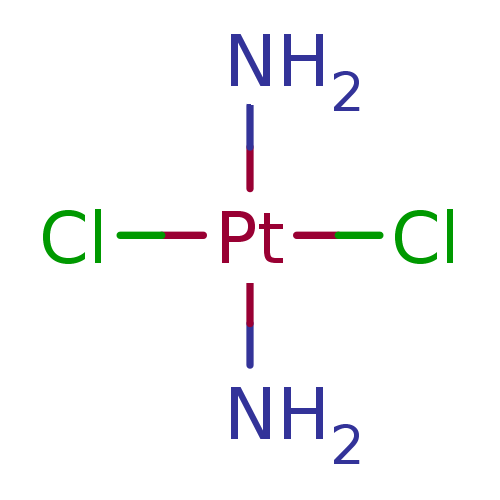
 Cis-Platinum(II) trans-dichlorodiammineplatinum.(transplatin) camphorato platinum complex derivative cis-Platinum diamminedichloride Platinum(IV) Complex Pt(II) Complex cis-diamminedichloroplatinum(II)(cis-DDP) Cisplatin(cis-Diammenedichloroplatinum) dichloromethanediamine(platinum complex) cisplatin complex dichloroplatinumdiamine cisplatin US11952364, Example Control BDBM50028111 Platinum (II) complex
- Sasanelli, R; Boccarelli, A; Giordano, D; Laforgia, M; Arnesano, F; Natile, G; Cardellicchio, C; Capozzi, MA; Coluccia, M Platinum complexes can inhibit matrix metalloproteinase activity: platinum-diethyl[(methylsulfinyl)methyl]phosphonate complexes as inhibitors of matrix metalloproteinases 2, 3, 9, and 12. J Med Chem 50: 3434-41 (2007)
- Margiotta, N; Ostuni, R; Ranaldo, R; Denora, N; Laquintana, V; Trapani, G; Liso, G; Natile, G Synthesis and characterization of a platinum(II) complex tethered to a ligand of the peripheral benzodiazepine receptor. J Med Chem 50: 1019-27 (2007)
- Wei, H; Guo, J; Sun, X; Gou, W; Ning, H; Shang, H; Liu, Q; Hou, W; Li, Y Discovery of Natural Ursane-type SENP1 Inhibitors and the Platinum Resistance Reversal Activity Against Human Ovarian Cancer Cells: A Structure-Activity Relationship Study. J Nat Prod 85: 1248-1255 (2022)
- Fluorescent Reporter Assay In vitro inhibition of the Mtu RecA Intein by Cisplatin-Splicing activity of the RecA intein was dertermined in the presence and absence of potential platinum (II) inhibitors using a fluorescent reporter assay.
- Chromatin Immunoprecipitation (CHIP) ChIP assay was performed using EZ ChIP Kit (Millipore, Billerica, Mass., USA) as per manufacturer's instruction. Briefly, after crosslinking with formaldehyde (1%), cell were lysed using SDS Lysis Buffer containing Protease Inhibitor Cocktail and nuclear extract were obtained. Then, crosslinked DNA was sheared using sonication; sheared DNA size was checked on agarose gel and ranged, in all cases, between 300-500 bp. An amount of 1/20 of the shared chromatin was kept as an input. Sheared chromatin was incubated with rabbit polyclonal Phospho-Stat5 (Tyr694) Antibody (Cell Signaling, Danvers, Mass., USA) at dilution 1:50 or rabbit polyclonal IgG at appropriate concentration. Incubation was performed at 4° C. overnight. The antibody/chromatin complex was precipitated using Protein G Agarose beads. After elution, the crosslink of protein/DNA was reversed, and DNA was purified using Spin Columns. PCR was performed using platinum Taq (Invitrogen Canada, Burlington, ON, Canada). Two sets of primers were designed to amplify two DNA segments that contain STAT5-binding sites located 1672 bp and 428 bp upstream the start sites of C-Myc and Cyclin-D1, respectively. The STAT5-binding site in the C-MYC promoter is characterized by a 4N spacer and has the sequence (ttcccccgaa), whereas the one in the Cyclin D1 promoter is characterized by a 3N spacer and has the sequence (ttcttggaa).
- Ba/F3 cell model generation and proliferation assays Ba/F3 cells were ordered from DSMZ (ACC300, Lot17) and grown in RPMI-1640 (ATCC 30-2001) + 10 % FCS + 10 ng/ml IL-3 at 37 °C in 5 % CO2 atmosphere. Plasmids containing EGFR mutants were obtained from GeneScript. To generate EGFR-dependent Ba/F3 models, Ba/F3 cells were transduced with retroviruses containing vectors that harbor EGFR isoforms. Platinum-E cells (Cell Biolabs) were used for retrovirus packaging. Retrovirus was added to Ba/F3 cells. To ensure infection, 4 μg/mL polybrene was added and cells were spinfected. Infection efficiency was confirmed by measuring GFP-positive cells using a cell analyzer. Cells with an infection efficiency of 10 % to 20 % were further cultivated and puromycin selection with 1 μg/mL was initiated. As a control, parental Ba/F3 cells were used to show selection status. Selection was considered successful when parental Ba/F3 cells cultures died. To evaluate the transforming potential of EGFR mutations, the growth medium was no longer supplemented with IL-3. Ba/F3 cells harboring the empty vector were used as a control. A switch from IL-3 to EGF was performed for Ba/F3 cells with the wildtype EGFR known for its dependency on EGF ligand. Approximately ten days before conducting the experiments, puromycin was left out. For proliferation assays (data in table 13), Ba/F3 cells were seeded into 96-well plates at 5 x 10³ cells / 100 μL in growth media. Compounds were added by using a HP D3000 Digital Dispenser. All treatments were performed in technical triplicates. Treated cells were incubated for 72 h at 37 °C with 5 % CO2. CellTiter-Glo Luminescent Cell Viability Assay (Promega) was performed and chemoluminescence was measured by using the multilabel Plate Reader VICTOR X4. The raw data were imported into and analyzed with the Boehringer Ingelheim proprietary software MegaLab (curve fitting based on the program PRISM, GraphPad Inc.).