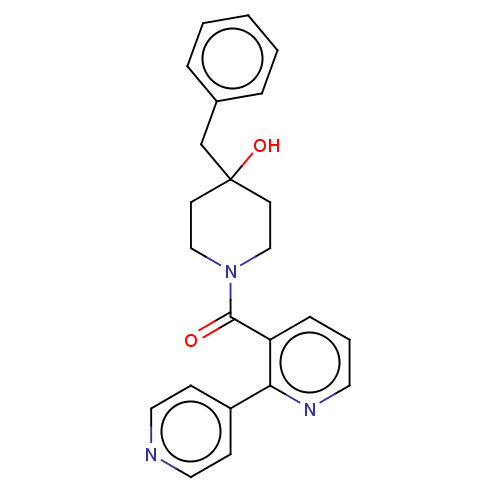
 SOTICLESTAT TAK-935 TAK935 OV-935 OV935 BDBM50583519
- Atigadda, VR; Kashyap, MP; Yang, Z; Chattopadhyay, D; Melo, N; Sinha, R; Belyaeva, OV; Chou, CF; Chang, PL; Kedishvili, NY; Grubbs, CJ; Renfrow, MB; Muccio, DD; Elmets, CA; Athar, M J Med Chem 65: 14409-14423 (2022)
- Zaryanova, EV; Lozinskaya, NA; Beznos, OV; Volkova, MS; Chesnokova, NB; Zefirov, NS Bioorg Med Chem Lett 27: 3787-3793 (2017)
- Rasina, D; Stakanovs, G; Borysov, OV; Pantelejevs, T; Bobrovs, R; Kanepe-Lapsa, I; Tars, K; Jaudzems, K; Jirgensons, A Bioorg Med Chem 26: 2488-2500 (2018)
- Duncan, LF; Wang, G; Ilyichova, OV; Dhouib, R; Totsika, M; Scanlon, MJ; Heras, B; Abbott, BM Bioorg Med Chem 45: (2021)
- Reichart, F; Maltsev, OV; Kapp, TG; Räder, AFB; Weinmüller, M; Marelli, UK; Notni, J; Wurzer, A; Beck, R; Wester, HJ; Steiger, K; Di Maro, S; Di Leva, FS; Marinelli, L; Nieberler, M; Reuning, U; Schwaiger, M; Kessler, H J Med Chem 62: 2024-2037 (2019)
- Koryakova, AG; Ivanenkov, YA; Ryzhova, EA; Bulanova, EA; Karapetian, RN; Mikitas, OV; Katrukha, EA; Kazey, VI; Okun, I; Kravchenko, DV; Lavrovsky, YV; Korzinov, OM; Ivachtchenko, AV Bioorg Med Chem Lett 18: 3661-6 (2008)
- Pearlstein, RA; Vaz, RJ; Kang, J; Chen, XL; Preobrazhenskaya, M; Shchekotikhin, AE; Korolev, AM; Lysenkova, LN; Miroshnikova, OV; Hendrix, J; Rampe, D Bioorg Med Chem Lett 13: 1829-35 (2003)
- Timple, JM; Magalhães, LG; Souza Rezende, KC; Pereira, AC; Cunha, WR; Andrade e Silva, ML; Mortensen, OV; Fontana, AC J Nat Prod 76: 1889-95 (2013)
- Muzychka, OV; Kobzar, OL; Popova, AV; Frasinyuk, MS; Vovk, AI Bioorg Med Chem 25: 3606-3613 (2017)
- Chekanov, MO; Ostrynska, OV; Synyugin, AR; Bdzhola, VG; Yarmoluk, SM J Enzyme Inhib Med Chem 29: 338-43 (2014)
- Mackman, RL; Ray, AS; Hui, HC; Zhang, L; Birkus, G; Boojamra, CG; Desai, MC; Douglas, JL; Gao, Y; Grant, D; Laflamme, G; Lin, KY; Markevitch, DY; Mishra, R; McDermott, M; Pakdaman, R; Petrakovsky, OV; Vela, JE; Cihlar, T Bioorg Med Chem 18: 3606-17 (2010)
- Sviripa, VM; Zhang, W; Balia, AG; Tsodikov, OV; Nickell, JR; Gizard, F; Yu, T; Lee, EY; Dwoskin, LP; Liu, C; Watt, DS J Med Chem 57: 6083-91 (2014)
- Borysko, P; Moroz, YS; Vasylchenko, OV; Hurmach, VV; Starodubtseva, A; Stefanishena, N; Nesteruk, K; Zozulya, S; Kondratov, IS; Grygorenko, OO Bioorg Med Chem 26: 3399-3405 (2018)
- Ivachtchenko, AV; Golovina, ES; Kadieva, MG; Koryakova, AG; Kovalenko, SM; Mitkin, OD; Okun, IM; Ravnyeyko, IM; Tkachenko, SE; Zaremba, OV J Comb Chem 12: 445-52 (2010)
- Mader, P; Brynda, J; Gitto, R; Agnello, S; Pachl, P; Supuran, CT; Chimirri, A; Řezáčová, P J Med Chem 54: 2522-6 (2011)
- ChEMBL_2261253 (CHEMBL5216264) Inhibition of IDO1 in human SK-OV-3 cells
- ChEMBL_2339809 Inhibition of PI3Kalpha (unknown origin) in human SK-OV-3 cells
- ChEMBL_2057394 (CHEMBL4712395) Inhibition of acid ceramidase in human SK-OV-3 cell lysates
- ChEMBL_2336714 Inhibition of PKB phosphorylation in human SK-OV-3 cells incubated for 1 hrs by ELISA
- ChEMBL_2337681 Inhibition of pax2 (unknown origin) in human SK-OV-3 cells measured after 24 hrs by immunoblotting analysis
- ChEMBL_2501556 Inhibition of PI3K alpha in human SK-OV-3 cells incubated for 2 hrs by Western blot analysis
- ChEMBL_1736302 (CHEMBL4151838) Antagonist activity at GR in human PBMC assessed as reduction in dexamethasone-induced GILZ gene expression incubated for 6 hrs by RT-qPCR method
- ChEMBL_1736304 (CHEMBL4151840) Antagonist activity at GR in rat PBMC assessed as reduction in dexamethasone-induced GILZ gene expression incubated for 24 hrs by RT-qPCR method
- ChEMBL_1736306 (CHEMBL4151842) Antagonist activity at GR in dog PBMC assessed as reduction in dexamethasone-induced GILZ gene expression incubated for 6 hrs by RT-qPCR method
- ChEMBL_1736312 (CHEMBL4151848) Antagonist activity at GR in human OVCAR5 assessed as reduction in dexamethasone-induced GILZ gene expression incubated for 24 hrs by RT-qPCR method
- ChEMBL_1736310 (CHEMBL4151846) Antagonist activity at GR in mini pig PBMC assessed as reduction in dexamethasone-induced GILZ gene expression incubated for 24 hrs by RT-qPCR method
- ChEMBL_2199068 (CHEMBL5111584) Inhibition of GCN2 in human SK-OV-3 cells assessed as reduction in phosphorylation of eIF2alpha by cellular assay
- ChEMBL_2193357 (CHEMBL5105717) Inhibition of alphavbeta3 integrin receptor-mediated cell adhesion to fibrinogen in human SK-OV-3 cells expressing alphavbeta5 integrin receptor
- ChEMBL_2265667 Inhibition of PI3Kalpha H1047R mutant in human SK-OV-3 cells assessed as protein phosphorylation incubated for 2 hrs by fluorescence assay
- ChEMBL_2237616 (CHEMBL5151512) Inhibition of PI3Kalpha in human SK-OV-3 cells assessed as reduction in AKT phosphorylation at S473 residue incubated for 30 mins
- ChEMBL_2199091 (CHEMBL5111607) Inhibition of GCN2 in human SK-OV-3 cells assessed as reduction in phosphorylation of eIF2alpha in presence of human serum by cellular assay
- ChEMBL_2482679 Inhibition of PI3Kalpha in human SK-OV-3 cells assessed as reduction in AKT phosphorylation at S473 residue incubated for 2 hrs by Western blot analysis
- ChEMBL_2094584 (CHEMBL4775847) Inhibition of CD73 in human SK-OV-3 cells incubated for 60 mins before addition of AMP and further incubated for 60 mins by colorimetric assay
- ChEMBL_2576989 Inhibition of GLUT1 in human SK-OV-3 cells assessed as decrease in conversion of D-[5-3H(N)]-glucose to 3H2O incubated for 24 hrs by liquid scintillation counting
- ChEMBL_2078882 (CHEMBL4734673) Inhibition of IDO1 in human SK-OV-3 cells assessed as effect on KYN level using L-tryptophan as substrate incubated for 18 hrs by 4-(dimethylamino)benzaldehyde based absorbance method
- ChEMBL_2228094 (CHEMBL5141607) Inhibition of N-terminal recombinant PKMYT1 (76 to 362 residues) in CCNE1 amplified human FU-OV-1 cells assessed as phosphorylation of CDK1 at Thr14 incubated for 2 hrs by AlphaLisa assay
- GILZ gene assays HUT78 cells were cultured in IMEM plus 20% heat inactivated FBS and cell density was maintained between 0.1 to 1.2 million/mL. 786-O cells were cultured in RPMI plus 10% heat inactivated FBS. Actively growing cells were harvested and resuspended in HBSS with 2% FBS at 1.1 million cells per mL then dispensed to 384-well V-bottom plates at 45 μL per well. Serially diluted ADC solution was added to the cell plate (5 μL per well) and mixed for 2 min. Cells were then cultured at 37° C., at 5% CO2 for a designated time before supernatant was removed. Cells were harvested in lysis buffer from the Cells-to-Ct kit (40 μL, Life Technologies, 4391851C) following the supplier's protocol and mixed for 10 min followed by addition of 5 μL per well of stop solution from the kit. cDNA was synthesized with a reverse transcription kit (Life Technologies, 4391852C) follow by qPCR using the TaqMan gene expression master mix (Life Technologies, 4369016) with GILZ gene assay (Life Technologies, Hs00608272_m1) and GAPDH assay (Hs2758991_g1) in a duplex format with 3-4 technical replicates.Determination of apparent permeability was as follows. MDCKII cells (kindly provided by the Netherlands Cancer Institute, under a licensing agreement) were seeded on to 96-well transwell culture plates (Millipore Corp, Billerica, Mass.) and used in experiments after five days in culture. Test compound (1 μM) was prepared in Hank's Balanced Salt Solution (HBSS), 10 mM (4-(2-hydroxyethyl)-1-piperrazineethanesulfonic acid) (HEPES, pH 7.4), with 10 μM cyclosporine A (to inhibit endogenous transport) and 1.2 μM dextran Texas red (to confirm monolayer integrity). Substrate solution (150 μL) was added to either the apical (A) or the basolateral (B) compartment of the culture plate, and buffer (150 μL; HBSS, 10 mM HEPES, pH 7.4) with 10 μM cyclosporine A was added to the compartment opposite to that containing the substrate. At t=3 hr, 50 μL samples were removed from both sides of monolayers dosed with test compound and placed in 96 well plates, 50 μL internal standard (1 μM labetolol) and 100 μL HBSS was added to the samples. Samples were analyzed by LC/MS/MS using an Applied Biosystems SCIEX API 5000 triple quadruple mass spectrometer (Concord, ON, Canada) with a TurbolonSpray ion source in the positive ion mode. A Thermo Scientific Transcend LX-2 system (Franklin, Mass.) was coupled to the API 5000 with a flow rate of 800 μL/min to direct sample into the mass spectrometer.
- Titre Blue Assay The cell titre blue viability (Promega, USA) assay provides a homogenous, fluorometric method for estimating the number of viable cells. It uses the dark blue indicator dye resazurin to measure the metabolic capacity of cells which is an indicator of cell viability. Viable cells are able to reduce resazurin into resorufin (pink) which is highly fluorescent. Briefly, U2OS or SK-OV-3 (6×10³ cells/mL) were seeded into 384-well plates and were incubated for 24 h. Compounds (at a range of concentrations) were added using the ECHO 550 liquid handler (Labcyte, USA) and then left at 37° C. for 96 h. Titre blue reagent was added to each well and left at 37° C. for 3-4 h. Fluorescence was measured using the Envision machine (Perkin Elmer, UK).In general, activity possessed by compounds of the formula I, may be demonstrated in the Arrayscan and Cellisa assays by an IC50 value of less than 15 μM. Suitably compounds have an IC50 value of less than 10 μM in these assays, more suitably less than 5 μM, even more suitably less than 2 μM and most suitably less than 1 μM. Preferred compounds of the invention have an IC50 value of less than 500 nM in the Arrayscan and Cellulisa assays.
- Cell-Based ELISA (Cellisa) Assay U2OS cells (5-8×10⁴ cells/mL) or SK-OV-3 cells (5-8×10⁴ cells/mL) were seeded into 96-well plates and incubated at 37° C. for 48 h. Compounds were then added at a range of concentrations and incubated for 1 h before addition of 17-AAG (250 nM). Cells were then incubated for 18 h. The medium was removed washed 2× with PBS and cells were then fixed with fixing solution (4% paraformaldehyde, 0.3% TritonX-100 in PBS) for 30 min at 4° C. The plates were then washed 2× with PBS before blocking with 5% milk for 30 min at 37° C. After washing the plates 4× with 0.1% Tween-20/deionised water, HSP72 antibody (SPA-810, Enzo Life) was added for 1.5 h at 37° C. Following 4× washes, the plates were incubated with europium-labelled anti-mouse antibody (0.6 ug/ml) in Delfia assay buffer (Perkin Elmer) for 1 h at 37° C. After washing the plates, Delfia enhancement solution was added, shaken for 10 min before reading in the Envision plate reader (Perkin-Elmer) with excitation at 340 nm and emission at 615 nm. The plates were washed again before protein determination using the bicinchoninic acid assay (BCA assay, Pierce Biotechnology). The europium counts were normalised for the amount of protein in each well. The 50% inhibitory concentration value of the compound was then calculated.