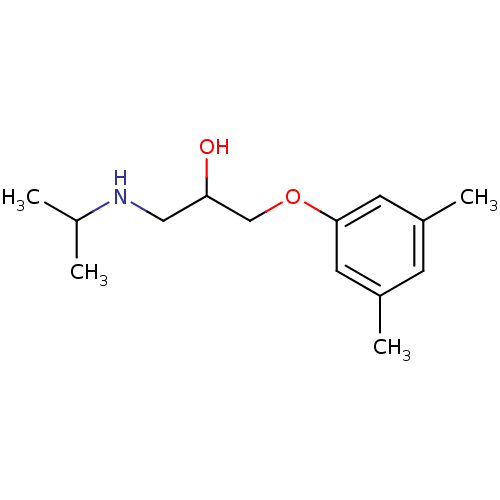
 CHEMBL1159714 Ko 707 BDBM50421719
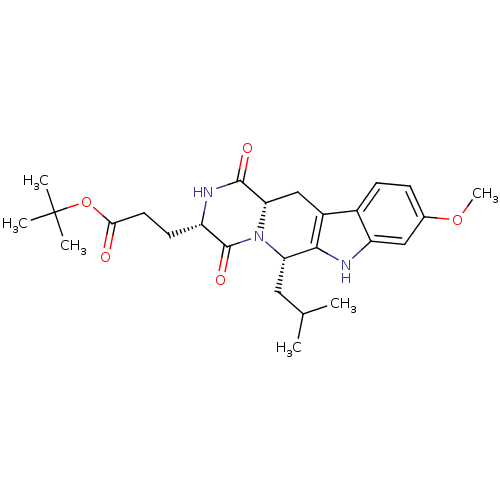 3-((3S,6S)-6-Isobutyl-9-methoxy-1,4-dioxo-1,2,3,4,6,7,12,12a-octahydro-pyrazino[1',2':1,6]pyrido[3,4-b]indol-3-yl)-propionic acid tert-butyl ester BDBM50305083 3-((3S,6S,12aS)-6-Isobutyl-9-methoxy-1,4-dioxo-1,2,3,4,6,7,12,12a-octahydro-pyrazino[1',2':1,6]pyrido[3,4-b]indol-3-yl)-propionic acid tert-butyl ester Ko143 Ko-143 US9695174, Ko143 CHEMBL488910
- Mitchell, SA; Danca, MD; Blomgren, PA; Darrow, JW; Currie, KS; Kropf, JE; Lee, SH; Gallion, SL; Xiong, JM; Pippin, DA; DeSimone, RW; Brittelli, DR; Eustice, DC; Bourret, A; Hill-Drzewi, M; Maciejewski, PM; Elkin, LL Imidazo[1,2-a]pyrazine diaryl ureas: inhibitors of the receptor tyrosine kinase EphB4. Bioorg Med Chem Lett 19: 6991-5 (2009)
- Bardelle, C; Barlaam, B; Brooks, N; Coleman, T; Cross, D; Ducray, R; Green, I; Brempt, CL; Olivier, A; Read, J Inhibitors of the tyrosine kinase EphB4. Part 3: identification of non-benzodioxole-based kinase inhibitors. Bioorg Med Chem Lett 20: 6242-5 (2010)
- Barlaam, B; Ducray, R; Lambert-van der Brempt, C; Plé, P; Bardelle, C; Brooks, N; Coleman, T; Cross, D; Kettle, JG; Read, J Inhibitors of the tyrosine kinase EphB4. Part 4: Discovery and optimization of a benzylic alcohol series. Bioorg Med Chem Lett 21: 2207-11 (2011)
- Li, C; Shan, Y; Sun, Y; Si, R; Liang, L; Pan, X; Wang, B; Zhang, J Discovery of novel anti-angiogenesis agents. Part 7: Multitarget inhibitors of VEGFR-2, TIE-2 and EphB4. Eur J Med Chem 141: 506-518 (2017)
- Bardelle, C; Coleman, T; Cross, D; Davenport, S; Kettle, JG; Ko, EJ; Leach, AG; Mortlock, A; Read, J; Roberts, NJ; Robins, P; Williams, EJ Inhibitors of the tyrosine kinase EphB4. Part 2: structure-based discovery and optimisation of 3,5-bis substituted anilinopyrimidines. Bioorg Med Chem Lett 18: 5717-21 (2009)
- Rescue of fragile X syndrome phenotypes in Fmr1 KO mice by the small-molecule PAK inhibitor FRAX486.
- Bardelle, C; Cross, D; Davenport, S; Kettle, JG; Ko, EJ; Leach, AG; Mortlock, A; Read, J; Roberts, NJ; Robins, P; Williams, EJ Inhibitors of the tyrosine kinase EphB4. Part 1: Structure-based design and optimization of a series of 2,4-bis-anilinopyrimidines. Bioorg Med Chem Lett 18: 2776-80 (2008)
- Lafleur, K; Dong, J; Huang, D; Caflisch, A; Nevado, C Optimization of inhibitors of the tyrosine kinase EphB4. 2. Cellular potency improvement and binding mode validation by X-ray crystallography. J Med Chem 56: 84-96 (2013)
- Lafleur, K; Huang, D; Zhou, T; Caflisch, A; Nevado, C Structure-based optimization of potent and selective inhibitors of the tyrosine kinase erythropoietin producing human hepatocellular carcinoma receptor B4 (EphB4). J Med Chem 52: 6433-46 (2009)
- Pan, X; Liang, L; Si, R; Wang, J; Zhang, Q; Zhou, H; Zhang, L; Zhang, J Discovery of novel anti-angiogenesis agents. Part 10: Multi-target inhibitors of VEGFR-2, Tie-2 and EphB4 incorporated with 1,2,3-triazol. Eur J Med Chem 163: 1-9 (2019)
- PubChem, PC Dose-response biochemical assay for antagonists of the interaction between the Eph receptor B4 (EphB4) and its ligand ephrin-B2 via TNYL-RAW peptide PubChem Bioassay (2007)
- Rosati, RL; Da Silva Jardine, P; Cameron, KO; Thompson, DD; Ke, HZ; Toler, SM; Brown, TA; Pan, LC; Ebbinghaus, CF; Reinhold, AR; Elliott, NC; Newhouse, BN; Tjoa, CM; Sweetnam, PM; Cole, MJ; Arriola, MW; Gauthier, JW; Crawford, DT; Nickerson, DF; Pirie, CM; Qi, H; Simmons, HA; Tkalcevic, GT J Med Chem 41: 2928-31 (1998)
- Dampalla, CS; Rathnayake, AD; Galasiti Kankanamalage, AC; Kim, Y; Perera, KD; Nguyen, HN; Miller, MJ; Madden, TK; Picard, HR; Thurman, HA; Kashipathy, MM; Liu, L; Battaile, KP; Lovell, S; Chang, KO; Groutas, WC J Med Chem 65: 7818-7832 (2022)
- Clausen, JD; Kjellerup, L; Cohrt, KO; Hansen, JB; Dalby-Brown, W; Winther, AL Bioorg Med Chem Lett 27: 4564-4570 (2017)
- Shaw, S; Bian, Z; Zhao, B; Tarr, JC; Veerasamy, N; Jeon, KO; Belmar, J; Arnold, AL; Fogarty, SA; Perry, E; Sensintaffar, JL; Camper, DV; Rossanese, OW; Lee, T; Olejniczak, ET; Fesik, SW J Med Chem 61: 2410-2421 (2018)
- Zhao, B; Bower, MJ; McDevitt, PJ; Zhao, H; Davis, ST; Johanson, KO; Green, SM; Concha, NO; Zhou, BB J Biol Chem 277: 46609-15 (2002)
- Zankel, TC; Isbell, SL; Ko, AA US Patent US10308607 (2019)
- Ko, B; Jang, Y; Kwak, SH; You, H; Kim, JH; Lee, JE; Park, HD; Kim, SK; Goddard, WA; Han, JH; Kim, YC J Med Chem 66: 14564-14582 (2023)
- Li, Z; Liao, C; Ko, BC; Shan, S; Tong, EH; Yin, Z; Pan, D; Wong, VK; Shi, L; Ning, ZQ; Hu, W; Zhou, J; Chung, SS; Lu, XP Bioorg Med Chem Lett 14: 3507-11 (2004)
- Ko, CC; Chen, YJ; Chen, CT; Liu, YC; Cheng, FC; Hsu, KC; Chow, LP J Biol Chem 289: 22078-89 (2014)
- Chen, CH; Lee, O; Yao, CN; Chuang, MY; Chang, YL; Chang, MH; Wen, YF; Yang, WH; Ko, CH; Chou, NT; Lin, MW; Lai, CP; Sun, CY; Wang, LM; Chen, YC; Hseu, TH; Chang, CN; Hsu, HC; Lin, HC; Chang, YL; Shih, YC; Chou, SH; Hsu, YL; Tseng, HW; Liu, CP; Tu, CM; Hu, TL; Tsai, YJ; Chen, TS; Lin, CL; Chiou, SJ; Liu, CC; Hwang, CS Bioorg Med Chem Lett 20: 6129-32 (2010)
- Ratni, H; Ebeling, M; Baird, J; Bendels, S; Bylund, J; Chen, KS; Denk, N; Feng, Z; Green, L; Guerard, M; Jablonski, P; Jacobsen, B; Khwaja, O; Kletzl, H; Ko, CP; Kustermann, S; Marquet, A; Metzger, F; Mueller, B; Naryshkin, NA; Paushkin, SV; Pinard, E; Poirier, A; Reutlinger, M; Weetall, M; Zeller, A; Zhao, X; Mueller, L J Med Chem 61: 6501-6517 (2018)
- Kim, M; Kim, G; Kang, M; Ko, D; Nam, Y; Moon, CS; Kang, HM; Shin, JS; Werz, O; Lee, KT; Lee, JY Bioorg Med Chem Lett 41: (2021)
- Park, HK; Jeong, H; Ko, E; Lee, G; Lee, JE; Lee, SK; Lee, AJ; Im, JY; Hu, S; Kim, SH; Lee, JH; Lee, C; Kang, S; Kang, BH J Med Chem 60: 7569-7578 (2017)
- Brand, S; Ko, EJ; Viayna, E; Thompson, S; Spinks, D; Thomas, M; Sandberg, L; Francisco, AF; Jayawardhana, S; Smith, VC; Jansen, C; De Rycker, M; Thomas, J; MacLean, L; Osuna-Cabello, M; Riley, J; Scullion, P; Stojanovski, L; Simeons, FRC; Epemolu, O; Shishikura, Y; Crouch, SD; Bakshi, TS; Nixon, CJ; Reid, IH; Hill, AP; Underwood, TZ; Hindley, SJ; Robinson, SA; Kelly, JM; Fiandor, JM; Wyatt, PG; Marco, M; Miles, TJ; Read, KD; Gilbert, IH J Med Chem 60: 7284-7299 (2017)
- Cheng, MC; Li, CY; Ko, HC; Ko, FN; Lin, YL; Wu, TS J Nat Prod 69: 1305-9 (2006)
- Hillmann, P; Ko, GY; Spinrath, A; Raulf, A; von Kügelgen, I; Wolff, SC; Nicholas, RA; Kostenis, E; Höltje, HD; Müller, CE J Med Chem 52: 2762-75 (2009)
- An, S; Yu, J; Choi, H; Ko, H; Ahn, S; Shin, JC; Pyo, JJ; Jeong, LS; Noh, M Bioorg Med Chem 28: (2020)
- Cheng, MC; Li, CY; Ko, HC; Ko, FN; Lin, YL; Wu, TS J Nat Prod 69: 1305-9 (2006)
- Ng, LT; Ko, HH; Lu, TM Bioorg Med Chem 17: 4360-6 (2009)
- Kwon, SH; Kim, S; Park, AY; Lee, S; Gadhe, CG; Seo, BA; Park, JS; Jo, S; Oh, Y; Kweon, SH; Ma, SX; Kim, WR; Kim, M; Kim, H; Kim, JE; Lee, S; Lee, J; Ko, HS J Med Chem 64: 15091-15110 (2021)
- Ko HY
- Ko J
- Bhattarai, BR; Ko, JH; Shrestha, S; Kafle, B; Cho, H; Kang, JH; Cho, H Bioorg Med Chem Lett 20: 1075-7 (2010)
- Ko, K; Kim, HJ; Ho, PS; Lee, SO; Lee, JE; Min, CR; Kim, YC; Yoon, JH; Park, EJ; Kwon, YJ; Yun, JH; Yoon, DO; Kim, JS; Park, WS; Oh, SS; Song, YM; Cho, WK; Morikawa, K; Lee, KJ; Park, CH J Med Chem 61: 2949-2961 (2018)
- Lee, W; Ko, KR; Kim, HK; Lee, DS; Nam, IJ; Lim, S; Kim, S J Nat Prod 81: 1343-1356 (2018)
- Ko, KS; Steffey, ME; Brandvold, KR; Soellner, MB ACS Med Chem Lett 4: 779-783 (2013)
- Jeon, S; Ko, M; Lee, J; Choi, I; Byun, SY; Park, S; Shum, D; Kim, S Antimicrob Agents Chemother 64: (2020)
- Nam, M; Kim, T; Kwak, J; Seo, SH; Ko, MK; Lim, EJ; Min, SJ; Cho, YS; Keum, G; Baek, DJ; Lee, J; Pae, AN Eur J Med Chem 97: 245-58 (2015)
- Jackson, JJ; Shibuya, GM; Ravishankar, B; Adusumilli, L; Bradford, D; Brockstedt, DG; Bucher, C; Bui, M; Cho, C; Colas, C; Cutler, G; Dukes, A; Han, X; Hu, DX; Jacobson, S; Kassner, PD; Katibah, GE; Ko, MYM; Kolhatkar, U; Leger, PR; Ma, A; Marshall, L; Maung, J; Ng, AA; Okano, A; Pookot, D; Poon, D; Ramana, C; Reilly, MK; Robles, O; Schwarz, JB; Shakhmin, AA; Shunatona, HP; Sreenivasan, R; Tivitmahaisoon, P; Xu, M; Zaw, T; Wustrow, DJ; Zibinsky, M J Med Chem 65: 12895-12924 (2022)
- Srivastava, AS; Ko, S; Watterson, SH; Pattoli, MA; Skala, S; Cheng, L; Obermeier, MT; Vickery, R; Discenza, LN; D'Arienzo, CJ; Gillooly, KM; Taylor, TL; Pulicicchio, C; McIntyre, KW; Yip, S; Li, P; Sun, D; Wu, DR; Dai, J; Wang, C; Zhang, Y; Wang, B; Pawluczyk, J; Kempson, J; Zhao, R; Hou, X; Rampulla, R; Mathur, A; Galella, MA; Salter-Cid, L; Barrish, JC; Carter, PH; Fura, A; Burke, JR; Tino, JA ACS Med Chem Lett 11: 2195-2203 (2020)
- Lim, CJ; Woo, SE; Ko, SI; Lee, BH; Oh, KS; Yi, KY Bioorg Med Chem Lett 26: 4684-4686 (2016)
- Hwang, GJ; Jang, M; Son, S; Lee, B; Jang, JP; Lee, JS; Ko, SK; Hong, YS; Ahn, JS; Jang, JH J Nat Prod 84: 2420-2426 (2021)
- Yang, MG; Xiao, Z; Cherney, RJ; Tebben, AJ; Batt, DG; Brown, GD; Chen, J; Cvijic, ME; Dabros, M; Duncia, JV; Galella, M; Gardner, DS; Khandelwal, P; Ko, SS; Malley, MF; Mo, R; Pang, J; Rose, AV; Santella, JB; Shi, H; Srivastava, A; Traeger, SC; Wang, B; Xu, S; Zhao, R; Barrish, JC; Mandlekar, S; Zhao, Q; Carter, PH ACS Med Chem Lett 10: 300-305 (2019)
- Dziadulewicz, EK; Ritchie, TJ; Hallett, A; Snell, CR; Ko, SY; Wrigglesworth, R; Hughes, GA; Dunstan, AR; Bloomfield, GC; Drake, GS; Brown, MC; Lee, W; Burgess, GM; Davis, C; Yaqoob, M; Perkins, MN; Campbell, EA; Davis, AJ; Rang, HP J Med Chem 43: 769-71 (2000)
- K-M Chen, C; Hudock, MP; Zhang, Y; Guo, RT; Cao, R; No, JH; Liang, PH; Ko, TP; Chang, TH; Chang, SC; Song, Y; Axelson, J; Kumar, A; Wang, AH; Oldfield, E J Med Chem 51: 5594-607 (2008)
- Quang, TH; Ngan, NT; Ko, W; Kim, DC; Yoon, CS; Sohn, JH; Yim, JH; Kim, YC; Oh, H Bioorg Med Chem Lett 24: 5787-91 (2014)
- Ryu, CK; Kang, HY; Lee, SK; Nam, KA; Hong, CY; Ko, WG; Lee, BH Bioorg Med Chem Lett 10: 461-4 (2000)
- Choi, J; Ko, Y; Lee, HS; Park, YS; Yang, Y; Yoon, S Eur J Med Chem 45: 193-202 (2010)
- Jeon, WS; Moon, K; Park, SH; Chun, H; Ko, YH; Lee, JY; Lee, ES; Samal, S; Selvapalam, N; Rekharsky, MV; Sindelar, V; Sobransingh, D; Inoue, Y; Kaifer, AE; Kim, K J Am Chem Soc 127: 12984-9 (2005)
- Kim, YK; Kwon, O; Park, H; Park, J; Choi, HG; Son, JB; Ko, E; Kim, SY; Lee, S; Kang, SY; Ko, YK; Park, J US Patent US11447480 (2022)
- Humblet, V; Misra, P; Bhushan, KR; Nasr, K; Ko, YS; Tsukamoto, T; Pannier, N; Frangioni, JV; Maison, W J Med Chem 52: 544-50 (2009)
- Suh, YG; Lee, KO; Moon, SH; Seo, SY; Lee, YS; Kim, SH; Paek, SM; Kim, YH; Lee, YS; Jeong, JM; Lee, SJ; Kim, SG Bioorg Med Chem Lett 14: 3487-90 (2004)
- Raddatz, P; Jonczyk, A; Minck, KO; Schmitges, CJ; Sombroek, J J Med Chem 34: 3267-80 (1991)
- Aziz, MW; Kamal, AM; Mohamed, KO; Elgendy, AA Bioorg Med Chem Lett 41: (2021)
- Mohammed, KO; Nissan, YM Chem Biol Drug Des 84: 473-88 (2014)
- Bugge, S; Moen, IU; Sylte, KO; Sundby, E; Hoff, BH Eur J Med Chem 94: 175-94 (2015)
- Narayanan, D; Tran, KT; Pallesen, JS; Solbak, SMØ; Qin, Y; Mukminova, E; Luchini, M; Vasilyeva, KO; González Chichón, D; Goutsiou, G; Poulsen, C; Haapanen, N; Popowicz, GM; Sattler, M; Olagnier, D; Gajhede, M; Bach, A J Med Chem 65: 14481-14526 (2022)
- Yerdelen, KO; Koca, M; Anil, B; Sevindik, H; Kasap, Z; Halici, Z; Turkaydin, K; Gunesacar, G Bioorg Med Chem Lett 25: 5576-82 (2015)
- Pontius, A; Krick, A; Mesry, R; Kehraus, S; Foegen, SE; Mu¨ller, M; Klimo, K; Gerha¨user, C; Ko¨nig, GM J Nat Prod 71: 1793-1799 (2008)
- Mattei, P; Boehringer, M; Di Giorgio, P; Fischer, H; Hennig, M; Huwyler, J; Koçer, B; Kuhn, B; Loeffler, BM; Macdonald, A; Narquizian, R; Rauber, E; Sebokova, E; Sprecher, U Bioorg Med Chem Lett 20: 1109-13 (2010)
- Bosnar, M; Kragol, G; Koštrun, S; Vujasinovic, I; Bošnjak, B; Bencetic Mihaljevic, V; Marušic Ištuk, Z; Kapic, S; Hrvacic, B; Brajša, K; Tavcar, B; Jelic, D; Glojnaric, I; Verbanac, D; Culic, O; Padovan, J; Alihodžic, S; Erakovic Haber, V; Spaventi, R J Med Chem 55: 6111-23 (2012)
- Schwardt, O; Rabbani, S; Hartmann, M; Abgottspon, D; Wittwer, M; Kleeb, S; Zalewski, A; Smieško, M; Cutting, B; Ernst, B Bioorg Med Chem 19: 6454-73 (2011)
- ZakoSek, M; Mihevc, SP; Majdic, G; Ko{hacek over (s)}ak, U; Gobec, S US Patent US20230331674 (2023)
- ChEMBL_424221 (CHEMBL908995) Inhibition of EphB4
- ChEMBL_437765 (CHEMBL905854) Inhibition of EphB4
- ChEMBL_462545 (CHEMBL929555) Inhibition of EphB4
- ChEMBL_497271 (CHEMBL1007022) Inhibition of EphB4
- ChEMBL_498293 (CHEMBL972535) Inhibition of EPHB4
- ChEMBL_511634 (CHEMBL976281) Inhibition of EphB4
- ChEMBL_519323 (CHEMBL947775) Inhibition of EphB4
- ChEMBL_655290 (CHEMBL1244334) Inhibition of EPHB4
- ChEMBL_701566 (CHEMBL1656205) Inhibition of EPHB4
- ChEMBL_793877 (CHEMBL1932850) Inhibition of EPHB4
- ChEMBL_841364 (CHEMBL2089891) Inhibition of EphB4
- ChEMBL_881192 (CHEMBL2211497) Inhibition of EPHB4
- ChEMBL_2482731 Inhibition of EphB4 (unknown origin)
- ChEMBL_2516262 Inhibition of EPHB4 (unknown origin)
- ChEMBL_2544044 Inhibition of EphB4 (unknown origin)
- ChEMBL_420192 (CHEMBL912735) Inhibition of human EPHB4
- ChEMBL_553934 (CHEMBL962867) Inhibition of recombinant EPHB4
- ChEMBL_557466 (CHEMBL962244) Inhibition of human EPHB4
- ChEMBL_574947 (CHEMBL1026227) Inhibition of recombinant EPHB4
- ChEMBL_655779 (CHEMBL1244823) Binding affinity to EPHB4
- ChEMBL_741347 (CHEMBL1764816) Inhibition of human EPHB4
- ChEMBL_773508 (CHEMBL1839874) Inhibition of recombinant EPHB4
- ChEMBL_1441597 (CHEMBL3376477) Inhibition of EPHB4 (unknown origin)
- ChEMBL_1459852 (CHEMBL3367275) Inhibition of EPHB4 (unknown origin)
- ChEMBL_1544017 (CHEMBL3750389) Inhibition of EPHB4 (unknown origin)
- ChEMBL_1730328 (CHEMBL4145864) Inhibition of EPHB4 (unknown origin)
- ChEMBL_1747156 (CHEMBL4181666) Inhibition of EphB4 (unknown origin)
- ChEMBL_1770335 (CHEMBL4222447) Inhibition of EPHB4 (unknown origin)
- ChEMBL_1778357 (CHEMBL4235349) Inhibition of EphB4 (unknown origin)
- ChEMBL_2061595 (CHEMBL4716848) Inhibition of EphB4 (unknown origin)
- ChEMBL_2328174 Inhibition of human EPHB4 (unknown origin)
- ChEMBL_554998 (CHEMBL957973) Inhibition of human recombinant EPHB4
- ChEMBL_947938 (CHEMBL2344159) Inhibition of EPHB4 (unknown origin)
- ChEMBL_1570039 (CHEMBL3789402) Inhibition of EphB4 receptor (unknown origin)
- ChEMBL_468966 (CHEMBL952111) Inhibition of EphB4 by FRET assay
- ChEMBL_531115 (CHEMBL973090) Inhibition of EphB4 by cellular assay
- ChEMBL_586570 (CHEMBL1060192) Binding constant for EPHB4 kinase domain
- ChEMBL_621326 (CHEMBL1109419) Inhibition of EphB4 after 1 hr
- ChEMBL_659338 (CHEMBL1247965) Inhibition of EphB4 by HTRF assay
- ChEMBL_774436 (CHEMBL1908653) Binding constant for EPHB4 kinase domain
- ChEMBL_566612 (CHEMBL964951) Inhibition of EphB4 by virtual HTS assay
- ChEMBL_674154 (CHEMBL1274251) Inhibition of EphB4 by acoustic dispensing assay
- ChEMBL_801301 (CHEMBL1947850) Inhibition of EphB4 using ATP as substrate
- ChEMBL_2496494 Inhibition of human EPHB4 by discoverX kinome scan assay
- ChEMBL_2525412 Inhibition of EphB4 (unknown origin) in presence of ATP
- ChEMBL_2537951 Inhibition of human EPHB4 by discoverX kinome scan assay
- ChEMBL_452960 (CHEMBL902105) Inhibition of human EphB4 by scintillation proximity method
- ChEMBL_468965 (CHEMBL952110) Inhibition of EphB4 by Panvera FRET-based assay
- ChEMBL_478601 (CHEMBL922442) Inhibition of EphB4 by luminescence based kinase assay
- ChEMBL_621633 (CHEMBL1115704) Inhibition of EphB4 autophosphorylation by cell based assay
- ChEMBL_674155 (CHEMBL1274252) Inhibition of EphB4 autophosphorylation expressed in CHOK1 cells
- ChEBML_1448589 Inhibition of human recombinant EPHB4 using poly(Glu,Tyr) substrate
- ChEMBL_592561 (CHEMBL1046768) Inhibition of EphB4 by [gamma33-P]ATP based assay
- ChEMBL_701614 (CHEMBL1656373) Inhibition of EPHB4 by TR-FRET based LanthaScreen assay
- ChEMBL_741350 (CHEMBL1764819) Inhibition of human EphB4 autophosphorylation expressed in CHOK1 cells
- ChEMBL_1475711 (CHEMBL3424913) Inhibition of EphB4 (unknown origin) by fluorescence-based enzymatic assay
- ChEMBL_1565878 (CHEMBL3789982) Inhibition of EphB4 (unknown origin) in presence of [gamma33P]ATP
- ChEMBL_853586 (CHEMBL2154041) Inhibition of EphB4 in presence of 1 uM radiolabeled ATP
- ChEBML_1644612 Inhibition of EphB4 (unknown origin) after 60 mins by ADP-Glo assay
- ChEMBL_1546651 (CHEMBL3748176) Inhibition of human EPHB4 using poly[Glu:Tyr] (4:1) as substrate
- ChEMBL_1561200 (CHEMBL3777628) Inhibition of N-terminal GST-fused His6-tagged human recombinant EphB4
- ChEMBL_2565096 Inhibition of EphB4 (unknown origin) ACT labeling site by KiNativ Profiling analysis
- ChEMBL_325000 (CHEMBL860636) Average Binding Constant for EPHB4; NA=Not Active at 10 uM
- ChEMBL_508986 (CHEMBL1005539) Inhibition of Tel-fused EphB4 kinase-mediated mouse BaF3 cell proliferation
- ChEMBL_1644612 (CHEMBL3993541) Inhibition of EphB4 (unknown origin) after 60 mins by ADP-Glo assay
- ChEMBL_1725304 (CHEMBL4140582) Inhibition of EPHB4 (unknown origin) after 4 hrs by ADP-Glo assay
- ChEMBL_853587 (CHEMBL2154042) Inhibition of EphB4 by FRET assay in presence of 30 uM ATP
- ChEMBL_947962 (CHEMBL2344183) Inhibition of EphB4 (unknown origin) using [gamma-33P]ATP by radiometric assay
- ChEMBL_1720861 (CHEMBL4135861) Inhibition of EphB4 (unknown origin) after 4 hrs by ADP-Glo luminescence assay
- ChEMBL_1920865 (CHEMBL4423710) Inhibition of EphB4 (unknown origin) after 1 hrs by ADP-Glo luminescence assay
- ChEMBL_592560 (CHEMBL1046767) Inhibition of EphB4 assessed as blockade of synthetic substrate phosphorylation by FRET assay
- ChEMBL_2513979 Binding affinity to human EPHB4 incubated for 45 mins by Kinobead based pull down assay
- ChEMBL_1830402 (CHEMBL4330410) Inhibition of EPHB4 (unknown origin) after 4 hrs by ADP-Glo reagent based luminescent assay
- ChEMBL_497272 (CHEMBL1007023) Inhibition of Myc-His-tagged EphB4 expressed in CHOK1 cells assessed as phosphorylation by ELISA
- ChEMBL_1445320 (CHEMBL3377875) Inhibition of EphB4 (unknown origin) by FRET-based enzymatic assay in presence of 30 uM ATP
- ChEMBL_1828533 (CHEMBL4328407) Inhibition of human EPHB4 using poly[Glu:Tyr] (4:1) as substrate by [gamma-33P]-ATP assay
- ChEMBL_2045340 (CHEMBL4700039) Inhibition of full-length human EPHB4 expressed in MEF cells assessed as autophosphorylation by sandwitch-ELISA
- ChEMBL_2065491 (CHEMBL4720744) Inhibition of human EPHB4 using poly[Glu:Tyr] (4:1) as substrate by [gamma-33P]-ATP assay
- ChEMBL_947994 (CHEMBL2344644) Inhibition of EphB4 (unknown origin) transfected in CHO cells using [gamma-33P]ATP by radiometric assay
- ChEMBL_2476844 Inhibition of tetracycline-inducible FLAG-tagged human PARL stably transfected in HEK293T harboring FITR/PARL KO
- ChEMBL_1495633 (CHEMBL3578504) Competitive binding affinity to EphB4 in human A375 cells after 15 mins in presence of ATP analogue
- ChEMBL_941274 (CHEMBL2329864) Displacement of ephrin-B1-Fc from EphB4 receptor Fc ectodomain (unknown origin) after 1 hr by ELISA
- ChEMBL_480051 (CHEMBL927990) Inhibition of mouse PKCtheta in KO cells assessed as blockade of anti CD28-stimulated IL2 production
- ChEMBL_1798949 (CHEMBL4271241) Binding affinity to Fc-tagged EphB4 (unknown origin) assessed as reduction in ephrin-B2 binding by SPR assay
- ChEMBL_947963 (CHEMBL2344184) Inhibition of EphB4 (unknown origin) using Z'-LYTE TYR-1 peptide as substrate after 2 hrs by FRET assay
- ChEMBL_2154863 (CHEMBL5039523) Agonist activity at STING KO human THP-1 dual cells incubated for 20 hrs by luciferase reporter gene assay
- ChEMBL_1454052 (CHEMBL3361798) Inhibition of phosphorylation of full-length myc-tagged human EphB4 overexpressed in mouse embryonic fibroblasts after 90 mins by sandwich ELISA
- ChEMBL_853583 (CHEMBL2154038) Inhibition of human full length EphB4 expressed in MEF cells assessed as inhibition of human ephrin B2/FC chimera-stimulated receptor autophosphorylation
- ChEMBL_2322358 Agonist activity at STING in human STHP1-Dual KO-STING cells incubated for 20 hrs by Quanti-luc reagent based assay
- ChEMBL_2354137 Agonist activity at STING in PMA-differentiated human THP1-Dual KO-STING cells incubated for 24 hrs by QUANTI-Blue assay
- Luciferase-Based Assay EphB4 kinase activity was similarly measured, using the luciferase-based technique described above. 28.9 mU/well EphB4 (Upstate) was reacted with 1 mg/ml poly(glu4tyr), 6 uM ATP and test reagents. The reaction was incubated for 60 minutes at 37 C and the residual ATP concentration was measured.
- ChEMBL_808130 (CHEMBL1961281) Inhibition of human recombinant EPHB4 expressed in Sf9 cells using poly(E,Y)4:1 as substrate after 80 mins by scintillation counting
- ChEMBL_947995 (CHEMBL2344645) Inhibition of EphB4 (unknown origin) transfected in CHO cells using Z'-LYTE TYR-1 peptide as substrate after 2 hrs by FRET assay
- ChEMBL_1972850 (CHEMBL4605668) Inhibition of EPHB4 (unknown origin) assessed as residual activity incubated for 5 mins in presence of [gamma-33ATP] by scintillation counting based radiometry assay
- ChEMBL_2473762 Inhibition of PRMT5 in human HCT-116 cells with MTAP KO assessed as decrease in SMDA level incubated for 48 hrs by immunofluorescence analysis
- ChEMBL_1539536 (CHEMBL3738312) Displacement of biotinylated ephrin-B1-Fc from EphB4 (unknown origin) preincubated for 1 hr followed by biotinylated-ephrin-B1-Fc addition measured after 4 hrs by ELISA
- ChEMBL_2030729 (CHEMBL4684887) Displacement of biotinylated ephrin-B1-Fc from mouse EphB4 Fc preincubated for 1 hr followed by ephrin-B1-FC addition and measured after 4 hrs by ELISA
- ChEMBL_2317087 Inhibition of full length NanoLuc fused EPHB4 (unknown origin) transfected in HEK293T cells using NanoBRET NanoGlo substrate incubated for 2 hrs in presence of tracer by NanoBRET assay
- ChEMBL_2543799 Inhibition of human wild type EPHB4 using PolyEY as substrate preincubated for 2 hrs followed by ATP addition and measured every 2 mins for 2.5 hrs by spectrophotometric analysis
- ChEMBL_2526394 Inhibition of EphB4 in human HeLa cells lysate pre incubated for 15 mins followed by ATP acyl phosphate probe addition and measured after 10 mins by LC-MS/MS analysis
- ChEMBL_2526520 Inhibition of EphB4 in human HeLa cells lysate pre incubated for 15 mins followed by ADP acyl phosphate probe addition and measured after 10 mins by LC-MS/MS analysis
- ChEMBL_2160781 (CHEMBL5045531) Agonist activity at STING in human THP1 Dual KO-STING cells assessed as IRF reporter activation incubated for 20 hrs by quanti-blue SEAP reporter gene assay
- ChEMBL_1877924 (CHEMBL4379318) Inhibition of recombinant human EphB4 (561 to end residues) using poly(Glu, Tyr) 4:1 as substrate after 40 mins in presence of [gamma-33ATP] by radiometric scintillation counting analysis
- ChEMBL_2513971 Inhibition of Nano Luc-fused full length C-terminal EPHB4 (unknown origin) expressed in HEK293T cells using NanoGlo as substrate incubated for 2 hrs in presence of tracer by NanoBRET assay
- ChEMBL_2160782 (CHEMBL5045532) Agonist activity at STING in mouse RAW-Lucia ISG-KO-STING cells assessed as IRF reporter activation incubated for 20 hrs by quanti-blue SEAP reporter gene assay
- ChEMBL_2160784 (CHEMBL5045534) Agonist activity at STING in human THP1-Dual KO-STING cells assessed as NF-kappaB reporter activation incubated for 20 hrs by quanti-blue SEAP reporter gene assay
- ChEMBL_2583200 Inhibition of human EPHB4 using poly[Glu:Tyr] (4:1) as substrate preincubated for 20 mins followed by [gamma-33P]-ATP addition and measured after 120 mins by radiometric Hot-SpotSM Kinase assay
- ChEMBL_1822979 (CHEMBL4322743) Binding affinity to recombinant N-terminal His-FLAG-GST-tagged EPHB4 (unknown origin) (577 to 987 residues) expressed in baculovirus infected Sf9 insect cells incubated for 1 hr by TR-FRET assay
- ChEBML_1970657 Inhibition of recombinant human His-tagged EPHB4 (561 to 987 residues) catalytic domain expressed in baculovirus expression system using tyrosine-01 peptide as substrate incubated for 60 mins in presence of ATP by Z'-LYTE assay
- ChEMBL_947993 (CHEMBL2344643) Inhibition of human myc-tagged full length EphB4 expressed in MEF cells assessed as inhibition of ephrinB2-Fc-induced autophosphorylation incubated for 90 mins prior to ephrinB2-Fc-induction measured after 2 hrs by sandwich ELISA
- ChEMBL_2528050 Inhibition of human N-terminal GST-fused EPHB4 cytoplasmic domain (577 to 987(end) residues) expressed in baculovirus expression system using Blk/Lyntide as substrate measured after 1 hr by off-chip mobility shift assay relative to control
- Dose-response biochemical assay for antagonists of the interaction between the Eph receptor B4 (EphB4) and its ligand ephrin-B2 via TNYL-RAW peptide Source (MLSCN Center Name): The Scripps Research Institute Molecular Screening Center Center Affiliation: The Scripps Research Institute, TSRI Assay Provider: Peter Kuhn, TSRI Network: Molecular Library Screening Center Network (MLSCN) Grant Proposal Number: 1 X01 MH079857-01 Grant Proposal PI: Peter Kuhn External Assay ID: EphB4TNYLRAW_INH_FP_1536_IC50 Name: Dose-response biochemical assay for antagonists of the interaction between the Eph receptor B4 (EphB4) and its ligand ephrin-B2 via TNYL-RAW peptide Description: The erythropoietin-producing hepatocellular (Eph) receptor family is the largest family of receptor tyrosine kinases identified to date, with 16 structurally similar family members(1). The Eph family plays important roles in both the developing and adult tissues, and is involved in biological processes such as tissue patterning, vascular system development, axonal guidance, and neuronal development (2-4). During vascular development, the Eph receptor B4 (EphB4) is p
- In Vitro EphB4 Enzyme Inhibition Assay This assay detects inhibitors of EphB4-mediated phosphorylation of a polypeptide substrate using Alphascreen luminescence detection technology. The recombinant EphB4 was incubated with biotin-poly-GAT in presence of magnesium- ATP. The reaction was stopped by addition of EDTA, together with streptavidin-coated donor beads which bind the biotin-substrate containing any phosphorylated tyrosine residues. Anti-phosphotyrosine antibodies present on acceptor beads bind to phosphorylated substrate, thus bringing the donor and acceptor beads into close proximity. Subsequent excitation of the donor beads at 680nm generated singlet oxygen species that interact with a chemiluminescer on the acceptor beads, leading to light emission at 520-620nm. The signal intensity is directly proportional to the level of substrate phosphorylation and thus inhibition is measured by a decrease in signal. The resulting assay signal was determined on the Perkin Elmer EnVision plate reader. The minimum value was subtracted from all values, and the signal plotted against compound concentration to generate IC50 data.
- Determination of the value of binding affinity constant (KO between the compound and BRD4 BD2 protein The purity of BRD4 BD2 protein used in the experiment was greater than 95%, and the protein concentration was 46.33 uM. The 96-well plate was purchased from Corning (black, #3694). The multifunctional microplate reader was a product of TECAN, model: SPARK 10M. Buffer: 100 mM potassium phosphate (pH 6.5), 2% ethylene glycol (Sigma) and 0.01% Trition X-100 (Sigma). The experimental water was Millipore-Q pure water.The Ki value of the compound and BRD4 BD2 protein was measured according to the FP test procedures for detecting the Ki value of the compound and BRD4 BD1 protein except that the BRD4 BD1 protein was replaced with the BRD4 BD2 protein.
- Determination of the value of binding affinity constant (KO between the compound and BRD4 BD1 protein The purity of BRD4 BD1 protein used in the experiment was greater than 95%, and the protein concentration was 43.4 uM. The 96-well plate was purchased from Corning (black, #3694). The multifunctional microplate reader was a product of TECAN, model: SPARK 10M. Buffer: 100 mM potassium phosphate (pH 6.5), 2% ethylene glycol (Sigma) and 0.01% Trition X-100 (Sigma). The experimental water was Millipore-Q pure water.The specific experimental steps were as follows.First, the compound to be tested was dissolved in ethylene glycol to prepare into a 10 mM standard stock solution. Subsequently, the standard stock solution of the compound to be tested was diluted into a working sample solution with the buffer in an EP tube and ready for use. The concentration of the prepared working sample solution was 5 times of the highest sample concentration required on the test plate (5×test compound solution).40 λL of a 5× test compound solution of a sample A was added to wells B1-B3 of a 96-well plate, and 40 μL of a 5× test compound solution of a sample B was added to wells B7-B9 of the 96-well plate, respectively. 20 uL of the buffer was added to the remaining wells, except for wells B1-B3 and B7-B9. Then, 20 uL of a solution was taken from wells B1-B3 to C1-C3, and this 2-fold dilution was repeated from C1-C3 until H4-H6; in the same way, 20 uL of a solution was taken from B7-B9 to C7-C9, this 2-fold dilution was repeated from C7-C9 until H10-H12. Finally, 80 uL of a mixed solution containing 2.5 nM Tracer and 37.5 nM BRD4 BD1 protein was added to each well.